
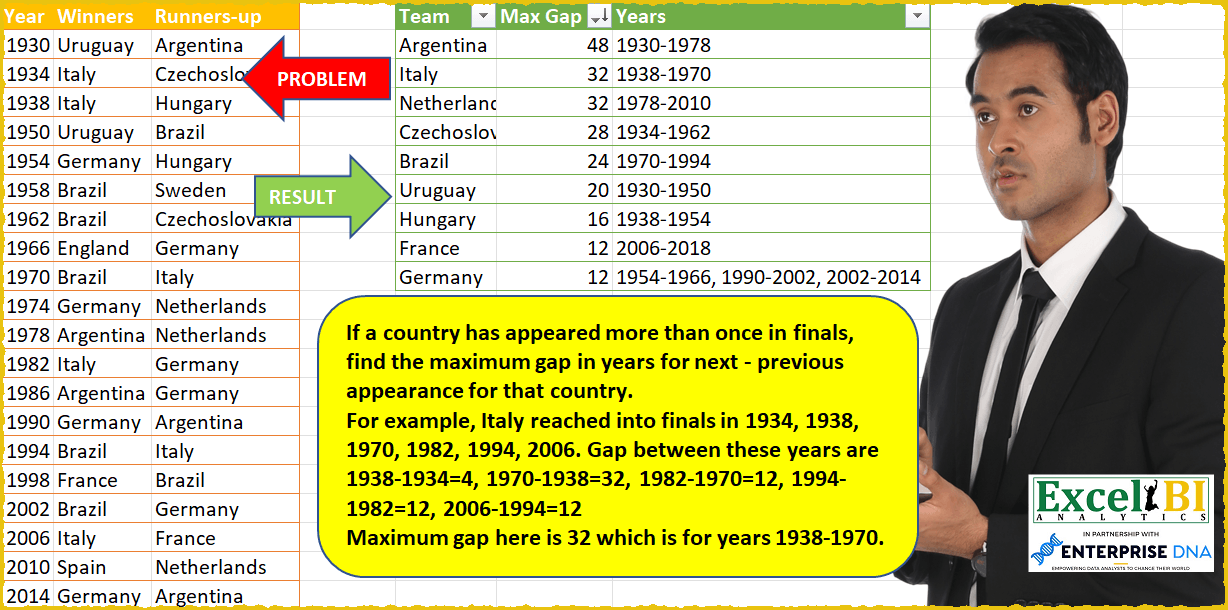
— This week is FIFA world cup challenges — If a country has appeared more than once in finals, find the maximum gap in years for next – previous appearance for that country. For example, Italy reached into finals in 1934, 1938, 1970, 1982, 1994, 2006. Gap between these years are 1938-1934=4, 1970-1938=32, 1982-1970=12, 1994-1982=12, 2006-1994=12 Maximum gap here is 32 which is for years 1938-1970.
📌 Challenge Details and Links
ExcelBI Power Query Challenge Number: 29
Challenge Difficulty: ⭐️⭐️⭐️⭐️⭐️
📥Download Sample File
📥Link to the solutions on LinkedIn
Solving the challenge of Find max finals gap for with Power Query
Power Query solution 1 for Find max finals gap for, proposed by Bhavya Gupta:
let
  Source = Excel.CurrentWorkbook(){[Name = "Table1"]}[Content],
  fnGetTable = (l) =>
    let
      C_1 = List.Skip(l, 1),
      C_2 = List.RemoveLastN(l, 1),
      C_3 = List.Transform({0 .. List.Count(l) - 2}, each C_1{_} - C_2{_}),
      C_4 = List.Transform(
        List.Zip({C_2, C_1}),
        each Text.Combine(List.Transform(_, each Text.From(_)), "-")
      ),
      C_5 = Table.FromRows(List.Zip({C_3, C_4}), {"Max Gap", "Years"}),
      C_6 = Table.Group(C_5, {"Max Gap"}, {{"Years", each Text.Combine([Years], ", ")}}),
      C_7 = Table.SelectRows(C_6, each ([Max Gap] = List.Max(C_6[Max Gap])))
    in
      C_7,
  Unpivoted = Table.UnpivotOtherColumns(Source, {"Year"}, "Attribute", "Team"),
  Grouped = Table.Group(
    Unpivoted,
    {"Team"},
    {{"Count", each Table.RowCount(_)}, {"Year", each fnGetTable([Year])}}
  ),
  Filtered = Table.SelectRows(Grouped, each [Count] > 1),
  Expanded = Table.ExpandTableColumn(Filtered, "Year", {"Max Gap", "Years"}, {"Max Gap", "Years"}),
  Removed = Table.RemoveColumns(Expanded, {"Count"}),
  Sorted = Table.Sort(Removed, {{"Max Gap", Order.Descending}, {"Team", Order.Ascending}})
in
  Sorted
Power Query solution 2 for Find max finals gap for, proposed by 🇮🇷 Navid Esmaeilzadeh اسماعیل زاده:
Part3:
#"Removed Other Columns2" = Table.SelectColumns(#"Filtered Rows2",{"Team", "Gap", "Years"}),
 #"Grouped Rows2" = Table.Group(#"Removed Other Columns2", {"Team"}, {{"Year", each Text.Combine([Years],","), type nullable text}, {"All", each _, type table [Team=text, Gap=nullable number, Years=nullable text]}}),
 #"Expanded All1" = Table.ExpandTableColumn(#"Grouped Rows2", "All", {"Gap"}, {"Gap"}),
 #"Sorted Rows1" = Table.Sort(#"Expanded All1",{{"Gap", Order.Descending}}),
 #"Removed Duplicates" = Table.Distinct(#"Sorted Rows1", {"Team"})
in
 #"Removed Duplicates"
Power Query solution 3 for Find max finals gap for, proposed by 🇮🇷 Navid Esmaeilzadeh اسماعیل زاده:
part2:
 #"Added Custom1" = Table.AddColumn(#"Added Index", "NextYear", each if [Index]=0 then null else #"Added Index"[Year]{[Index.1]-1}),
 #"Filtered Rows1" = Table.SelectRows(#"Added Custom1", each ([NextYear] <> null)),
 #"Inserted Subtraction" = Table.AddColumn(#"Filtered Rows1", "Subtraction", each [Year] - [NextYear], type number),
 #"Renamed Columns1" = Table.RenameColumns(#"Inserted Subtraction",{{"Subtraction", "Gap"}}),
 #"Merged Columns" = Table.CombineColumns(Table.TransformColumnTypes(#"Renamed Columns1", {{"Year", type text}, {"NextYear", type text}}, "en-US"),{"Year", "NextYear"},Combiner.CombineTextByDelimiter("-", QuoteStyle.None),"Years"),
 #"Grouped Rows1" = Table.Group(#"Merged Columns", {"Team"}, {{"MaxGap", each List.Max([Gap]), type number}, {"All", each _, type table [Team=text, Index=number, Index.1=number, Years=text, Gap=number]}}),
 #"Expanded All" = Table.ExpandTableColumn(#"Grouped Rows1", "All", {"Years", "Gap"}, {"Years", "Gap"}),
 #"Added Conditional Column" = Table.AddColumn(#"Expanded All", "FinalYear", each if [MaxGap] = [Gap] then [Years] else null),
 #"Filtered Rows2" = Table.SelectRows(#"Added Conditional Column", each ([FinalYear] <> null)),
Power Query solution 4 for Find max finals gap for, proposed by 🇮🇷 Navid Esmaeilzadeh اسماعیل زاده:
let
 Source = Excel.CurrentWorkbook(){[Name = "Table1"]}[Content],
 #"Unpivoted Other Columns" = Table.UnpivotOtherColumns(Source, {"Year"}, "Attribute", "Value"),
 #"Removed Other Columns" = Table.SelectColumns(#"Unpivoted Other Columns",{"Year", "Value"}),
 #"Renamed Columns" = Table.RenameColumns(#"Removed Other Columns",{{"Value", "Team"}}),
 #"Sorted Rows" = Table.Sort(#"Renamed Columns",{{"Team", Order.Ascending}, {"Year", Order.Ascending}}),
 #"Grouped Rows" = Table.Group(#"Sorted Rows", {"Team"}, {{"Count", each Table.RowCount(_), Int64.Type}, {"All", each _, type table [Year=number, Team=text]}}),
 #"Filtered Rows" = Table.SelectRows(#"Grouped Rows", each [Count] > 1),
 #"Added Custom" = Table.AddColumn(#"Filtered Rows", "Custom", each Table.AddIndexColumn([All],"Index",0,1)),
 #"Removed Other Columns1" = Table.SelectColumns(#"Added Custom",{"Custom"}),
 #"Expanded Custom" = Table.ExpandTableColumn(#"Removed Other Columns1", "Custom", {"Year", "Team", "Index"}, {"Year", "Team", "Index"}),
 #"Added Index" = Table.AddIndexColumn(#"Expanded Custom", "Index.1", 0, 1, Int64.Type),
Power Query solution 5 for Find max finals gap for, proposed by Matthias Friedmann:
let
  Source = Excel.CurrentWorkbook(){[Name = "WCfinals"]}[Content],
  #"Unpivoted Columns" = Table.UnpivotOtherColumns(Source, {"Year"}, "Attribute", "Team")[
    [Year],
    [Team]
  ],
  #"Grouped Rows" = Table.Group(
    #"Unpivoted Columns",
    {"Team"},
    {
      {
        "All",
        each
          let
            gap = Table.AddColumn(
              Table.AddColumn(
                Table.Skip(
                  Table.FromColumns(
                    {[Year]} & {{null} & List.RemoveLastN([Year], 1)},
                    {"Year", "Prev"}
                  ),
                  1
                ),
                "Max Gap",
                each [Year] - [Prev]
              ),
              "Years",
              each Text.From([Prev]) & "-" & Text.From([Year])
            )[[Max Gap], [Years]]
          in
            Table.SelectRows(gap, each [Max Gap] = List.Max(gap[Max Gap]))
      }
    }
  ),
  #"Expanded All" = Table.ExpandTableColumn(
    #"Grouped Rows",
    "All",
    {"Max Gap", "Years"},
    {"Max Gap", "Years"}
  ),
  #"Filtered Rows" = Table.SelectRows(#"Expanded All", each ([Years] <> null)),
  #"Grouped Rows1" = Table.Group(
    #"Filtered Rows",
    {"Team", "Max Gap"},
    {{"Years", each Text.Combine([Years], ", ")}}
  ),
  #"Sorted Rows" = Table.Sort(#"Grouped Rows1", {{"Max Gap", Order.Descending}})
in
  #"Sorted Rows"
Power Query solution 6 for Find max finals gap for, proposed by Mahmoud Bani Asadi:
let
  Source = Excel.CurrentWorkbook(){[Name = "Table1"]}[Content],
  Unpivot = Table.UnpivotOtherColumns(Source, {"Year"}, "Position", "Team"),
  Grouped = Table.Group(
    Unpivot,
    {"Team"},
    {{"Year", each _[Year]}, {"Next", each List.Skip(_[Year])}}
  ),
  Custom = Table.AddColumn(
    Grouped,
    "Custom",
    each Table.FromColumns({[Year], [Next]}, {"Year", "Next"})
  )[[Team], [Custom]],
  Expanded = Table.ExpandTableColumn(Custom, "Custom", {"Year", "Next"}, {"Year", "Next"}),
  Subtract = Table.AddColumn(Expanded, "Gap", each [Next] - [Year], type number),
  Gap = Table.SelectRows(Subtract, each ([Next] <> null)),
  MaxGap = Table.Group(Gap, {"Team"}, {{"Gap", each List.Max([Gap])}}),
  Combine = Table.Join(Gap, {"Team", "Gap"}, MaxGap, {"Team", "Gap"}),
  Merged = Table.CombineColumns(
    Table.TransformColumnTypes(Combine, {{"Year", type text}, {"Next", type text}}, "en-GB"),
    {"Year", "Next"},
    Combiner.CombineTextByDelimiter("-", QuoteStyle.None),
    "Years"
  ),
  Grp = Table.Group(Merged, {"Team", "Gap"}, {{"Years", each Text.Combine([Years], ",")}}),
  Sorted = Table.Sort(Grp, {{"Gap", Order.Descending}})
in
  Sorted
Solving the challenge of Find max finals gap for with Excel
Excel solution 1 for Find max finals gap for, proposed by محمد حلمي:
=LET(
a,
    A2:A22,

w,
    HSTACK(
        VSTACK(
            a,
            a
        ),
        TOCOL(
            B2:C22,
            ,
            1
        )
    ),

u,
    DROP(
        w,
        ,
        1
    ),

b,
    SORT(REDUCE(HSTACK(
        {"Team",
        "Max Gap",
        "Years"}
    ),

UNIQUE(
    u
),
    LAMBDA(a,
    d,
    LET(
v,
    SORT(
        FILTER(
            w,
            u=d
        )
    ),

r,
    TAKE(
        v,
        ,
        1
    ),

e,
    DROP(
        r,
        1
    ),

n,
    IFERROR(
        e-DROP(
            r,
            -1
        ),

    ),

m,
    MAX(
        n
    ),

VSTACK(a,
    HSTACK(d,
    m,
    TEXTJOIN(", ",
    ,
    IFERROR(
IFNA(IF((m=n)*(r<>e),
    r&"-"&e,
    ""),
    ""),
    ""))))))),
    {2,
    1},
    {-1,
    1}),

FILTER(
    b,
    LEN(
        INDEX(
            b,
            ,
            2
        )
    )>1
))
Excel solution 2 for Find max finals gap for, proposed by محمد حلمي:
=LET(

    a,
    A2:A22,

    x,
    VSTACK(
        a,
        a
    ),

    r,
    VSTACK(
        B2:B22,
        C2:C22
    ),

    y,
    UNIQUE(
        r
    ),

    o,
    MAP(
        y,
        LAMBDA(
            w,
            LET(

                z,
                VSTACK(
                    3000,
                    SORT(
                        FILTER(
                            x,
                            r=w
                        )
                    )
                ),

                c,
                SCAN(
                    "",
                    SEQUENCE(
                        ROWS(
                            z
                        )
                    ),

                    LAMBDA(
                        a,
                        d,
                        IFERROR(
                            INDEX(
                                z,
                                d+1
                            )-INDEX(
                                z,
                                d
                            ),

                        )
                    )
                ),

                v,
                MAX(
                    c
                )&" "&
                SCAN(
                    "",
                    SEQUENCE(
                        ROWS(
                    c
                )
                    ),

                    LAMBDA(
                        a,
                        d,

                        TEXTJOIN(
                            ", ",
                            ,
                            FILTER(

                                MAP(
                                    SEQUENCE(
                        ROWS(
                            z
                        )
                    ),

                                    LAMBDA(
                                        a,
                                        TEXTJOIN(
                                            "-",
                                            ,
                                            INDEX(
                                                z,
                                                a+{0;1}
                                            )
                                        )
                                    )
                                ),
                                c=MAX(
                    c
                )
                            )
                        )
                    )
                ),

                INDEX(
                    v,
                    COUNTA(
                        v
                    )
                )
            )
        )
    ),

    i,
    SORT(
        HSTACK(
            y,
            TEXTBEFORE(
                o,
                " "
            )+0,

            TEXTAFTER(
                o,
                " "
            )
        ),
        {2,
        1},
        {-1,
        1}
    ),

    FILTER(
        i,
        IFERROR(
            INDEX(
                i,
                ,
                2
            ),

        )
    )
)
Excel solution 3 for Find max finals gap for, proposed by 🇰🇷 Taeyong Shin:
=LET(
    y,
    A2:A22,
    t,
    B2:C22,
    L,
    LAMBDA(
        n,
        LAMBDA(
            x,
            LET(
                s,
                SORT(
                    x
                ),
                e,
                DROP(
                    VSTACK(
                        s,
                        0
                    ),
                    1
                ),
                d,
                e-s,
                m,
                MAX(
                    d
                ),
                IF(
                    n,
                    m,
                    ARRAYTOTEXT(
                        FILTER(
                            s&-e,
                            d=m
                        )
                    )
                )
            )
        )
    ),
    g,
    GROUPBY(
        TOCOL(
            t,
            ,
            1
        ),
        VSTACK(
            y,
            y
        ),
        HSTACK(
            L(
                1
            ),
            L(
                0
            )
        ),
        ,
        0,
        -2,
        TOCOL(
            COUNTIF(
                t,
                t
            )-1,
            ,
            1
        )
    ),
    IF(
        SEQUENCE(
            ROWS(
                g
            )
        )=1,
        E1:G1,
        g
    )
)
Excel solution 4 for Find max finals gap for, proposed by 🇰🇷 Taeyong Shin:
=LET(
 Y, A2:A22,
 W, B2:B22,
 Ru, C2:C22,
 Data, SORT(HSTACK(VSTACK(Y, Y), VSTACK(W, Ru)), {2,1}, {1,-1}),
 Teams, CHOOSECOLS(Data, 2),
 Wy, CHOOSECOLS(Data, 1),
 Uteam, UNIQUE(VSTACK(UNIQUE(Teams), UNIQUE(Teams, , 1)), , 1),
 Thunk, MAP(Uteam, LAMBDA(m, LAMBDA(
 LET(
 gap, FILTER(Wy, Teams = m),
 mg, DROP(gap, -1) - DROP(gap, 1),
 my, DROP(gap, 1) & "-" & DROP(gap, -1),
 HSTACK(MAX(mg), ARRAYTOTEXT(SORT(FILTER(my, mg = MAX(mg)), , 1))  )
 ))
 )),
 Vals, DROP(REDUCE("", Thunk, LAMBDA(a,b, VSTACK(a, b()) )), 1),
 SORT(HSTACK(Uteam, Vals), {2,1}, {-1,1})
)
Excel solution 5 for Find max finals gap for, proposed by Bhavya Gupta:
=LET(Y,
    A2:A22,
    T,
    B2:C22,
    a,
    TOCOL(
        T
    ),
    b,
    TOCOL(
        IFNA(
            EXPAND(
                Y,
                ,
                2
            ),
            Y
        )
    ),
    c,
    UNIQUE(
        a
    ),
    d,
    FILTER(c,
    MAP(c,
    LAMBDA(x,
    SUM(--(x=a))))>1),
    m,
    MAP(
        d,
        LAMBDA(
            x,
            LET(
                p,
                FILTER(
                    b,
                    a=x
                ),
                q,
                DROP(
                    p,
                    1
                ),
                r,
                DROP(
                    p,
                    -1
                ),
                s,
                q-r,
                ARRAYTOTEXT(
                    FILTER(
                        r&"-"&q,
                        s=MAX(
                            s
                        )
                    )
                )&";"&MAX(
                            s
                        )
            )
        )
    ),
    s,
    SORT(
        HSTACK(
            d,
            TEXTAFTER(
                m,
                ";"
            )*1,
            TEXTBEFORE(
                m,
                ";"
            )
        ),
        {2,
        1},
        {-1,
        1}
    ),
    s)
Excel solution 6 for Find max finals gap for, proposed by Rajesh Sinha:
=TRANSPOSE(
    UNIQUE(
        SORT(
            FILTER(
                $B$50:$B$68,
                 COUNTIFS(
                     $B$50:$B$68,
                      $B$50:$B$68
                 )>=4,
                 ""
            ),
            ,
            1
        )
&    )
)

D54: =FILTER(
    $A$50:$A$68,
    $B$50:$B$68=D$53,
    ""
)

G54: =IF(
    ISBLANK(
        D55
    ),
    "",
    D55-D54
)

G61: =SUM(
    G54:G59
)
Solving the challenge of Find max finals gap for with SQL
SQL solution 1 for Find max finals gap for, proposed by Zoran Milokanović:
SELECT
 F.TEAM
, F.GAP AS MAX_GAP
,LISTAGG(F.YEAR) AS YEAR
FROM
(
 SELECT
 T2.TEAM
 ,T2.YEAR - T2.PREVIOUS_APPEARANCE AS GAP
 ,TO_CHAR(T2.PREVIOUS_APPEARANCE) || '-' || TO_CHAR(T2.YEAR) AS YEAR
 ,RANK() OVER (PARTITION BY T2.TEAM ORDER BY T2.YEAR - T2.PREVIOUS_APPEARANCE DESC) AS TOP_N_WITH_TIES
 FROM
 (
 SELECT
 T.YEAR
 , T.TEAM
 ,LAG(T.YEAR) OVER (PARTITION BY T.TEAM ORDER BY T.YEAR) AS PREVIOUS_APPEARANCE
 FROM
 (
 SELECT
 D.YEAR
 , D.WINNERS AS TEAM
 FROM DATA D
 UNION ALL
 SELECT
 D.YEAR
 ,D.RUNNERS_UP AS TEAM
 FROM DATA D
 ) T
 ) T2
 WHERE
 T2.PREVIOUS_APPEARANCE IS NOT NULL
) F
WHERE
 F.TOP_N_WITH_TIES = 1 -- MAXIMUM GAP
GROUP BY
 F.TEAM
, F.GAP
ORDER BY
 2 DESC, 1
;
&&