
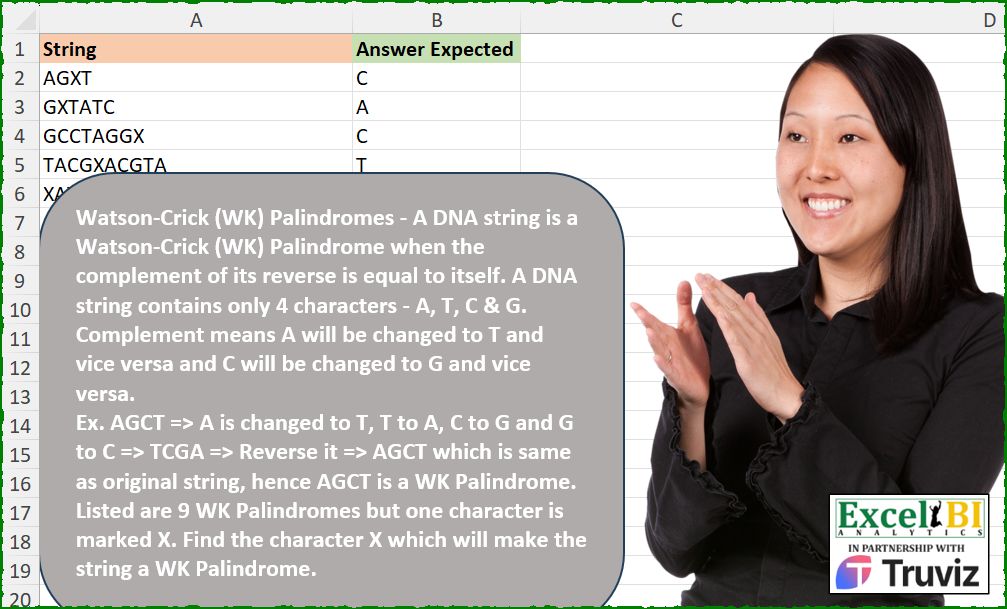
Watson-Crick (WK) Palindromes – A DNA string is a Watson-Crick (WK) Palindrome when the complement of its reverse is equal to itself. A DNA string contains only 4 characters – A, T, C & G. Complement means A will be changed to T and vice versa and C will be changed to G and vice versa. Ex. AGCT => A is changed to T, T to A, C to G and G to C => TCGA => Reverse it => AGCT which is same as original string, hence AGCT is a WK Palindrome. Listed are 9 WK Palindromes but one character is marked X. Find the character X which will make the string a WK Palindrome.
📌 Challenge Details and Links
ExcelBI Excel Challenge Number: 551
Challenge Difficulty: ⭐️⭐️⭐️
📥Download Sample File
📥Link to the solutions on LinkedIn
Solving the challenge of Find Watson-Crick Palindromes with Power Query
Power Query solution 1 for Find Watson-Crick Palindromes, proposed by Alejandro Simón 🇵🇦 🇪🇸:
let
  Source = Excel.CurrentWorkbook(){[Name = "Table1"]}[Content],
  Sol = Table.AddColumn(
    Source,
    "Answer",
    (x) =>
      let
        a = {"A", "T", "C", "G"},
        b = {"T", "A", "G", "C"},
        c = List.Zip({a, b}),
        d = List.Transform(a, each Text.Replace(x[String], "X", _)),
        e = List.Transform(
          d,
          each
            let
              A = List.ReplaceMatchingItems(Text.ToList(_), c),
              B = Text.Reverse(Text.Combine(A)),
              C = List.PositionOf(List.Transform(d, each _ = B), true)
            in
              C
        ),
        f = a{List.Select(e, each _ >= 0){0}}
      in
        f
  )
in
  Sol
Power Query solution 2 for Find Watson-Crick Palindromes, proposed by Ramiro Ayala Chávez:
let
  S = Excel.CurrentWorkbook(){[Name = "Table1"]}[Content],
  Sol = Table.AddColumn(
    S,
    "Answer Expected",
    each
      let
        L = List.Transform,
        a = Text.ToList([String]),
        b = List.Count(a),
        c = List.PositionOf(a, "X"),
        d = List.Accumulate(
          {"A", "T", "C", "G"},
          a,
          (st, cu) => st & {List.ReplaceRange(st, c, 1, {cu})}
        ),
        e = L(List.LastN(d, 4), each List.FirstN(_, b)),
        f = List.Zip({{"A", "T", "C", "G"}, {"T", "A", "G", "C"}}),
        g = L(e, each List.ReplaceMatchingItems(_, f)),
        h = L(g, List.Reverse),
        i = L(h, each List.Difference(_, a)),
        j = List.Select(i, each List.Count(_) = 1){0}{0}
      in
        j
  )
in
  Sol
Power Query solution 3 for Find Watson-Crick Palindromes, proposed by Tyler N.:
let
  a = YourTable,
  b = "ATCG",
  c = List.Transform(
    a[String],
    each
      let
        d = Text.PositionOf(b, Text.At(_, Text.Length(_) - Text.PositionOf(_, "X") - 1)),
        e = Text.At(b, d + Number.Power(- 1, d + 2))
      in
        e
  )
in
  c
Solving the challenge of Find Watson-Crick Palindromes with Excel
Excel solution 1 for Find Watson-Crick Palindromes, proposed by Bo Rydobon 🇹🇭:
=LET(z,A2:A10,MID("TAGC",FIND(MID(z,LEN(z)-FIND("X",z)+1,1),"ATCG"),1))Excel solution 2 for Find Watson-Crick Palindromes, proposed by John V.:
=LET(s,A2:A10,MID("TAGC",FIND(MID(s,1+LEN(s)-FIND("X",s),1),"ATCG"),1))Excel solution 3 for Find Watson-Crick Palindromes, proposed by Kris Jaganah:
=MAP(A2:A10,
    LAMBDA(y,
    LET(a,
    MID(
        y,
        SEQUENCE(
            LEN(
                y
            )
        ),
        1
    ),
    b,
    {"A",
    "T";"C",
    "G"},
    c,
    MAP(
        b,
        LAMBDA(
            x,
            SUM(
                N(
                    a=x
                )
            )
        )
    ),
    TOCOL(IFS((MMULT(
        c,
        {1;-1}
    )<>0)*(BYROW(
        c,
        MIN
    )=c),
    b),
    3))))
Excel solution 4 for Find Watson-Crick Palindromes, proposed by Julian Poeltl:
=MAP(
    A2:A10,
    LAMBDA(
        St,
        TOCOL(
            MAP(
                VSTACK(
                    "A",
                    "T",
                    "C",
                    "G"
                ),
                LAMBDA(
                    A,
                    LET(
                        S,
                        SUBSTITUTE(
                            St,
                            "X",
                            A
                        ),
                        O,
                        VSTACK(
                            "A",
                            "T",
                            "C",
                            "G",
                            "H",
                            "I",
                            "J",
                            "K"
                        ),
                        N,
                        VSTACK(
                            "H",
                            "I",
                            "J",
                            "K",
                            "T",
                            "A",
                            "G",
                            "C"
                        ),
                        R,
                        REDUCE(
                            S,
                            O,
                            LAMBDA(
                                A,
                                B,
                                SUBSTITUTE(
                                    A,
                                    B,
                                    XLOOKUP(
                                        B,
                                        O,
                                        N
                                    )
                                )
                            )
                        ),
                        L,
                        LEN(
                            R
                        ),
                        IF(
                            CONCAT(
                                MID(
                                    R,
                                    SEQUENCE(
                                        L,
                                        ,
                                        L,
                                        -1
                                    ),
                                    1
                                )
                            )=S,
                            A,
                            F
                        )
                    )
                )
            ),
            3
        )
    )
)
Excel solution 5 for Find Watson-Crick Palindromes, proposed by Timothée BLIOT:
=MAP(
    A2:A10,
    LAMBDA(
        z,
        LET(
            A,
            FIND(
                "X",
                z
            ),
            B,
            LEN(
                z
            ),
            C,
            MID(
                z,
                B+1-SEQUENCE(
                    B
                ),
                1
            ),
            XLOOKUP(
                INDEX(
                    C,
                    A
                ),
                {"T",
                "C",
                "G",
                "A"},
                {"A",
                "G",
                "C",
                "T"}
            )
        )
    )
)
Excel solution 6 for Find Watson-Crick Palindromes, proposed by Oscar Mendez Roca Farell:
=MAP(
    A2:A10,
     LAMBDA(
         a,
          LET(
              w,
               {"A",
              "T";"C",
              "G"},
               n,
               LEN(
                   a
               )-LEN(
                   SUBSTITUTE(
                       a,
                        w,
                       ""
                   )
               ),
               t,
               TAKE(
                   n,
                   ,
                   1
               ),
               d,
               DROP(
                   n,
                   ,
                   1
               ),
               CONCAT(
                   REPT(
                       w,
                        HSTACK(
                            t-d,
                             d-t
                        )=-1
                   )
               )
          )
     )
)
Excel solution 7 for Find Watson-Crick Palindromes, proposed by Sunny Baggu:
=MAP(
 A2:A10,
 LAMBDA(t,
 LET(
 m, MID(t, SEQUENCE(LEN(t)), 1),
 c, {"A"; "T"; "C"; "G"},
 a, MAP(c, LAMBDA(a, SUM(N(m = a)))),
 XLOOKUP(LARGE(UNIQUE(a), 2), a, c)
 )
 )
)
Excel solution 8 for Find Watson-Crick Palindromes, proposed by Anshu Bantra:
=MAP(
 A2:A10,

 LAMBDA(dna,

 LET(
 dna_str,
     {"A",
     "T",
     "C",
     "G"},

 dna_rev,
     {"T",
     "A",
     "G",
     "C"},

 split_,
     MID(
         dna,
          SEQUENCE(
              LEN(
                  dna
              )
          ),
          1
     ),

 XLOOKUP(
 INDEX(split_,
     (LEN(
                  dna
              ) - FIND(
                  "X",
                   dna
              ) + 1)),

 dna_str,

 dna_rev  )
 )
 )
)
Excel solution 9 for Find Watson-Crick Palindromes, proposed by Pieter de B.:
=VLOOKUP(
    MID(
        A2:A10,
        1+LEN(
            A2:A10
        )-FIND(
            "X",
            A2:A10
        ),
        1
    ),
    {"A",
    "T";"T",
    "A";"C",
    "G";"G",
    "C"},
    2,

)
Excel solution 10 for Find Watson-Crick Palindromes, proposed by ferhat CK:
=MAP(
    A2:A10,
    LAMBDA(
        y,
        LET(
            a,
            TOCOL(
                {"T",
                "C",
                "A",
                "G"}
            ),
            aa,
            TOCOL(
                {"A",
                "G",
                "T",
                "C"}
            ),
            b,
            MAP(
                a,
                LAMBDA(
                    i,
                    SUBSTITUTE(
                        y,
                        "X",
                        i
                    )
                )
            ),
            r,
            MAP(
                b,
                LAMBDA(
                    x,
                    LET(
                        q,
                        MID(
                            x,
                            SEQUENCE(
                                LEN(
                                    x
                                )
                            ),
                            1
                        ),
                        w,
                        XLOOKUP(
                            q,
                            a,
                            aa
                        ),
                        IF(
                            x=CONCAT(
                                MID(
                                    CONCAT(
                                        w
                                    ),
                                    SEQUENCE(
                                        LEN(
                                    x
                                ),
                                        ,
                                        LEN(
                                    x
                                ),
                                        -1
                                    ),
                                    1
                                )
                            ),
                            x,
                            1/0
                        )
                    )
                )
            ),
            XLOOKUP(
                TOCOL(
                    r,
                    3
                ),
                r,
                a
            )
        )
    )
)
Excel solution 11 for Find Watson-Crick Palindromes, proposed by Songglod P.:
=MAP(
    A2:A10,
    LAMBDA(
        str,
        LET(
            dna_x,
            {"A";"T";"C";"G"},
            dna_y,
            {"T";"A";"G";"C"},
            map_dna,
            LAMBDA(
                dna,
                XLOOKUP(
                    MID(
                        dna,
                        SEQUENCE(
                            LEN(
                                dna
                            )
                        ),
                        1
                    ),
                    dna_x,
                    dna_y
                )
            ),
            rev,
            LAMBDA(
                arr,
                INDEX(
                    arr,
                    SEQUENCE(
                        COUNTA(
                            arr
                        ),
                        ,
                        COUNTA(
                            arr
                        ),
                        -1
                    )
                )
            ),
            a,
            MAP(
                dna_x,
                dna_y,
                LAMBDA(
                    x,
                    y,
                    CONCAT(
                        rev(
                            IFNA(
                                map_dna(
                                    str
                                ),
                                y
                            )
                        )
                    )=SUBSTITUTE(
                        str,
                        "X",
                        x
                    )
                )
            ),
            FILTER(
                dna_x,
                a
            )
        )
    )
)
Excel solution 12 for Find Watson-Crick Palindromes, proposed by Celia Alves:
=BYROW(
 A2:A10,
 LAMBDA(r,
 LET(
 word, r,
 charsequence, SEQUENCE(, LEN(word)),
 wordsplit, MID(word, charsequence, 1),
 charswitch, SWITCH(
 wordsplit,
 "A", "T",
 "T", "A",
 "C", "G",
 "G", "C"
 ),
 charswitchreversed, INDEX(
 charswitch,
 ,
 SEQUENCE(, LEN(word), LEN(word), -1)
 ),
 xposition, MATCH(TRUE, ISNA(charswitch), 0),
 xletter, INDEX(charswitchreversed, , xposition),
 xletter
 )
 )
)
Solving the challenge of Find Watson-Crick Palindromes with Python
Python solution 1 for Find Watson-Crick Palindromes, proposed by Konrad Gryczan, PhD:
import pandas as pd
path = "551 Watson-Crick Palindromes.xlsx"
input = pd.read_excel(path, usecols="A", nrows=10)
test = pd.read_excel(path, usecols="B", nrows=10)
def compliment(x):
 return x.replace({"A": "T", "T": "A", "C": "G", "G": "C"}).fillna("N")
input['nchar'] = input['String'].str.len()
input['pos'] = input['String'].str.find('X')
input['char'] = input.apply(lambda row: row['String'][row['nchar'] - row['pos'] - 1], axis=1)
input['compliment'] = compliment(input['char'])
result = input[['compliment']].rename(columns={'compliment': 'Answer Expected'})
print(result.equals(test)) # True
Solving the challenge of Find Watson-Crick Palindromes with Python in Excel
Python in Ex&cel solution 1 for Find Watson-Crick Palindromes, proposed by Alejandro Campos:
def complement_dna(dna_str):
 complement_map = {'A': 'T', 'T': 'A', 'C': 'G', 'G': 'C'}
 return ''.join([complement_map[base] if base in complement_map else base for base in dna_str])
def find_X(dna_str):
 for char in 'ATCG':
 replaced_str = dna_str.replace('X', char)
 complement = complement_dna(replaced_str)
 if replaced_str == complement[::-1]:
 return char
 return None
dna_strings = xl("A2:A10").to_numpy().tolist()
df = pd.DataFrame(dna_strings, columns=['DNA_String'])
df['X_Replacement'] = df['DNA_String'].apply(find_X)
df
Python in Excel solution 2 for Find Watson-Crick Palindromes, proposed by Abdallah Ally:
# Create a function to find missing character
def find_missing_char(dna_text):
 dna_map = {'A': 'T', 'T': 'A', 'C': 'G', 'G': 'C'}
 ind = dna_text.find('X')
 for char in 'ATCG':
 new_string = dna_text[:ind] + char + dna_text[ind + 1:]
 rev_comp = ''.join(dna_map[x] for x in new_string[::-1])
 if rev_comp == new_string:
 return char
 return ''

df = xl("A1:B10", headers=True)
# Perform adata munging
df['My Answer'] = df['String'].map(find_missing_char)
df['Check'] = df['My Answer'] == df['Answer Expected']
df
Solving the challenge of Find Watson-Crick Palindromes with R
R solution 1 for Find Watson-Crick Palindromes, proposed by Konrad Gryczan, PhD:
library(tidyverse)
library(readxl)
path = "Excel/551 Watson-Crick Palindromes.xlsx"
input = read_excel(path, range = "A1:A10")
test = read_excel(path, range = "B1:B10")
compliment = function(x) {
 recode(x, "A" = "T", "T" = "A", "C" = "G", "G" = "C", .default = "N")
}
result = input %>%
 mutate(nchar = nchar(.$String),
 pos = str_locate(.$String, "X"),
 char = str_sub(.$String, nchar - pos[,1] + 1, nchar - pos[,1] + 1),
 compliment = compliment(.$char)) %>%
 select(`Answer Expected` = compliment)
identical(result, test)
#> [1] TRUE
&&