
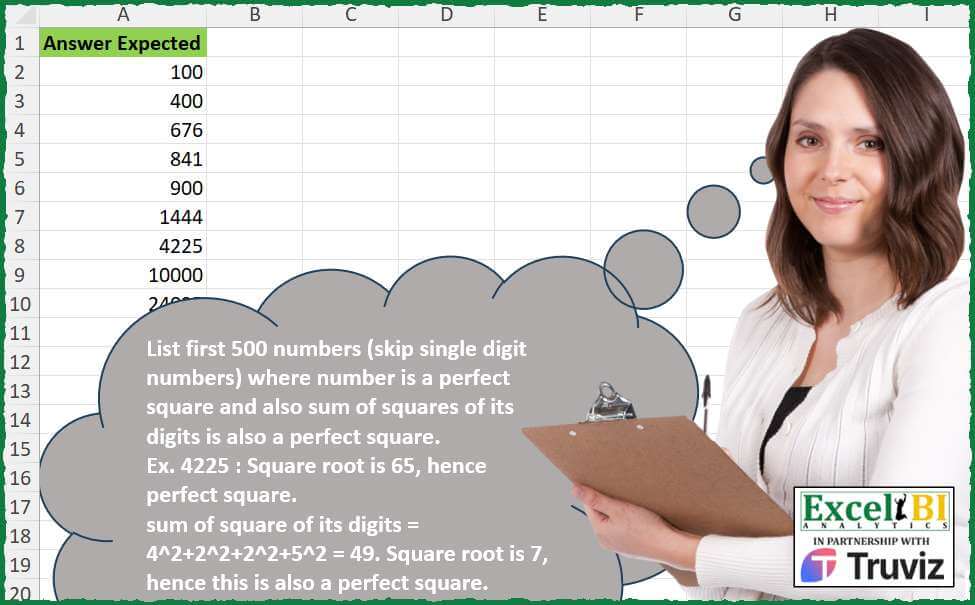
List first 500 numbers (skip single digit numbers) where number is a perfect square and also sum of squares of its digits is also a perfect square. Ex. 4225 : Square root is 65, hence perfect square. Sum of square of its digits = 4^2+2^2+2^2+5^2 = 49. Square root is 7, hence this is also a perfect square.
📌 Challenge Details and Links
ExcelBI Excel Challenge Number: 508
Challenge Difficulty: ⭐️⭐️
📥Download Sample File
📥Link to the solutions on LinkedIn
Solving the challenge of Perfect Square with Digit-Square Sum with Power Query
Power Query solution 1 for Perfect Square with Digit-Square Sum, proposed by Aditya Kumar Darak 🇮🇳:
let
  Generate = List.Generate(
    () => [a = 3, c = false, z = 0],
    each [z] <= 500,
    each [
      a  = [a] + 1,
      sq = a * a,
      t  = Text.From(sq),
      l  = Text.ToList(t),
      g  = List.Transform(l, (f) => Number.Power(Number.From(f), 2)),
      s  = Number.Sqrt(List.Sum(g)),
      c  = Int64.From(s) = s,
      z  = [z] + Number.From(c)
    ],
    each if [c] then [sq] else null
  ),
  Return = List.RemoveNulls(Generate)
in
  Return
Power Query solution 2 for Perfect Square with Digit-Square Sum, proposed by Abdallah Ally:
let
  IsPerfectSumSquare = (num) =>
    let
      sumDigitsSquare = List.Sum(
        List.Transform(Text.ToList(Text.From(num)), each Number.Power(Number.FromText(_), 2))
      ),
      cond = Number.RoundDown(Number.Sqrt(sumDigitsSquare))
        = Number.Round(Number.Sqrt(sumDigitsSquare), 9)
    in
      cond,
  GenerateNumbers = (n, end) =>
    let
      Source = List.Transform(List.Buffer({10 .. end}), each _ * _),
      FilteredNums = List.Select(Source, each IsPerfectSumSquare(_)),
      Result =
        if List.Count(FilteredNums) >= n then
          List.FirstN(FilteredNums, n)
        else
          @GenerateNumbers(n, end * 10)
    in
      Result,
  Numbers = GenerateNumbers(500, 1000)
in
  Numbers
Solving the challenge of Perfect Square with Digit-Square Sum with Excel
Excel solution 1 for Perfect Square with Digit-Square Sum, proposed by Bo Rydobon 🇹🇭:
=TOCOL(MAP(SEQUENCE(12250,,4)^2,LAMBDA(n,n/(MOD(SUM((0&MID(n,SEQUENCE(9),1))^2)^0.5,1)=0))),3)Excel solution 2 for Perfect Square with Digit-Square Sum, proposed by Rick Rothstein:
=TOCOL(MAP(SEQUENCE(12248,,10)^2,LAMBDA(x,LET(n,SUM(MID(x,SEQUENCE(LEN(x)),1)^2),h,n^0.5,IF(h=INT(h),x,1/0)))),3)Excel solution 3 for Perfect Square with Digit-Square Sum, proposed by محمد حلمي:
=TOCOL(MAP(SEQUENCE(
    12250,
    ,
    9
)^2,
    LAMBDA(a,
    a/(
MOD(
    SUM(
        MID(
            a,
            SEQUENCE(
                LEN(
                    a
                )
            ),
            1
        )^2
    )^0.5,
    1
)=0))),
    2)
Excel solution 4 for Perfect Square with Digit-Square Sum, proposed by محمد حلمي:
=TOCOL(MAP(SEQUENCE(
    12250
)+9,
    LAMBDA(a,
    a^2/(MOD(
        SUM(
            MID(
                a^2,
                SEQUENCE(
                    LEN(
                        a^2
                    )
                ),
                1
            )^2
        )^0.5,
        1
    )=0))),
    2)
Excel solution 5 for Perfect Square with Digit-Square Sum, proposed by Julian Poeltl:
=TAKE(
    LET(
        S,
        SEQUENCE(
            12250,
            ,
            10
        ),
        SS,
        S^2,
        SD,
        SQRT(
            MAP(
                SS,
                LAMBDA(
                    A,
                    SUM(
                        --MID(
                            A,
                            SEQUENCE(
                                LEN(
                                    A
                                )
                            ),
                            1
                        )^2
                    )
                )
            )
        ),
        FILTER(
            SS,
            INT(
                SD
            )=SD
        )
    ),
    500
)
Excel solution 6 for Perfect Square with Digit-Square Sum, proposed by Timothée BLIOT:
=LET(A,SEQUENCE(10^5,,10)^2,B,MAP(A,LAMBDA(x,SUM((MID(x,SEQUENCE(LEN(x)),1))^2))),TAKE(FILTER(A,B^0.5=INT(B^0.5)),500))Excel solution 7 for Perfect Square with Digit-Square Sum, proposed by Duy Tùng:
=TOCOL(MAP(SEQUENCE(15000,,10)^2,LAMBDA(s,LET(a,SUM(REGEXEXTRACT(s,".",1)^2),s/(MOD(a,a^0.5)=0)))),3)Excel solution 8 for Perfect Square with Digit-Square Sum, proposed by Sunny Baggu:
=LET(
 _s, SEQUENCE(12249, , 4),
 FILTER(
 _s,
 MAP(
 _s,
 LAMBDA(k,
 LET(
 n, k ^ 2,
 a, SUM(MID(n, SEQUENCE(LEN(n)), 1) ^ 2),
 SQRT(a) = INT(SQRT(a))
 )
 )
 )
 ) ^ 2
)
Excel solution 9 for Perfect Square with Digit-Square Sum, proposed by LEONARD OCHEA 🇷🇴:
=LET(
    s,
    SEQUENCE(
        12240,
        ,
        10
    )^2,
    t,
    SEQUENCE(
        ,
        9
    ),
    m,
    MMULT(
        IFERROR(
            MID(
                s,
                t,
                1
            )^2,
            0
        ),
        TOCOL(
            t
        )^0
    ),
    n,
    m^0.5,
    TOCOL(
        IF(
            n=INT(
                n
            ),
            s,
            z
        ),
        3
    )
)
Excel solution 10 for Perfect Square with Digit-Square Sum, proposed by Anshu Bantra:
= 10
lst = []
while len(lst) < 500:
 sq_ = num**(2)
 digits_ = sum([int(_)**2 for _ in str(sq_)])**(1/2)
 if digits_.is_integer():
 lst.append(sq_)
Excel solution 11 for Perfect Square with Digit-Square Sum, proposed by Bilal Mahmoud kh.:
=LET(
    n,
    SEQUENCE(
        13000,
        ,
        10
    ),
    p,
    POWER(
        n,
        2
    ),
    m,
    MAP(
        p,
        LAMBDA(
            x,
            LET(
                a,
                SUM(
                    POWER(
                        --MID(
                            x,
                            SEQUENCE(
                                LEN(
                                    x
                                )
                            ),
                            1
                        ),
                        2
                    )
                ),
                b,
                SQRT(
                    a
                ),
                INT(
                    b
                )=b
            )
        )
    ),
    FILTER(
        p,
        m
    )
)
Excel solution 12 for Perfect Square with Digit-Square Sum, proposed by Imam Hambali:
=LET(
a,
     SEQUENCE(
         12500,
         ,
         10
     )^2,

b,
     MAP(
         a,
          LAMBDA(
              x,
              SUM(
                  MID(
                      x,
                       SEQUENCE(
                           ,
                           LEN(
                               x
                           )
                       ),
                      1
                  )^2
              )^0.5
          )
     ),

TAKE(FILTER(a,
     (MOD(
         b,
         1
     )=0) * (MOD(
         a^0.5,
         1
     )=0)),
    500)
)
Excel solution 13 for Perfect Square with Digit-Square Sum, proposed by Eddy Wijaya:
=LET(
limit,500,
seqDB,SEQUENCE(13000,,10),
power2,POWER(seqDB,2),
textPower2,DROP(REDUCE(0,power2,LAMBDA(a,v,IFNA(VSTACK(
a,
LET(
power2SplittedDigit,POWER(TOROW(VALUE(MID(v,SEQUENCE(LEN(v)),1))),2),
sumSplittedDigit,SUM(power2SplittedDigit),
integerChecker,MOD(SQRT(sumSplittedDigit),1)=0,
HSTACK(integerChecker,v,sumSplittedDigit,power2SplittedDigit))),""))),1),
filtertextPower2,FILTER(textPower2,TAKE(textPower2,,1)=TRUE),
res,HSTACK(SEQUENCE(ROWS(filtertextPower2)),CHOOSECOLS(filtertextPower2,1,2)),
CHOOSECOLS(FILTER(res,TAKE(res,,1)<=limit),-1))
Excel solution 14 for Perfect Square with Digit-Square Sum, proposed by Edwin Tisnado:
=TOCOL(
    MAP(
        ROW(
            10:12250
        )^2,
        LAMBDA(
            x,
            x/ISERR(
                SEARCH(
                    ".",
                    SUM(
                        MID(
                            x,
                            SEQUENCE(
                                LEN(
                                    x
                                )
                            ),
                            1
                        )^2
                    )^0.5
                )
            )
        )
    ),
    2
)
Excel solution 15 for Perfect Square with Digit-Square Sum, proposed by Ricardo Alexis Domínguez Hernández:
=LET(b,
    SEQUENCE(
        100000
    ),
    a,
    MAP(
        b^2,

        LAMBDA(
            x,

            MOD(
                SQRT(
                    SUM(
                        MID(
                            x,
                            SEQUENCE(
                                ,
                                LEN(
                                    x
                                )
                            ),
                            1
                        )^2
                    )
                ),
                1
            )
        )
    ),

TAKE(FILTER(IF(a=0,
    (a+1)*b^2,
    0),
    IF(a=0,
    (a+1)*b^2,
    0)>9),
    500))
Excel solution 16 for Perfect Square with Digit-Square Sum, proposed by Tyler Cameron:
=TOCOL(
    MAP(
        SEQUENCE(
            12246,
            ,
            4
        )^2,
        LAMBDA(
            x,
            IF(
                MOD(
                    SUM(
                        MID(
                            x,
                            SEQUENCE(
                                LEN(
                                    x
                                )
                            ),
                            1
                        )^2
                    )^0.5,
                    1
                )=0,
                x,
                a
            )
        )
    ),
    3
)
Solving the challenge of Perfect Square with Digit-Square Sum with Python in Excel
Python in Excel solution 1 for Perfect Square with Digit-Square Sum, proposed by Alejandro Campos:
import math
def es_cuadrado_perfecto(n):
 return math.isqrt(n) ** 2 == n
def suma_cuadrados_digitos(n):
 return sum(int(digito) ** 2 for digito in str(n))
def encontrar_numeros_especiales(cantidad):
 resultado = []
 num = 10
 while len(resultado) < cantidad:
 if es_cuadrado_perfecto(num):
 suma_cuadrados = suma_cuadrados_digitos(num)
 if es_cuadrado_perfecto(suma_cuadrados):
 resultado.append(num)
 num += 1
 return resultado
numeros_especiales = encontrar_numeros_especiales(100)
numeros_especiales


        Show translation
Python in Excel solution 2 for Perfect Square with Digit-Square Sum, proposed by Abdallah Ally:
from itertools import islice, count
from math import isqrt, sqrt
def is_perfect_sum_square(num):
 sum_digits_squre = sum([int(x) ** 2 for x in str(num)])
 cond = isqrt(sum_digits_squre) == round(sqrt(sum_digits_squre), 9)
 return cond
def generate_numbers(n):
 end_num = 1000
 while True:
 nums = map(lambda x: x ** 2, range(10, end_num))
 nums = list(filter(is_perfect_sum_square, nums))
 if len(nums) >= n:
 return nums[ : n]
 else:
 end_num *= 10
numbers = generate_numbers(500)
numbers
Solving the challenge of Perfect Square with Digit-Square Sum with R
R solution 1 for Perfect Square with Digit-Square Sum, proposed by Konrad Gryczan, PhD:
Excecution time - 0.11 sec
library(tidyverse)
library(readxl)
test = read_excel(path, range = "A1:A501")
is_perfect_square <- function(n) {
 sqrt_n <- sqrt(n)
 sqrt_n == floor(sqrt_n)
}
result <- integer(0)
i <- 1
while (length(result) < 500) {
 if (nchar(as.character(test[i, 1])) > 1) {
 if (is_perfect_square(test[i, 1]) && is_perfect_square(sum(as.numeric(strsplit(as.character(test[i, 1]), "")[[1]])^2))) {
 result <- c(result, test[i, 1])
 }
 }
 i <- i + 1
}
result = data.frame(Result = unlist(result))
identical(result$Result, test$`Answer Expected`)
# [1] TRUE
&&&