
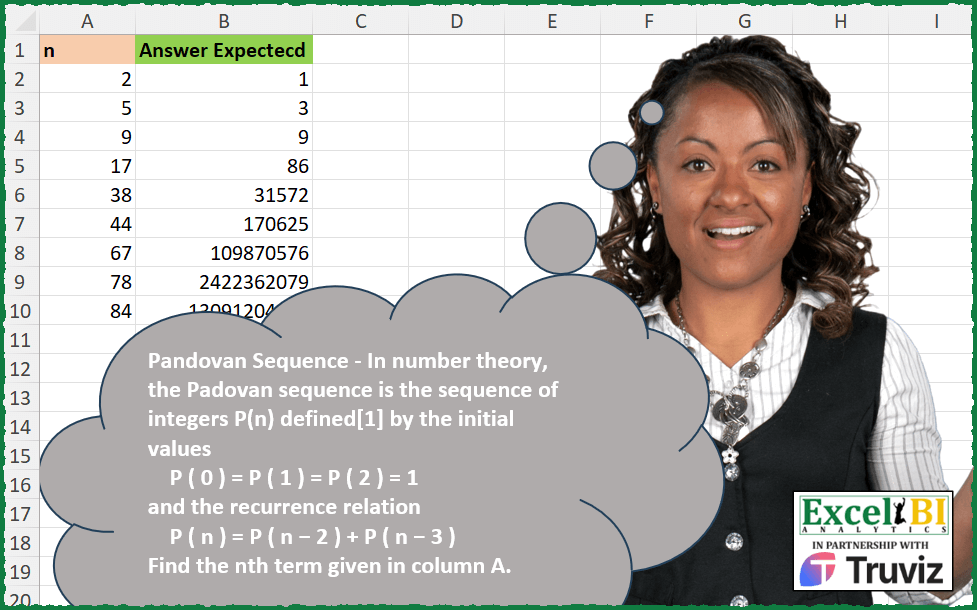
Pandovan Sequence – In number theory, the Pandovan sequence is the sequence of integers P(n) defined[1] by the initial values P ( 0 ) = P ( 1 ) = P ( 2 ) = 1 and the recurrence relation P ( n ) = P ( n − 2 ) + P ( n − 3 ) Find the nth term given in column A.
📌 Challenge Details and Links
ExcelBI Excel Challenge Number: 485
Challenge Difficulty: ⭐️⭐️
📥Download Sample File
📥Link to the solutions on LinkedIn
Solving the challenge of Compute Pandovan Sequence Terms with Power Query
Power Query solution 1 for Compute Pandovan Sequence Terms, proposed by Aditya Kumar Darak 🇮🇳:
let
  Source = Excel.CurrentWorkbook(){[Name = "data"]}[Content],
  Max = List.Max(Source[n]),
  Generate = List.Generate(
    () => [a = - 1, b = {0, 0, 0}],
    each [a] <= Max,
    each [a = [a] + 1, b = {[b]{1}, [b]{2}, c}, c = List.Max({[b]{0} + [b]{1}, 1})],
    each [n = [a], Answer = [c]]
  ),
  Table = Table.FromRecords(List.Skip(Generate)),
  Return = Table.Join(Source, "n", Table, "n")
in
  Return
Power Query solution 2 for Compute Pandovan Sequence Terms, proposed by Alejandro Simón 🇵🇦 🇪🇸:
let
  Source = Excel.CurrentWorkbook(){[Name = "Table1"]}[Content],
  Sol = Table.AddColumn(
    Source,
    "Custom",
    (x) =>
      List.Last(
        let
          LG = List.Generate(
            () => [x = 0, y = {1}],
            each [x] <= x[n],
            each [x = [x] + 1, y = if [x] < 2 then [y] & {1} else [y] & {[y]{x - 2} + [y]{x - 3}}],
            each List.Last([y])
          )
        in
          LG
      )
  )
in
  Sol
Power Query solution 3 for Compute Pandovan Sequence Terms, proposed by Alexis Olson:
let
  Source  = Excel.CurrentWorkbook(){[Name = "Table1"]}[Content],
  Max     = List.Max(Source[n]),
  All     = List.Accumulate({3 .. Max}, {1, 1, 1}, (L, n) => L & {L{n - 2} + L{n - 3}}),
  ToTable = Table.FromColumns({{0 .. Max}, All}, {"n", "Answer Expected"}),
  Result  = Table.SelectRows(ToTable, each List.Contains(Source[n], [n]))
in
  Result
Power Query solution 4 for Compute Pandovan Sequence Terms, proposed by Abdallah Ally:
let
  Source = Excel.CurrentWorkbook(){[Name = "Table1"]}[Content],
  f = (num) =>
    List.Last(
      List.Accumulate(
        {0 .. num},
        {},
        (x, y) => if y < 3 then x & {1} else x & {List.Sum(List.FirstN(List.LastN(x, 3), 2))}
      )
    ),
  a = Table.AddColumn(Source, "My Answer", each f([n])),
  Result = Table.AddColumn(a, "Check", each [Answer Expectecd] = [My Answer])
in
  Result
Solving the challenge of Compute Pandovan Sequence Terms with Excel
Excel solution 1 for Compute Pandovan Sequence Terms, proposed by Bo Rydobon 🇹🇭:
=INDEX(REDUCE(1,SEQUENCE(84),LAMBDA(a,v,VSTACK(a,SUM(TAKE(TAKE(a,-3),2))))),A2:A10)Excel solution 2 for Compute Pandovan Sequence Terms, proposed by Rick Rothstein:
=CHOOSEROWS(DROP(REDUCE({1;1;1},SEQUENCE(84),LAMBDA(a,v,VSTACK(a,SUM(TAKE(TAKE(a,-3),2))))),1),A2:A10)Excel solution 3 for Compute Pandovan Sequence Terms, proposed by John V.:
=INDEX(
    REDUCE(
        ,
        SEQUENCE(
            A10
        ),
        LAMBDA(
            a,
            v,
            VSTACK(
                a,
                SUM(
                    TAKE(
                        TAKE(
                            a,
                            -3
                        ),
                        2
                    )
                )
            )
        )
    ),
    A2:A10
)
Excel solution 4 for Compute Pandovan Sequence Terms, proposed by محمد حلمي:
=INDEX(
    REDUCE(
        {1;1},
        SEQUENCE(
            A10
        ),
        LAMBDA(
            a,
            v,
            VSTACK(
                a,
                SUM(
                    TAKE(
                        TAKE(
                            a,
                            -3
                        ),
                        2
                    )
                )
            )
        )
    ),
    A2:A10
)
Excel solution 5 for Compute Pandovan Sequence Terms, proposed by محمد حلمي:
=INDEX(
    REDUCE(
        {1;1;1},
        SEQUENCE(
            MAX(
                A2:A10
            )
        ),
        LAMBDA(
            a,
            v,

            VSTACK(
                a,
                SUM(
                    CHOOSEROWS(
                        a,
                        -2,
                        -3
                    )
                )
            )
        )
    ),
    A2:A10+1
)
Excel solution 6 for Compute Pandovan Sequence Terms, proposed by Julian Poeltl:
=INDEX(REDUCE(VSTACK(1,1,1),SEQUENCE(MAX(A2:A10-2)),LAMBDA(A,B,VSTACK(A,INDEX(A,B)+INDEX(A,B+1)))),A2:A10+1)Excel solution 7 for Compute Pandovan Sequence Terms, proposed by Timothée BLIOT:
=INDEX(
    REDUCE(
        {1;1;2},
        SEQUENCE(
            99
        ),
        LAMBDA(
            w,
            v,
            VSTACK(
                w,
                SUM(
                    DROP(
                        TAKE(
                            w,
                            -3
                        ),
                        -1
                    )
                )
            )
        )
    ),
    A2:A10
)
Excel solution 8 for Compute Pandovan Sequence Terms, proposed by Sunny Baggu:
=LET(
 _a, SEQUENCE(MAX(A2:A10) + 1, , 0),
 INDEX(
 REDUCE(
 {1; 1; 1},
 _a,
 LAMBDA(a, v, VSTACK(a, SUM(CHOOSEROWS(a, -2, -3))))
 ),
 XMATCH(A2:A10, _a)
 )
)
Excel solution 9 for Compute Pandovan Sequence Terms, proposed by Abdallah Ally:
=MAP(A2:A10,LAMBDA(x,TAKE(REDUCE(1,SEQUENCE(x),LAMBDA(x ,y,VSTACK(x,IF(y<3,1,SUM(CHOOSEROWS(x,-2,-3)))))),-1)))Excel solution 10 for Compute Pandovan Sequence Terms, proposed by Bilal Mahmoud kh.:
=MAP(A2:A10,LAMBDA(e,LET(r,IFERROR(REDUCE({1;1;1},SEQUENCE(IF(e>3,e-3,0)),LAMBDA(x,y,VSTACK(x,LARGE(x,2)+LARGE(x,3)))),1),b,IFERROR(LARGE(r,2)+LARGE(r,3),1),b)))Excel solution 11 for Compute Pandovan Sequence Terms, proposed by Ziad A.:
=INDEX(REDUCE({1;1;1},SEQUENCE(A1),LAMBDA(a,_,{a;SUM(CHOOSEROWS(a,-2,-3))})),A1+1)
Recursive, (up to n=41)
=LET(P,LAMBDA(P,n,IF(n<3,1,P(P,n-2)+P(P,n-3))),P(P,A1))
Excel solution 12 for Compute Pandovan Sequence Terms, proposed by Edwin Tisnado:
=MAP(
    A2:A10,
    LAMBDA(
        x,
        IF(
            x<3,
            1,
            TAKE(
                REDUCE(
                    {1;1;1},
                    SEQUENCE(
                        x-2
                    ),
                    LAMBDA(
                        u,
                        v,
                        VSTACK(
                            u,
                            INDEX(
                                u,
                                v
                            )+INDEX(
                                u,
                                v+1
                            )
                        )
                    )
                ),
                -1
            )
        )
    )
)
Excel solution 13 for Compute Pandovan Sequence Terms, proposed by Diarmuid Early:
=LET(p,
    ((9 - SQRT(
        69
    ))^(1/3) + (9 + SQRT(
        69
    ))^(1/3))/(2^(1/3)*3^(2/3)),

 ROUND(p^5/(2*p+3)*p^A2:A10,
    0))

Or if you want to make it shorter,
     you can hard-code the numbers:
=ROUND(
    0.722124418303123*1.32471795724475^A2:A10,
    0
)
Excel solution 14 for Compute Pandovan Sequence Terms, proposed by Burhan Cesur:
=CHOOSEROWS(
    DROP(
        REDUCE(
            SEQUENCE(
                3
            )^0,
            SEQUENCE(
                MAX(
                    A2:A10
                )
            ),
            LAMBDA(
                s,
                v,
                VSTACK(
                    s,
                    SUM(
                        INDEX(
                            s,
                            SEQUENCE(
                                2,
                                ,
                                COUNT(
                                    s
                                )-2
                            )
                        )
                    )
                )
            )
        ),
        1
    ),
    A2:A10
)
Excel solution 15 for Compute Pandovan Sequence Terms, proposed by Bevon Clarke:
=LET(
    n,
    20,
    seq,
    SEQUENCE(
        n,
        1,
        0,
        1
    ),
    p,
    LAMBDA(
        a,
        c,
        IF(
            c<3,
            1,
            INDEX(
                a,
                c-2
            )+INDEX(
                a,
                c-3
            )
        )
    ),
    result,
    SCAN(
        0,
        seq,
        LAMBDA(
            acc,
            idx,
            VSTACK(
                acc,
                 p(
                     acc,
                     idx
                 )
            )
        )
    ),
    DROP(
        result,
        1
    )
)
Solving the challenge of Compute Pandovan Sequence Terms with Python
Python solution 1 for Compute Pandovan Sequence Terms, proposed by Konrad Gryczan, PhD:
With memoization to speed it up.
from functools import lru_cache
import pandas as pd
path = "485 Pandovan Sequence.xlsx"
input = pd.read_excel(path, usecols="A")
test  = pd.read_excel(path, usecols="B")
@lru_cache(maxsize=None)
def padovan(n):
 if n <= 2:
 return 1
 else:
 return padovan(n - 2) + padovan(n - 3)
input["Pandovan"] = input["n"].apply(padovan)
print(input["Pandovan"].equals(test["Answer Expectecd"])) # True
Solving the challenge of Compute Pandovan Sequence Terms with Python in Excel
Python in Excel solution 1 for Compute Pandovan Sequence Terms, proposed by Abdallah Ally:
import pandas as pd
# Function to generate an nth pandovan number
def pandovan_number(n, memo={}):
 if n in memo:
 return memo[n]
 if n < 3:
 return 1
 memo[n] = pandovan_number(n - 2, memo) + pandovan_number(n - 3, memo)
 return memo[n]
file_path = 'Excel_Challenge_485 - Pandovan Sequence.xlsx'
df = pd.read_excel(file_path)
# Perform data wrangling
df['My Answer'] = df['n'].map(pandovan_number)
df['Check'] = df['Answer Expectecd'] == df['My Answer']
df
Solving the challenge of Compute Pandovan Sequence Terms with R
R solution 1 for Compute Pandovan Sequence Terms, proposed by Konrad Gryczan, PhD:
With memoization to speed it up.
library(purrr)
library(memoise)
library(readxl)
library(tidyverse)
path = "Excel/485 Pandovan Sequence.xlsx"
input = read_excel(path, range = "A1:A10")
test = read_excel(path, range = "B1:B10")
padovan <- function(n) {
 if (n <= 2) {
 return(1)
 } else {
 return(padovan_memo(n - 2) + padovan_memo(n - 3))
 }
}
padovan_memo = memoise(padovan)
result = input %>%
 mutate(`Answer Expectecd` = map_dbl(n, padovan_memo))
identical(result$`Answer Expectecd`, test$`Answer Expectecd`)
# [1] TRUE
R solution 2 for Compute Pandovan Sequence Terms, proposed by Anil Kumar Goyal:
pandovan <- function(n){
 reduce(seq(n - 2), .init = c(1, 1, 1), .f = ~ {
 c(.x, sum(head(.x, 2))) %>% tail(3)
 }) %>%
 tail(1)
}
map_dbl(c(2, 5, 9, 17, 38, 44, 67, 78, 84), pandovan)
&&&