
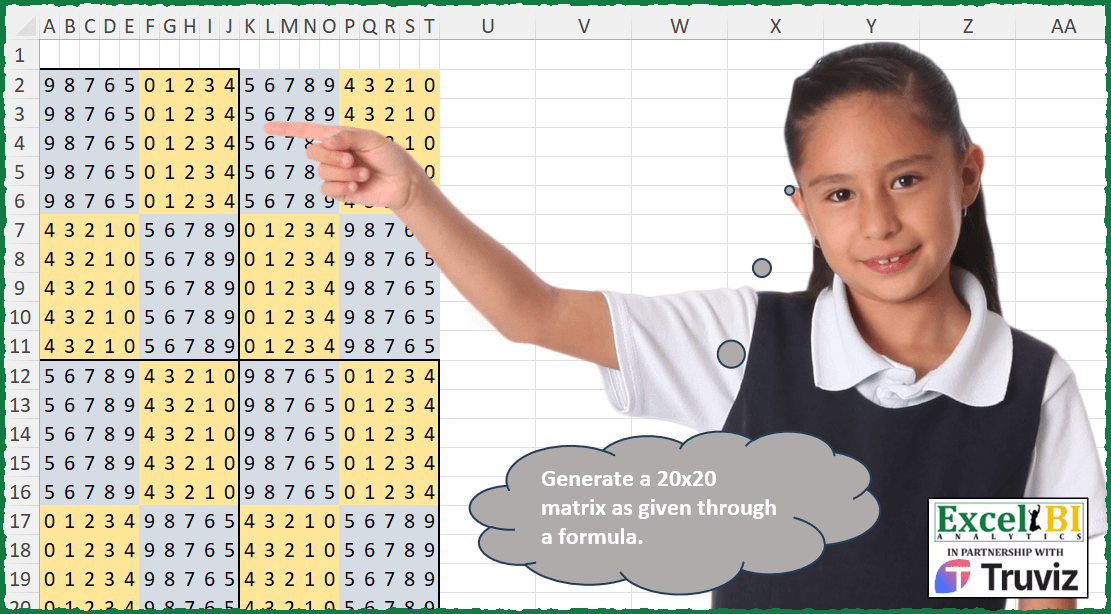
Generate a 20×20 matrix as given through a formula.
📌 Challenge Details and Links
ExcelBI Excel Challenge Number: 483
Challenge Difficulty: ⭐️⭐️
📥Download Sample File
📥Link to the solutions on LinkedIn
Solving the challenge of Generate 20×20 Number Matrix with Power Query
Power Query solution 1 for Generate 20×20 Number Matrix, proposed by Aditya Kumar Darak 🇮🇳:
let
  List = {{0 .. 4}, {5 .. 9}},
  Generate = List.Transform(
    {1 .. 4},
    each [
      Q = Number.IntegerDivide(_ - 1, 2),
      IE = Number.IsEven(Q),
      T = List.Transform(
        {1 .. 4},
        (f) =>
          [
            q  = Number.IntegerDivide(f - 1, 2),
            m  = Number.Mod(f, 2),
            tf = if IE then q <> m else q = m,
            i  = Number.Mod(_ + f - 1, 2),
            l  = List{i},
            g  = if tf then List.Reverse(l) else l,
            r  = List.Repeat({g}, 5),
            z  = List.Zip(r)
          ][z]
      ),
      C = List.Combine(T),
      R = Table.FromColumns(C)
    ][R]
  ),
  Return = Table.Combine(Generate)
in
  Return
Power Query solution 2 for Generate 20×20 Number Matrix, proposed by Alexis Olson:
let
  b = {0 .. 4},
  d = List.Reverse(b),
  p = {5 .. 9},
  q = List.Reverse(p),
  Result = Table.FromRows(
    List.Combine(
      List.Transform(
        {q & b & p & d, d & p & b & q, p & d & q & b, b & q & d & p},
        each List.Repeat({_}, 4)
      )
    ),
    {"a" .. "t"}
  )
in
  Result
Power Query solution 3 for Generate 20×20 Number Matrix, proposed by Ahmed Ariem:
let
  L1 = List.Buffer({0 .. 4}),
  L2 = List.Buffer({5 .. 9}),
  L3 = List.Buffer(List.Reverse({0 .. 4})),
  L4 = List.Buffer(List.Reverse({5 .. 9})),
  lst1 = [t1 = L4 & L1, t2 = L2 & L3, t3 = {t1 & t2 & {0}}][t3],
  lst2 = [t1 = L3 & L2, t2 = L1 & L4, t3 = {t1 & t2 & {1}}][t3],
  lst3 = [t1 = L2 & L3, t2 = L4 & L1, t3 = {t1 & t2 & {2}}][t3],
  lst4 = [t1 = L1 & L4, t2 = L3 & L2, t3 = {t1 & t2 & {3}}][t3],
  tbl = Table.Repeat(Table.FromList(lst1 & lst2 & lst3 & lst4, (x) => x), 5),
  Source = Table.RemoveColumns(
    Table.Sort(tbl, {List.Last(Table.ColumnNames(tbl)), Order.Ascending}),
    (List.Last(Table.ColumnNames(tbl)))
  )
in
  Source
Power Query solution 4 for Generate 20×20 Number Matrix, proposed by Ahmed Ariem:
let
  L1 = List.Buffer({0 .. 4}),
  L2 = List.Buffer({5 .. 9}),
  L3 = List.Buffer(List.Reverse({0 .. 4})),
  L4 = List.Buffer(List.Reverse({5 .. 9})),
  lst1 = [t1 = L4 & L1, t2 = L2 & L3, t3 = {t1 & t2}][t3],
  lst2 = [t1 = L3 & L2, t2 = L1 & L4, t3 = {t1 & t2}][t3],
  lst3 = [t1 = L2 & L3, t2 = L4 & L1, t3 = {t1 & t2}][t3],
  lst4 = [t1 = L1 & L4, t2 = L3 & L2, t3 = {t1 & t2}][t3],
  Source1 = Table.RemoveColumns(
    Table.Sort(
      Table.Repeat(
        Table.FromList(
          List.Transform(lst1, (x) => {0} & x)
            & List.Transform(lst2, (x) => {1} & x)
            & List.Transform(lst3, (x) => {2} & x)
            & List.Transform(lst4, (x) => {3} & x),
          (x) => x
        ),
        5
      ),
      {{"Column1", Order.Ascending}}
    ),
    {"Column1"}
  )
in
  Source1
Solving the challenge of Generate 20×20 Number Matrix with Excel
Excel solution 1 for Generate 20×20 Number Matrix, proposed by Bo Rydobon 🇹🇭:
=LET(s,SEQUENCE(,20),t,s-(ABS(s*2-21)>9)*(2*s+4),MOD(CHOOSE(TOCOL(s+4)/5,t+4,t-1,-t,-t-5),10))Excel solution 2 for Generate 20×20 Number Matrix, proposed by Rick Rothstein:
=LET(a,MOD(SEQUENCE(5,10,0),10),b,9-a,n,TAKE(b,,5),z,TAKE(a,,5),v,TAKE(a,,-5),f,TAKE(b,,-5),VSTACK(HSTACK(n,z,v,f),HSTACK(f,v,z,n),HSTACK(v,f,n,z),HSTACK(z,n,f,v)))Excel solution 3 for Generate 20×20 Number Matrix, proposed by John V.:
=LET(
    s,
    SEQUENCE,
    b,
    IF(
        s(
            5
        ),
        s(
            ,
            5
        )-1
    ),
    c,
    5+b,
    d,
    4-b,
    a,
    5+d,
    h,
    HSTACK,
    VSTACK(
        h(
            a,
            b,
            c,
            d
        ),
        h(
            d,
            c,
            b,
            a
        ),
        h(
            c,
            d,
            a,
            b
        ),
        h(
            b,
            a,
            d,
            c
        )
    )
)
Excel solution 4 for Generate 20×20 Number Matrix, proposed by محمد حلمي:
=LET(i,SEQUENCE(,20,0),x,TAKE(i,,10),
e,IF(SEQUENCE(5),HSTACK(9-TAKE(x,,5),x,9-DROP(x,,5))),r,SORTBY(e,
HSTACK(11-x,21-x)),VSTACK(e,r,SORTBY(VSTACK(r,e),-i)))
Excel solution 5 for Generate 20×20 Number Matrix, proposed by Konrad Gryczan, PhD:
= 0:4
b = 5:9

patterns = list(
    c(
        rev(
            b
        ),
        a,
         b,
         rev(
             a
         )
    ),

     c(
         rev(
             a
         ),
         b,
          a,
          rev(
            b
        )
     ),

     c(
         b,
          rev(
             a
         ),
          rev(
            b
        ),
          a
     ),

     c(
         a,
          rev(
            b
        ),
          rev(
             a
         ),
          b
     )
)

final_matrix = patterns %>%
 map(
      ~ matrix(
          rep(
              .x,
               5
          ),
           nrow = 5,
           byrow = TRUE
      )
 ) %>%
 reduce(
     rbind
 ) %>%
 as.data.frame()

all.equal(
    test,
     final_matrix,
     check.attributes = F
)
Excel solution 6 for Generate 20×20 Number Matrix, proposed by Julian Poeltl:
=LET(
    O,
    SEQUENCE(
        5,
        ,
        9,
        0
    )+SEQUENCE(
        ,
        5,
        0,
        -1
    ),
    T,
    SEQUENCE(
        5,
        ,
        0,
        0
    )+SEQUENCE(
        ,
        5,
        0
    ),
    Th,
    SEQUENCE(
        5,
        ,
        4,
        0
    )+SEQUENCE(
        ,
        5,
        0,
        -1
    ),
    F,
    SEQUENCE(
        5,
        ,
        5,
        0
    )+SEQUENCE(
        ,
        5,
        0
    ),
    FO,
    VSTACK(
        HSTACK(
            O,
            T
        ),
        HSTACK(
            Th,
            F
        )
    ),
    FT,
    VSTACK(
        HSTACK(
            F,
            Th
        ),
        HSTACK(
            T,
            O
        )
    ),
    VSTACK(
        HSTACK(
            FO,
            FT
        ),
        HSTACK(
            FT,
            FO
        )
    )
)
Excel solution 7 for Generate 20×20 Number Matrix, proposed by Timothée BLIOT:
=LET(
    A,
    MOD(
        SEQUENCE(
            5,
            5
        )-1,
        5
    ),
    B,
    MOD(
        SEQUENCE(
            5,
            5,
            4,
            -1
        ),
        5
    ),
    C,
    A+5,
    D,
    B+5,
    H,
    HSTACK,
    VSTACK(
        H(
            D,
            A,
            C,
            B
        ),
        H(
            B,
            C,
            A,
            D
        ),
        H(
            C,
            B,
            D,
            A
        ),
        H(
            A,
            D,
            B,
            C
        )
    )
)
Excel solution 8 for Generate 20×20 Number Matrix, proposed by Hussein SATOUR:
=LET(
    x,
    SEQUENCE(
        ,
        5,
        0
    ),
    z,
    SEQUENCE(
        5
    )*0,
    b,
    HSTACK(
        VSTACK(
            9-x+z,
            4-x+z
        ),
        VSTACK(
            x+z,
            x+z+5
        )
    ),
    c,
    HSTACK(
        VSTACK(
            x+z+5,
            x+z
        ),
        VSTACK(
            4-x+z,
            9-x+z
        )
    ),
    HSTACK(
        VSTACK(
            b,
            c
        ),
        VSTACK(
            c,
            b
        )
    )
)
Excel solution 9 for Generate 20×20 Number Matrix, proposed by Sunny Baggu:
=LET(

     l,
     LAMBDA(
         x,
          MAKEARRAY(
              5,
               5,
               LAMBDA(
                   r,
                    c,
                    c + x
               )
          )
     ),

     a,
     ABS(
         l(
             -10
         )
     ),

     b,
     l(
         -1
     ),

     c,
     ABS(
         l(
             -5
         )
     ),

     d,
     l(
         4
     ),

     e,
     VSTACK(
         HSTACK(
             a,
              b
         ),
          HSTACK(
              c,
               d
          )
     ),

     f,
     VSTACK(
         HSTACK(
             d,
              c
         ),
          HSTACK(
              b,
               a
          )
     ),

     VSTACK(
         HSTACK(
             e,
              f
         ),
          HSTACK(
              f,
               e
          )
     )

)
Excel solution 10 for Generate 20×20 Number Matrix, proposed by Hamidi Hamid:
=LET(
    w,
    SEQUENCE(
        5
    ),
    nf,
    SI(
        w,
        SEQUENCE(
            ,
            5,
            9,
            -1
        ),
        0
    ),
    cq,
    SI(
        w,
        SEQUENCE(
            ,
            5,
            5,
            1
        ),
        0
    ),
    qt,
    SI(
        w,
        SEQUENCE(
            ,
            5,
            4,
            -1
        ),
        0
    ),
    zr,
    SI(
        w,
        SEQUENCE(
            ,
            5,
            0,
            1
        ),
        0
    ),
    ASSEMB.V(
        ASSEMB.H(
            nf,
            zr,
            cq,
            qt
        ),
        ASSEMB.H(
            qt,
            cq,
            zr,
            nf
        ),
        ASSEMB.H(
            cq,
            qt,
            nf,
            zr
        ),
        ASSEMB.H(
            zr,
            nf,
            qt,
            cq
        )
    )
)
Excel solution 11 for Generate 20×20 Number Matrix, proposed by Pieter de Bruijn:
=LET(
    s,
    SEQUENCE(
        ,
        5,
        0
    ),
    z,
    SEQUENCE(
        20
    ),
    IF(
        z<6,
        HSTACK(
            9-s,
            s,
            5+s,
            4-s
        ),
        IF(
            z<11,
            HSTACK(
                4-s,
                5+s,
                s,
                9-s
            ),
            IF(
                z<16,
                HSTACK(
                    5+s,
                    4-s,
                    9-s,
                    s
                ),
                HSTACK(
                    s,
                    9-s,
                    4-s,
                    5+s
                )
            )
        )
    )
)
Excel solution 12 for Generate 20x20 Number Matrix, proposed by Sandeep Marwal:
=LET(
    a,
    A1:E1,
    b,
    F1:J1,
    fn,
    LAMBDA(
        n,
        CHOOSECOLS(
            n,
            SEQUENCE(
                ,
                COLUMNS(
                    n
                ),
                COLUMNS(
                    n
                ),
                -1
            )
        )
    ),
    fir,
    HSTACK(
        a,
        b,
        fn(
            a
        ),
        fn(
            b
        ),
        fn(
            b
        ),
        fn(
            a
        ),
        b,
        a
    ),
    sec,
    HSTACK(
        fir,
        fn(
            fir
        )
    ),
    out,
    HSTACK(
        {1;2;3;4},
        WRAPROWS(
            sec,
            20
        )
    ),
    output,
    DROP(
        SORT(
            VSTACK(
                out,
                out,
                out,
                out,
                out
            ),
            1
        ),
        ,
        1
    ),
    output
)
Excel solution 13 for Generate 20x20 Number Matrix, proposed by Ricardo Alexis Domínguez Hernández:
=LET(
    a,
    SEQUENCE(
        ,
        5,
        9,
        -1
    ),
    b,
    SEQUENCE(
        ,
        5,
        0,
        1
    ),
    c,
    SEQUENCE(
        ,
        5,
        5,
        1
    ),
    d,
    SEQUENCE(
        ,
        5,
        4,
        -1
    ),

    VSTACK(

        IF(
            SEQUENCE(
                5
            ),
            HSTACK(
                a,
                b,
                c,
                d
            )
        ),

        IF(
            SEQUENCE(
                5
            ),
            HSTACK(
                d,
                c,
                b,
                a
            )
        ),

        IF(
            SEQUENCE(
                5
            ),
            HSTACK(
                c,
                d,
                a,
                b
            )
        ),

        IF(
            SEQUENCE(
                5
            ),
            HSTACK(
                b,
                a,
                d,
                c
            )
        )

    )
)
Solving the challenge of Generate 20x20 Number Matrix with Python
Python solution 1 for Generate 20x20 Number Matrix, proposed by Konrad Gryczan, PhD:
import pandas as pd
import numpy as np
path = "483 Generate Matrix.xlsx"
test = pd.read_excel(path, usecols="A:T", skiprows=1, header=None)
seg1 = [5, 6, 7, 8, 9]
seg2 = [0, 1, 2, 3, 4]
seg3 = [9, 8, 7, 6, 5]
seg4 = [4, 3, 2, 1, 0]
pattern1 = seg3 + seg2 + seg1 + seg4
pattern2 = seg4 + seg1 + seg2 + seg3
pattern3 = seg1 + seg4 + seg3 + seg2
pattern4 = seg2 + seg3 + seg4 + seg1
block1 = np.tile(pattern1, (5, 1))
block2 = np.tile(pattern2, (5, 1))
block3 = np.tile(pattern3, (5, 1))
block4 = np.tile(pattern4, (5, 1))
final_matrix = np.concatenate((block1, block2, block3, block4), axis=0)
final_matrix = pd.DataFrame(final_matrix)
print(np.array_equal(test, final_matrix))   # True
Solving the challenge of Generate 20x20 Number Matrix with Python in Excel
Python in Excel solution 1 for Generate 20x20 Number Matrix, proposed by Owen Price:
Exploring NumPy operations with a Python in Excel challengeSolving the challenge of Generate 20x20 Number Matrix with R
R solution 1 for Generate 20x20 Number Matrix, proposed by Konrad Gryczan, PhD:
library(tidyverse)
library(readxl)
path = "Excel/483 Generate Matrix.xlsx"
test = read_excel(path, range = "A2:T21", col_names = F)
seg1 = 5:9
seg2 = 0:4
seg3 = rev(seg1)
seg4 = rev(seg2)
pattern1 <- c(seg3, seg2, seg1, seg4)
pattern2 <- c(seg4, seg1, seg2, seg3)
pattern3 <- c(seg1, seg4, seg3, seg2)
pattern4 <- c(seg2, seg3, seg4, seg1)
block1 <- matrix(rep(pattern1, 5), nrow = 5, byrow = TRUE)
block2 <- matrix(rep(pattern2, 5), nrow = 5, byrow = TRUE)
block3 <- matrix(rep(pattern3, 5), nrow = 5, byrow = TRUE)
block4 <- matrix(rep(pattern4, 5), nrow = 5, byrow = TRUE)
final_matrix <- rbind(block1, block2, block3, block4) %>% as.data.frame()
all.equal(test, final_matrix, check.attributes = F)
# [1] TRUE
&&