
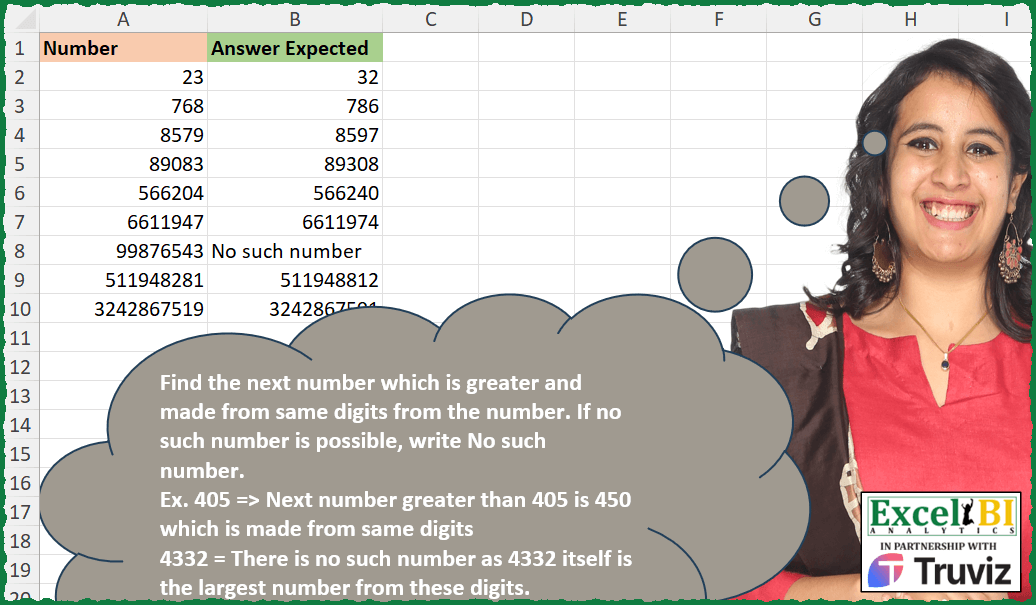
Find the next number which is greater and made from arranging digits from that number. If no such number is possible, write No such number. Ex. 405 => Next number greater than 405 is 450 which is made from same digits. 4332 = There is no such number as 4332 itself is the largest number from these digits.
📌 Challenge Details and Links
ExcelBI Excel Challenge Number: 470
Challenge Difficulty: ⭐️⭐️
📥Download Sample File
📥Link to the solutions on LinkedIn
Solving the challenge of Next Larger Permutation with Power Query
Power Query solution 1 for Next Larger Permutation, proposed by Bo Rydobon 🇹🇭:
let
  Source = Excel.CurrentWorkbook(){[Name = "Table1"]}[Content],
  Ans = Table.AddColumn(
    Source,
    "Ans",
    each
      let
        t = Text.From([Number]),
        b = Text.ToList(t),
        n = List.Last(
          List.PositionOf(List.Transform(List.Zip({b, List.Skip(b)}), each _{0} < _{1}), true, 2)
        ),
        e = List.Select(List.Sort(List.Skip(b, n + 1)), each _ > b{n}){0},
        f = Text.Combine(List.Sort(List.Skip(b, n)))
      in
        try
          Number.From(Text.Start(t, n) & e & Text.ReplaceRange(f, Text.PositionOf(f, e), 1, ""))
        otherwise
          "No such number"
  )
in
  Ans
Power Query solution 2 for Next Larger Permutation, proposed by Aditya Kumar Darak 🇮🇳:
let
  Source = Excel.CurrentWorkbook(){[Name = "data"]}[Content],
  Return = Table.AddColumn(
    Source,
    "Answer",
    each [
      T = Text.From([Number]),
      S = Text.ToList(T),
      O = List.Sort(S, 1),
      G = List.Generate(
        () => [Number] + 1,
        (f) => List.Sort(Text.ToList(Text.From(f)), 1) <> O,
        (f) => f + 1
      ),
      R = if S = O then "No such number" else List.Last(G) + 1
    ][R]
  )
in
  Return
Power Query solution 3 for Next Larger Permutation, proposed by Alejandro Simón 🇵🇦 🇪🇸:
let
  Source = Excel.CurrentWorkbook(){[Name = "Table1"]}[Content],
  G = (f, g) =>
    let
      a = List.Transform({f, g}, each List.Sort(Text.ToList(Text.From(_)))),
      b = if f - g > 1000 then "No Such Number" else if a{0} = a{1} then f else @G(f + 1, g)
    in
      b,
  Sol = Table.AddColumn(Source, "Answer", each G([Number] + 1, [Number]))
in
  Sol
Power Query solution 4 for Next Larger Permutation, proposed by Abdallah Ally:
let
  Source = Excel.CurrentWorkbook(){[Name = "Table1"]}[Content],
  f = (x) =>
    let
      g = (y) => Number.From(Text.Combine(List.Sort(Text.ToList(Text.From(y)), 1))),
      a = g(x),
      b = List.Numbers(x + 1, a - x),
      c = if x = a then "No such number" else List.First(List.Select(b, each g(_) = a))
    in
      c,
  ResultTable = Table.AddColumn(Source, "My Answer", each f([Number]))
in
  ResultTable
Solving the challenge of Next Larger Permutation with Excel
Excel solution 1 for Next Larger Permutation, proposed by Bo Rydobon 🇹🇭:
=IFNA(
    --MAP(
        A2:A10,
        LAMBDA(
            a,
            LET(
                b,
                MID(
                    a,
                    SEQUENCE(
                        LEN(
                            a
                        )
                    ),
                    1
                ),
                n,
                XMATCH(
                    TRUE,
                    b
Excel solution 2 for Next Larger Permutation, proposed by Bo Rydobon 🇹🇭:
=IFNA(
    --MAP(
        A2:A10,
        LAMBDA(
            a,
            LET(
                s,
                SEQUENCE(
                    LEN(
                        a
                    )-1
                ),
                n,
                XMATCH(
                    TRUE,
                    MID(
                        a,
                        s,
                        1
                    )b,
                    c
                )
            )
        )
    ),
    "No such number"
)
Excel solution 3 for Next Larger Permutation, proposed by Rick Rothstein:
=MAP(
    A2:A10,
    LAMBDA(
        n,
        LET(
            f,
            LAMBDA(
                x,
                CONCAT(
                    SORT(
                        MID(
                            x,
                            SEQUENCE(
                                LEN(
                                    x
                                )
                            ),
                            1
                        ),
                        ,
                        -1
                    )
                )
            ),
            z,
            n+MIN(
                MAP(
                    SEQUENCE(
                        811
                    ),
                    LAMBDA(
                        x,
                        IF(
                            f(
                                n
                            )=f(
                                n+x
                            ),
                            x,
                            ""
                        )
                    )
                )
            ),
            IF(
                z=n,
                "No such number",
                z
            )
        )
    )
)
Excel solution 4 for Next Larger Permutation, proposed by John V.:
=LET(
    f,
    LAMBDA(
        n,
        CONCAT(
            SORT(
                MID(
                    n,
                    SEQUENCE(
                        LEN(
                            n
                        )
                    ),
                    1
                )
            )
        )
    ),
    r,
    LAMBDA(
        r,
        b,
        i,
        IF(
            f(
                i
            )=f(
                b
            ),
            i,
            r(
                r,
                b,
                i+1
            )
        )
    ),
    IFERROR(
        MAP(
            A2:A10,
            LAMBDA(
                x,
                r(
                    r,
                    x,
                    1+x
                )
            )
        ),
        "No such number"
    )
)
Excel solution 5 for Next Larger Permutation, proposed by محمد حلمي:
=MAP(
    A2:A10,
    LAMBDA(
        d,
        LET(

            s,
            SEQUENCE(
                999
            ),
            r,
            LAMBDA(
                x,
                SORT(
                    MID(
                        x,
                        s,
                        1
                    )
                )
            ),
            XLOOKUP(
                1,

                MAP(
                    d+s,
                    LAMBDA(
                        a,
                        --AND(
                            r(
                                a
                            )=r(
                                d
                            )
                        )
                    )
                ),
                d+s,
                "No such number"
            )
        )
    )
)
Excel solution 6 for Next Larger Permutation, proposed by Kris Jaganah:
=MAP(A2:A10,
    LAMBDA(y,
    LET(a,
    {1;2;3},
    b,
    RIGHT(
        y,
        3
    ),
    c,
    MID(
        IF(
            LEN(
                b
            )=2,
            0&b,
            b
        ),
        a,
        1
    ),
    d,
    SEQUENCE(
        3^3
    ),
    e,
    3-{1,
    2,
    3},
    f,
    INT(d/(3^e)),
    g,
    INDEX(
        c,
        MOD(
            f,
            3
        )+1
    ),
    h,
    TOCOL(
        --BYROW(
            g,
            LAMBDA(
                x,
                LET(
                    p,
                    COUNT(
                        UNIQUE(
                            -x,
                            1
                        )
                    ),
                    IF(
                        p=3,
                        CONCAT(
                            x
                        ),
                        ""
                    )
                )
            )
        ),
        3
    ),
    i,
    IFERROR(--(MID(
        y,
        1,
        MAX(
            LEN(
                y
            )-3,
            0
        )
    )&TAKE(SORT(TOCOL(h/(h>--b),
    3)),
    1)),
    "No such number"),
    i)))
Excel solution 7 for Next Larger Permutation, proposed by Julian Poeltl:
=MAP(
    A2:A10,
    LAMBDA(
        N,
        LET(
            S,
            SEQUENCE(
                999,
                ,
                N+1
            ),
            ST,
            LAMBDA(
                A,
                CONCAT(
                    LEN(
                        A
                    )-LEN(
                        SUBSTITUTE(
                            A,
                            SEQUENCE(
                                ,
                                10,
                                0
                            ),
                            ""
                        )
                    )
                )
            ),
            IFERROR(
                TAKE(
                    FILTER(
                        S,
                        ST(
                            N
                        )=MAP(
                            S,
                            LAMBDA(
                                A,
                                ST(
                        A
                    )
                            )
                        )
                    ),
                    1
                ),
                "No such number"
            )
        )
    )
)
Excel solution 8 for Next Larger Permutation, proposed by Timothée BLIOT:
=MAP(A2:A10,
    LAMBDA(z,
    LET(I,
    --RIGHT(
        z,
        9
    ),
    A,
    LEN(
        I
    ),
    B,
    SEQUENCE(
        ,
        A
    ),
     C,
    MID(
        I,
        B,
        1
    ),
    D,
    C&CHAR(
        B
    ),
    F,
    REDUCE(
        TOCOL(
            D
        ),
        SEQUENCE(
            A-1
        ),
         LAMBDA(
              w,
             v,
             LET(
                 E,
                 FILTER(
                     w,
                     LEN(
                         w
                     )=v*2
                 ),
                 TOCOL(
                     IF(
                         ISERR(
                             FIND(
                                 D,
                                 E
                             )
                         ) ,
                         E&D,
                         1/0
                     ),
                     3
                 )
             )
         )
    ),
    G,
    SORT(
        MAP(
            F,
            LAMBDA(
                x,
                --CONCAT(
                    REGEXEXTRACT(
                         x,
                        "d",
                        1
                    )
                )
            )
        )
    ),
     TAKE(FILTER(--(IF(
         LEN(
             z
         )>9,
         LEFT(
             z,
             LEN(
             z
         )-9
         ),
         ""
     )&G),
    G>I,
    "No such number"),
    1))))
Excel solution 9 for Next Larger Permutation, proposed by Sunny Baggu:
=IFERROR(

     MAP(

          A2:A10,

          LAMBDA(
              n,

               LET(

                    a,
                    n + SEQUENCE(
                        999
                    ),

                    b,
                    SORT(
                        MID(
                            n,
                             SEQUENCE(
                                 LEN(
                                     n
                                 )
                             ),
                             1
                        )
                    ),

                    c,
                    MAP(
                        a,
                         LAMBDA(
                             a,
                              AND(
                                  SORT(
                                      MID(
                                          a,
                                           SEQUENCE(
                                               LEN(
                                                   a
                                               )
                                           ),
                                           1
                                      )
                                  ) = b
                              )
                         )
                    ),

                    TAKE(
                        FILTER(
                            a,
                             IFNA(
                                 c,
                                  FALSE
                             )
                        ),
                         1
                    )

               )

          )

     ),

     "No such number"

)
Excel solution 10 for Next Larger Permutation, proposed by Abdallah Ally:
=MAP(
    A2:A10,
    LAMBDA(
        x,
        LET(
            a,
            x,
            f,
            LAMBDA(
                x,
                SORT(
                    MID(
                        x,
                        SEQUENCE(
                             LEN(
                                 x
                             )
                        ),
                        1
       &             )
                )
            ),
            b,
            SEQUENCE(
                1000,
                ,
                a+1
            ),
            IF(
                --CONCAT(
                    SORT(
                        f(
                            a
                        ),
                        ,
                        -1
                    )
                )=a,
                "No such number",
                TAKE(
                    FILTER(
                        b,
                        MAP(
                            b,
                            LAMBDA(
                                x,
                                NOT(
                                    ISERROR(
                                        1/AND(
                                             f(
                                 x
                             )=f(
                            a
                        )
                                        )
                                    )
                                )
                            )
                        )
                    ),
                    1
                )
            )
        )
    )
)
Excel solution 11 for Next Larger Permutation, proposed by Andy Heybruch:
=LET(
    _n,
    A2,

    _x,
    LAMBDA(
        a,
        CONCAT(
            SORT(
                MID(
                    a,
                    SEQUENCE(
                        LEN(
                            a
                        )
                    ),
                    1
                )
            )
        )
    ),

    _ncheck,
    _x(
        _n
    ),

    _seq,
    SEQUENCE(
        1000,
        ,
        _n+1
    ),

    IFERROR(
        TAKE(
            FILTER(
                _seq,
                MAP(
                    _seq,
                    LAMBDA(
                        v,
                        _x(
                            v
                        )
                    )
                )=_ncheck
            ),
            1
        ),
        "No such number"
    )
)
Excel solution 12 for Next Larger Permutation, proposed by Andres Rojas Moncada:
=LET(
    ord,
    LAMBDA(
        n,
        CONCAT(
            SORT(
                MID(
                    n,
                    SEQUENCE(
                        LEN(
                            n
                        )
                    ),
                    1
                )
            )
        )
    ),
    inc,
    LAMBDA(
        f,
        v,
        s,
        IF(
            ord(
                v
            )=s,
            v,
            f(
                f,
                v+1,
                s
            )
        )
    ),
    IFERROR(
        MAP(
            A2:A11,
            LAMBDA(
                x,
                inc(
                    inc,
                    x+1,
                    ord(
                        x
                    )
                )
            )
        ),
        "No such number"
    )
)
Excel solution 13 for Next Larger Permutation, proposed by Caroline Blake:
=MAP(
    A2:A10,
    LAMBDA(
        v,
        LET(
            b,
            MAP(
                SEQUENCE(
                    1000,
                    ,
                    v
                ),
                LAMBDA(
                    a,
                    LET(
                        x,
                        CONCAT(
                            SORT(
                                VALUE(
                                    MID(
                                        a,
                                        SEQUENCE(
                                            ,
                                            LEN(
                                                a
                                            )
                                        ),
                                        1
                                    )
                                ),
                                ,
                                -1,
                                TRUE
                            )
                        ),
                        x
                    )
                )
            ),
            f,
            CONCAT(
                SORT(
                    VALUE(
                        MID(
                            v,
                            SEQUENCE(
                                ,
                                LEN(
                                    v
                                )
                            ),
                            1
                        )
                    ),
                    ,
                    -1,
                    TRUE
                )
            ),
            l,
            b=f,
            IF(
                VALUE(
                                    v
                                )=VALUE(
                                    f
                                ),
                "No such number",
                CHOOSEROWS(
                    FILTER(
                        SEQUENCE(
                    1000,
                    ,
                    v
                ),
                        b=f
                    ),
                    2
                )
            )
        )
    )
)
Solving the challenge of Next Larger Permutation with Python
Python solution 1 for Next Larger Permutation, proposed by Konrad Gryczan, PhD:
import pandas as pd
input = pd.read_excel("469 Next Greater Number with Same Digits.xlsx", sheet_name="Sheet1", usecols="A")
test  = pd.read_excel("469 Next Greater Number with Same Digits.xlsx", sheet_name="Sheet1", usecols="B")
def find_greater_from_same_digits(number):
 number = str(number)
 n = len(number)
 number_splitted = list(map(int, list(number)))
 i = n - 2
 while i >= 0:
 if number_splitted[i] < number_splitted[i + 1]:
 break
 i -= 1
 if i == -1:
 return "No such number"
 j = n - 1
 while j > i:
 if number_splitted[j] > number_splitted[i]:
 break
 j -= 1
 number_splitted[i], number_splitted[j] = number_splitted[j], number_splitted[i]
 number_splitted = number_splitted[:i+1] + number_splitted[i+1:][::-1]
 return ''.join(map(str, number_splitted))
result = input.copy()
result["Answer Expected"] = result["Number"].map(find_greater_from_same_digits)
print(pd.concat([result, test], axis=1))
Solving the challenge of Next Larger Permutation with Python in Excel
Python in Excel solution 1 for Next Larger Permutation, proposed by Abdallah Ally:
# Simple with Python
import pandas as pd
file_path = 'Excel_Challenge_469 - Next Greater Number with Same Digits.xlsx'
df = pd.read_excel(file_path)
# Perform data wrangling
def next_greater_number(number):
 largest_num = int(''.join(sorted(str(number))[::-1]))
 if number == largest_num:
 return 'No such number'

 for num in range(number + 1, largest_num + 1):
 if sorted(str(num)) == sorted(str(number)):
 return num
df['My Answer'] = df['Number'].map(next_greater_number)
df['Check'] = df.iloc[:, 1] == df.iloc[:, 2]
df
Solving the challenge of Next Larger Permutation with R
R solution 1 for Next Larger Permutation, proposed by Konrad Gryczan, PhD:
library(tidyverse)
library(readxl)
library(gtools)
input = read_excel("Excel/469 Next Greater Number with Same Digits.xlsx", range = "A1:A10")
test = read_excel("Excel/469 Next Greater Number with Same Digits.xlsx", range = "B1:B10")
find_greater_from_same_digits = function(number) {
 number = as.character(number)
 n = nchar(number)
 number_splitted = as.numeric(unlist(strsplit(number, "")))
 i = n - 1
 while (i > 0) {
 if (number_splitted[i] < number_splitted[i + 1]) {
 break
 }
 i = i - 1
 }
 if (i == 0) {
 return("No such number")
 }
 j = n
 while (j > i) {
 if (number_splitted[j] > number_splitted[i]) {
 break
 }
 j = j - 1
 }
 number_splitted[c(i, j)] = number_splitted[c(j, i)]
 number_splitted = c(number_splitted[1:i], rev(number_splitted[(i + 1):n]))
 return(paste(number_splitted, collapse = ""))
}
result = input %>%
 mutate(`Answer Expected` = map_chr(Number, find_greater_from_same_digits))
identical(result$`Answer Expected`, test$`Answer Expected`)
# [1] TRUE
&&