
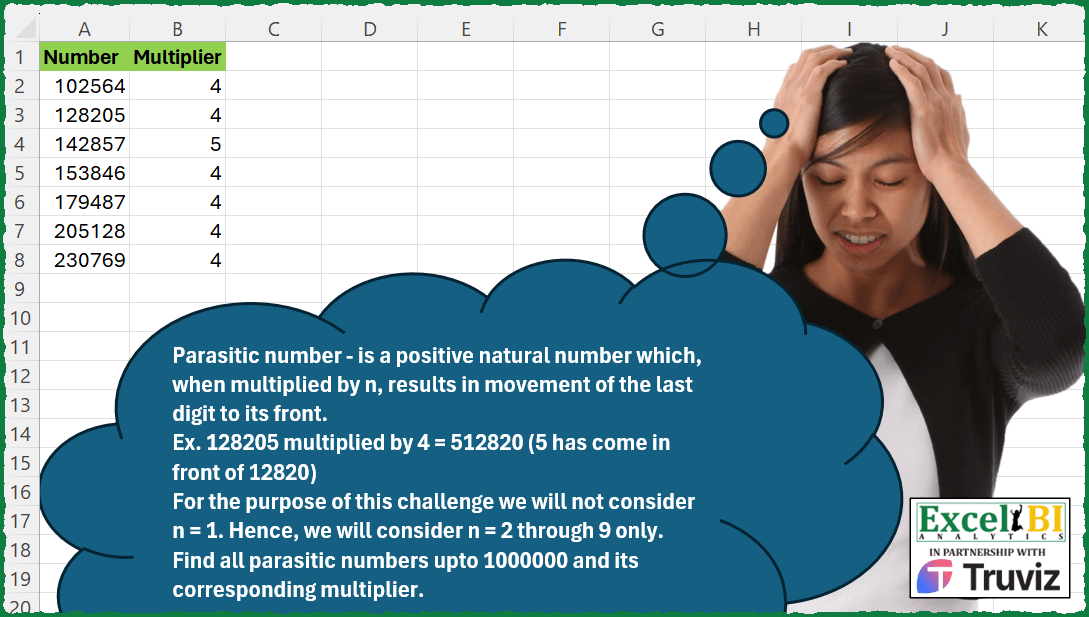
Parasitic number – is a positive natural number which, when multiplied by single digit n, results in movement of the last digit to its front. Ex. 128205 multiplied by 4 = 512820 (5 has come in front of 12820) For the purpose of this challenge we will not consider n = 1. Hence, we will consider n = 2 through 9 only. Find all parasitic numbers up to 1000000 and its corresponding multiplier.
📌 Challenge Details and Links
ExcelBI Excel Challenge Number: 452
Challenge Difficulty: ⭐️
📥Download Sample File
📥Link to the solutions on LinkedIn
Solving the challenge of Parasitic Number Identification with Power Query
Power Query solution 1 for Parasitic Number Identification, proposed by Aditya Kumar Darak 🇮🇳:
let
  Generate = List.TransformMany(
    {2 .. 9},
    (x) => {2 .. 9},
    (x, y) =>
      [
        C1 = x / (10 * y - 1) * 1000000,
        C2 = Number.IntegerDivide(C1, 1),
        C3 = C2 * y,
        T  = Text.From(C2),
        C4 = Number.From(Text.End(T, 1) & Text.Start(T, Text.Length(T) - 1)),
        R  = if C3 <> C4 then null else [Number = C2, Multiplier = y]
      ][R]
  ),
  Table = Table.FromRecords(List.RemoveNulls(Generate)),
  Return = Table.Sort(Table, "Number")
in
  Return
Power Query solution 2 for Parasitic Number Identification, proposed by Alejandro Simón 🇵🇦 🇪🇸:
let
  Origen = Excel.CurrentWorkbook(){[Name = "Tabla1"]}[Content],
  a = Text.ToList,
  b = Text.From,
  c = Number.From,
  d = List.Last,
  Sol = Table.AddColumn(
    Origen,
    "Multiplier",
    (o) =>
      d(
        List.Generate(
          () => [x = 2, q = false],
          each [q] <> true,
          each [
            x = [x] + 1,
            r = c(d(a(b(o[Number])))),
            s = [x] * o[Number],
            t = c(a(b(s)){0}),
            q = r = t
          ],
          each [x]
        )
      )
  )
in
  Sol
Power Query solution 3 for Parasitic Number Identification, proposed by Ramiro Ayala Chávez:
let
  A = {1 .. 1000000},
  B = Table.FromColumns({A}, {"Number"}),
  Fx = (x) =>
    let
      a = x,
      b = List.Generate(() => [i = 2], each [i] <= 9, each [i = [i] + 1], each {a * [i]} & {[i]}),
      c = Text.From(a),
      d = Number.From(Text.RemoveRange(Text.Insert(c, 0, Text.End(c, 1)), Text.Length(c), 1)),
      e = List.RemoveNulls(List.Transform(b, each if _{0} = d then _ else null)){0}
    in
      e,
  C = Table.AddColumn(B, "Multiplier", each try Fx([Number]){1} otherwise null),
  Sol = Table.SelectRows(C, each [Multiplier] <> null)
in
  Sol
Solving the challenge of Parasitic Number Identification with Excel
Excel solution 1 for Parasitic Number Identification, proposed by Bo Rydobon 🇹🇭:
=LET(b,
    SEQUENCE(
        10^6
    ),
    y,
    MAP(b,
    LAMBDA(c,
    (RIGHT(
        c
    )&LEFT(
        c,
        LEN(
        c
    )-1
    ))/c)),
    FILTER(HSTACK(
        b,
        y
    ),
    (y>1)*(INT(
        y
    )=y)))
Excel solution 2 for Parasitic Number Identification, proposed by Bo Rydobon 🇹🇭:
=LET(s,
    SEQUENCE(
        ,
        8,
        2
    ),
    p,
    MAP(INT(TOCOL(
        s
    )/(s*10-1)*10^6),
    LAMBDA(c,
    c*10/(MOD((RIGHT(
        c
    )&LEFT(
        c,
        LEN(
        c
    )-1
    )),
    c)=0)))+s,
    --MID(
        TOCOL(
            p,
            3
        ),
        {1,
        7},
        6
    ))
Excel solution 3 for Parasitic Number Identification, proposed by John V.:
=LET(i,
    3663*ROW(
        1:273
    ),
    c,
    LEN(
        i
    ),
    n,
    COLUMN(
        B:I
    ),
    r,
    BYROW(n*(i*n=--MID(
        i&i,
        c,
        c
    )),
    MAX),
    FILTER(
        HSTACK(
            i,
            r
        ),
        r
    ))
Excel solution 4 for Parasitic Number Identification, proposed by محمد حلمي:
=LET(s,
    SEQUENCE(
        2^17
    )+102560,
    j,
    MAP(s,
    LAMBDA(a,

IFNA(XMATCH(TRUE,
    --(RIGHT(
        a
    )&LEFT(
        a,
        5
    ))=
a*SEQUENCE(
    8,
    ,
    2
))+1,
    ))),
    FILTER(
        HSTACK(
            s,
            j
        ),
        j
    ))
Excel solution 5 for Parasitic Number Identification, proposed by Kris Jaganah:
=LET(a,
    SEQUENCE(
        10^6
    ),
    b,
    {2,
    3,
    4,
    5,
    6,
    7,
    8,
    9},
    c,
    (RIGHT(
        a
    )&LEFT(
        a,
        LEN(
        a
    )-1
    )),
    d,
    BYROW(IF(((a*b)-c)=0,
    b),
    SUM),
    FILTER(
        HSTACK(
            a,
            d
        ),
        d
    ))
Excel solution 6 for Parasitic Number Identification, proposed by Julian Poeltl:
=LET(S,
    SEQUENCE(
        10^6
    ),
    R,
    IF((RIGHT(
        S,
        1
    )&LEFT(
        S,
        LEN(
            S
        )-1
    ))*1=S*SEQUENCE(
        ,
        8,
        2
    ),
    1),
    B,
    BYROW(
        R,
        LAMBDA(
            A,
            XMATCH(
                1,
                A
            )
        )
    ),
    FILTER(
        HSTACK(
            S,
            B+1
        ),
        NOT(
            ISNA(
                B
            )
        )
    ))
Excel solution 7 for Parasitic Number Identification, proposed by Timothée BLIOT:
=LET(A,
    SEQUENCE(
        10^6
    ),
    B,
    SEQUENCE(
        ,
        8
    )+1,
    C,
    RIGHT(A*(B/B))=LEFT(
        A*B
    ),
    HSTACK(
        TOCOL(
            IF(
                C,
                A*B/B,
                1/0
            ),
            3
        ),
        TOCOL(
            IF(
                C,
                A/A*B,
                1/0
            ),
            3
        )
    ))
Excel solution 8 for Parasitic Number Identification, proposed by Nikola Z Grujicic – Nikola Ž Grujičić:
=LET(
    a,
     SEQUENCE(
         1000000
     ),
     x,
     MAP(
         a,
          LAMBDA(
              d,
               LET(
                   e,
                    ""&d*{2;3;4;5;6;7;8;9},
                    f,
                    1*RIGHT(
                        e ,
                        LEN(
                            e
                        )-1
                    )&LEFT(
                        e,
                        1
                    ),
                    g,
                    --f,
                    MATCH(
                        d,
                        g,
                        0
                    )+1
               )
          )
     ),
     j,
     FILTER(
         a,
          ISNUMBER(
              x
          )
     ),
     k,
     FILTER(
         x,
          ISNUMBER(
              x
          )
     ),
     HSTACK(
         j,
          k
     )
)
Excel solution 9 for Parasitic Number Identification, proposed by Hussein SATOUR:
=LET(a,
    SEQUENCE(
        1000000
    ),
    b,
    FILTER(a,
    MAP(a,
    LAMBDA(x,
    SUM(((RIGHT(
        x
    )&ROUNDDOWN(
        x/10,
        0
    ))/SEQUENCE(
        8,
        ,
        2
    )= x)*1)))),
    HSTACK(b,
    (RIGHT(
        b
    )&LEFT(
        b,
        LEN(
        b
    )-1
    ))/b))
Excel solution 10 for Parasitic Number Identification, proposed by Sunny Baggu:
=TEXTSPLIT(
 TEXTJOIN(
 ";",

 ,

 REDUCE(
 "",

 SEQUENCE(
     8,
      ,
      2
 ),

 LAMBDA(x,
     y,

 VSTACK(
 x,

 LET(
 n,
     y,

 s,
     SEQUENCE(
         11,
          ,
          0
     ),

 MAP(
 n + SEQUENCE(
     10 - n
 ) - 1,

 LAMBDA(k,

 LET(
 _n,
     IF(
         s >= 0,
          n
     ),

 _v1,
     SCAN(0,
     s,
     LAMBDA(a,
     v,
     n * (RIGHT(
         a,
          v
     ) & k))),

 _v2,
     (k & RIGHT(
         _v1,
          s
     )) + 0,

 IFERROR(
     FILTER(
         _v1,
          _v1 = _v2
     ) / n & "," & n,
      ""
 )
 )
 )
 )
 )
 )
 )
 )
 ),

 ",",

 ";"
)
Excel solution 11 for Parasitic Number Identification, proposed by LEONARD OCHEA 🇷🇴:
=LET(
    v,
    SEQUENCE(
        275,
        ,
        0,
        3663
    ),
    h,
    SEQUENCE(
        ,
        8,
        2
    ),
    TEXTSPLIT(
        TEXTJOIN(
            "*",
            ,
            REPT(
                v&"|"&h,
                v*h&""=RIGHT(
                    v
                )&INT(
                    v/10
                )
            )
        ),
        "|",
        "*"
    )*1
)

It seems that the parasitic numbers have a greatest common divisor : => GCD(
    A2:A8
)
Excel solution 12 for Parasitic Number Identification, proposed by LEONARD OCHEA 🇷🇴:
=LET(
    v,
    SEQUENCE(
        10^6
    ),
    h,
    SEQUENCE(
        ,
        8,
        2
    ),
    TEXTSPLIT(
        TEXTJOIN(
            "*",
            ,
            TOCOL(
                IF(
                    v*h&""=RIGHT(
                        v
                    )&INT(
                        v/10
                    ),
                    v&"/"&h,
                    z
                ),
                2
            )
        ),
        "/",
        "*"
    )
)

For BETA version
=LET(
    s,
    SEQUENCE,
    v,
    s(
        10^6
    ),
    h,
    s(
        ,
        8,
        2
    ),
    TEXTSPLIT(
        TEXTJOIN(
            "*",
            ,
            TOCOL(
                IF(
                    v*h&""=RIGHT(
                        v
                    )&INT(
                        v/10
                    ),
                    v&"/"&h,
                    z
                ),
                2
            )
        ),
        "/",
        "*"
    )
)
Excel solution 13 for Parasitic Number Identification, proposed by Abdallah Ally:
=LET(a,
    SEQUENCE(
        1000000
    ),
    b,
    MAP(a,
    LAMBDA(x,
    REDUCE(0,
     SEQUENCE(
         8
     )+1,
    LAMBDA(u,
    v,
    IF(--(RIGHT(
        x
    )&LEFT(
        x,
        LEN(
        x
    )-1
    ))=x*v,
     u+v,
    u))))),
    FILTER(
        HSTACK(
            a,
            b
        ),
        b
    ))
Excel solution 14 for Parasitic Number Identification, proposed by 🇵🇪 Ned Navarrete C.:
=REDUCE(A1:B1,
    SEQUENCE(
        10^6
    ),
    LAMBDA(c,
    v,
    LET(n,
    --(RIGHT(
        v
    )&LEFT(
        v,
        LEN(
        v
    )-1
    )),
    IF(
        AND(
            GCD(
                v,
                n
            )=v,
            n<>v
        ),
        VSTACK(
            c,
            HSTACK(
                v,
                n/v
            )
        ),
        c
    ))))
Excel solution 15 for Parasitic Number Identification, proposed by Md. Zohurul Islam:
=LET(
    n,
    SEQUENCE(
        500000,
        ,
        100001
    ),

    sq,
    SEQUENCE(
        ,
        8
    )+1,

    a,
    ABS(
        RIGHT(
            n,
            1
        )&LEFT(
            n,
            5
        )
    ),

    b,
    ABS(
        a=sq*n
    ),

    d,
    BYROW(
        b,
        LAMBDA(
            x,
            IFERROR(
                FILTER(
                    sq,
                    x
                ),
                0
            )
        )
    ),

    e,
    FILTER(
        HSTACK(
            n,
            d
        ),
        d>0
    ),

    e
)
Excel solution 16 for Parasitic Number Identification, proposed by Pieter de B.:
=LET(s,
    SEQUENCE(
        10^6
    ),
    r,
    ROUND(
        RIGHT(
            s
        )/LEFT(
            s,
            3
        )%,

    ),
    WRAPROWS(TOCOL(IFS((FIND(
        LEFT(
            s,
            LEN(
            s
        )-1
        ),
        s*r
    )=2)*(LEFT(
        s*r
    )=RIGHT(
            s
        )),
    HSTACK(
        s,
        r
    )),
    2),
    2))
Excel solution 17 for Parasitic Number Identification, proposed by Andy Heybruch:
=LET(
_num,
    SEQUENCE(
        10^6
    ),

_mult,
    SEQUENCE(
        ,
        8,
        2
    ),

_r,
    --(RIGHT(
        _num
    )&LEFT(
        _num,
        LEN(
        _num
    )-1
    )),

_check,
    --((_num*_mult)=_r),

_array,
    HSTACK(
        _num,
        BYROW(
            _check,
            LAMBDA(
                a,
                IFERROR(
                    XMATCH(
                        1,
                        a,
                        0
                    )+1,
                    0
                )
            )
        )
    ),

FILTER(
    _array,
    TAKE(
        _array,
        ,
        -1
    )>0
))
Excel solution 18 for Parasitic Number Identification, proposed by Ernesto Vega Castillo:
=LET(s,
    SEQUENCE(
        1000000
    ),
    m,
    MOD(
        s,
        10
    ),
    i,
    INT(
        s/10
    ),
    c,
    m&i,
    d,
    --c/s,
    f,
    FILTER(HSTACK(
        s,
        d
    ),
    (d=4)+(d=5)),
    f)
Excel solution 19 for Parasitic Number Identification, proposed by Gabriel Raigosa:
=MID(LET(c,SEQUENCE(,8,2),f,SEQUENCE(10^6,,10^5),TOCOL(IF(--(RIGHT(f,1)&LEFT(f,5))=f*c,f&c,x),2)),{1,7},{6,1})

🔹ES:
 =EXTRAE(LET(c,SECUENCIA(,8,2),f,SECUENCIA(10^6,,10^5),ENCOL(SI(--(DERECHA(f,1)&IZQUIERDA(f,5))=f*c,f&c,x),2)),{1,7},{6,1})
Excel solution 20 for Parasitic Number Identification, proposed by Tyler Cameron:
=LET(a,
    SEQUENCE(
        1000000
    ),
    b,
    SEQUENCE(
        ,
        8,
        2
    ),
    DROP(TEXTSPLIT(CONCAT(IF(a*b=--(RIGHT(
        a,
        1
    )&LEFT(
        a,
        LEN(
            a
        )-1
    )),
    a&","&b&"-",
    "")),
    ",",
    "-"),
    -1))
Excel solution 21 for Parasitic Number Identification, proposed by Marek Tomanek:
=LET(
nums&;
    SEQUENCE(
        999900;
        ;
        100
    );

r_nums;
    RIGHT(
        nums
    );

s_nums;
    SUBSTITUTE(
        nums;
        r_nums;
        ""
    );

j_nums;
    --(r_nums&s_nums);

f_nums;
    FILTER(nums;
    (IF(
        MOD(
            j_nums;
            nums
        )=0;
        1;
        0
    ))=1);

d_nums;
    XLOOKUP(
        f_nums;
        nums;
        j_nums
    )/f_nums;

CHOOSE(
    {12};
    f_nums;
    d_nums
))
Solving the challenge of Parasitic Number Identification with Python
Python solution 1 for Parasitic Number Identification, proposed by Konrad Gryczan, PhD:
import pandas as pd
test = pd.read_excel("452 Parasitic Numbers.xlsx", usecols="A:B")
a = pd.DataFrame({"Number": list(map(str, range(1, 1000001)))})
a["cycled"] = a["Number"].apply(lambda x: x[-1] + x[0:-1])
a = a[(a["Number"].str.len() == a["cycled"].str.len()) &
 (a["cycled"].astype(int) % a["Number"].astype(int) == 0) &
 (a["cycled"].astype(int) != a["Number"].astype(int))]
a["Multiplier"] = a["cycled"].astype(int) / a["Number"].astype(int)
a = a.drop("cycled", axis=1).reset_index(drop=True).astype("int64")
print(a.equals(test)) # True
Solving the challenge of Parasitic Number Identification with Python in Excel
Python in Excel solution 1 for Parasitic Number Identification, proposed by Abdallah Ally:
import pandas as pd
file_path = 'Excel_Challenge_452 - Parasitic Numbers.xlsx'
df = pd.read_excel(file_path)
# Perform data transformation and cleansing
values = []
for x in range(1, 10 ** 6 + 1):
 for y in range(2, 10):
 if int(str(x)[-1] + str(x)[: -1]) == x * y and [x, y] not in values:
 values.append([x,y])
df[['MyNumber', 'MyMultiplier']] = values
df
Solving the challenge of Parasitic Number Identification with R
R solution 1 for Parasitic Number Identification, proposed by Konrad Gryczan, PhD:
library(tidyverse)
library(readxl)
test = read_excel("Excel/452 Parasitic Numbers.xlsx", range = "A1:B8")
a = tibble(Number = as.character(1:1000000)) %>%
 mutate(cycled = str_c(str_sub(Number, -1), str_sub(Number, 1, -2)) %>%
 as.numeric() %>%
 as.character()) %>%
 filter(nchar(Number) == nchar(cycled),
 as.integer(cycled) %% as.integer(Number) == 0,
 as.integer(cycled) != as.integer(Number)) %>%
 mutate(across(everything(), as.numeric)) %>%
 mutate(Multiplier = cycled / Number) %>%
 select(-cycled)
identical(a, test)
# [1] TRUE
Solving the challenge of Parasitic Number Identification with Excel VBA
Excel VBA solution 1 for Parasitic Number Identification, proposed by Rushikesh K.:
Sub FindParasiticNumbers()
 Dim i As Long
 Dim j As Integer
 Dim strNum As String
 Dim multiplier As Integer

 For i = 1 To 1000000
 strNum = CStr(i)

 ' Check each digit from 2 to 9
 For j = 2 To 9
 If IsParasitic(strNum, j) Then
 multiplier = CInt(Mid(strNum, Len(strNum) - 1, 1))
 Cells(Rows.Count, 1).End(xlUp).Offset(1, 0).Value = i ' Write parasitic number to column A
 Cells(Rows.Count, 2).End(xlUp).Offset(1, 0).Value = multiplier ' Write corresponding multiplier to column B
 Exit For
 End If
 Next j
 Next i
End Sub
Function IsParasitic(num As String, digit As Integer) As Boolean
 Dim result As String
 Dim i As Integer

 result = CStr(Val(num) * digit)

 For i = 1 To Len(result)
 If InStr(num, Mid(result, i, 1)) = 0 Then
 IsParasitic = False
 Exit Function
 End If
 Next i

 For i = 1 To Len(num)
 If InStr(result, Mid(num, i, 1)) = 0 Then
 IsParasitic = False
 Exit Function
 End If
 Next i

 IsParasitic = True
End Function
&&