
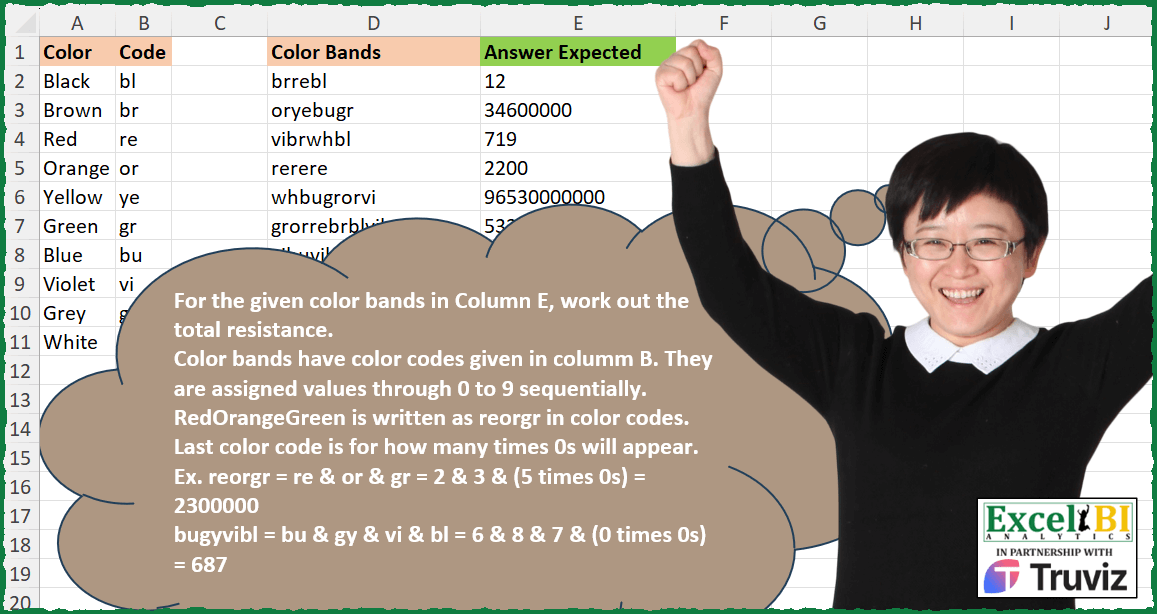
For the given color bands in Column E, work out the total resistance. Color bands have color codes given in columm B. They are assigned values through 0 to 9 sequentially. RedOrangeGreen is written as reorgr in color codes. Last color code is for how many times 0s will appear. Ex. reorgr = re & or & gr = 2 & 3 & (5 times 0s) = 2300000 bugyvibl = bu & gy & vi & bl = 6 & 8 & 7 & (0 times 0s) = 687
📌 Challenge Details and Links
ExcelBI Excel Challenge Number: 420
Challenge Difficulty: ⭐️
📥Download Sample File
📥Link to the solutions on LinkedIn
Solving the challenge of Decode Color Band Resistance with Power Query
Power Query solution 1 for Decode Color Band Resistance, proposed by Aditya Kumar Darak 🇮🇳:
let
  Lookup = Excel.CurrentWorkbook(){[Name = "tblLookup"]}[Content],
  ColourBand = Excel.CurrentWorkbook(){[Name = "tblClrBnd"]}[Content],
  Return = Table.AddColumn(
    ColourBand,
    "Answer",
    each [
      S = Splitter.SplitTextByRepeatedLengths(2)([Color Bands]),
      O1 = List.Transform(
        List.RemoveLastN(S, 1),
        (f) => Text.From(List.PositionOf(Lookup[Code], f))
      ),
      O2 = Text.Repeat("0", List.PositionOf(Lookup[Code], List.Last(S))),
      R = Text.Combine(O1) & O2
    ][R]
  )
in
  Return
Power Query solution 2 for Decode Color Band Resistance, proposed by Luan Rodrigues:
let
  Fonte = Tabela2,
  tab1 = Table.AddIndexColumn(Tabela1, "Ind", 0, 1),
  res = Table.AddColumn(
    Fonte,
    "Personalizar",
    each Text.Combine(
      let
        a = List.Transform(
          Splitter.SplitTextByRepeatedLengths(2)([Color Bands]),
          each Table.SelectRows(tab1, (x) => x[Code] = _)[Ind]{0}
        ),
        b =
          if List.Last(a) = 0 then
            List.FirstN(a, List.Count(a) - 1)
          else
            List.FirstN(a, List.Count(a) - 1) & List.Repeat({0}, List.Last(a))
      in
        List.Transform(b, Text.From)
    )
  )
in
  res
Power Query solution 3 for Decode Color Band Resistance, proposed by Ramiro Ayala Chávez:
let
  t1 = Excel.CurrentWorkbook(){[Name = "Table1"]}[Content],
  t2 = Excel.CurrentWorkbook(){[Name = "Table2"]}[Content],
  L = List.Transform,
  a = Table.AddIndexColumn(t1, "D"),
  b = L(t2[Color Bands], each Splitter.SplitTextByRepeatedLengths(2)(_)),
  c = L(b, each Table.FromColumns({_})),
  d = L(c, each Table.AddColumn(_, "N", each a[D]{List.PositionOf(a[Code], [Column1])})[N]),
  e = L(
    d,
    each
      if List.Last(_) = 0 then
        List.RemoveLastN(_)
      else
        List.RemoveLastN(List.InsertRange(_, List.Count(_) - 1, List.Repeat({0}, List.Last(_))))
  ),
  Sol = Table.FromColumns(
    {t2[Color Bands], L(e, each Text.Combine(L(_, each Text.From(_))))},
    Table.ColumnNames(t2) & {"Answer Expected"}
  )
in
  Sol
Power Query solution 4 for Decode Color Band Resistance, proposed by Udit Chatterjee:
let
  fxCustomSplitter = (string as text, splitsAt as number) =>
    let
      textLength           = Text.Length(string),
      splitPositions       = List.Generate(() => 0, each _ < textLength, each _ + splitsAt),
      splittedStringList   = Splitter.SplitTextByPositions(splitPositions)(string),
      textTypeSplittedList = List.Transform(splittedStringList, each Text.From(_))
    in
      textTypeSplittedList,
  fxListMapper = (mainList as list, refList as list) =>
    let
      lastCode           = List.Last(mainList),
      subList            = List.RemoveLastN(mainList, 1),
      mappedList         = List.Transform(subList, each Text.From(List.PositionOf(refList, _))),
      mappedLastCode     = Text.Repeat("0", List.PositionOf(refList, lastCode)),
      completeMappedList = List.Combine({mappedList, {mappedLastCode}}),
      MappedText         = Text.Combine(completeMappedList)
    in
      MappedText,
  Source = ch2024_01_60,
  colorCodes = Source[Code],
  colorBands = List.RemoveItems(Source[Color Bands], {"", null}),
  colorBandCodes = List.Transform(colorBands, each @fxCustomSplitter(_, 2)),
  colorBandIndexCodes = List.Transform(colorBandCodes, each @fxListMapper(_, colorCodes))
in
  colorBandIndexCodes
Solving the challenge of Decode Color Band Resistance with Excel
Excel solution 1 for Decode Color Band Resistance, proposed by Bo Rydobon 🇹🇭:
=MAP(
    D2:D10,
    LAMBDA(
        a,
        LET(
            x,
            XMATCH(
                MID(
                    a,
                    SEQUENCE(
                        LEN(
                            a
                        )/2,
                        ,
                        ,
                        2
                    ),
                    2
                ),
                B2:B11
            )-1,
            CONCAT(
                DROP(
                    x,
                    -1
                )
            )*10^TAKE(
                    x,
                    -1
                )
        )
    )
)
Excel solution 2 for Decode Color Band Resistance, proposed by Rick Rothstein:
=MAP(D2:D10,
    LAMBDA(d,
    LET(b,
    B2:B11,
    c,
    LEN(
        d
    )-2,
    SUBSTITUTE(REDUCE(LEFT(
        d,
        c
    ),
    SEQUENCE((c)/2,
    ,
    ,
    2),
    LAMBDA(
        a,
        x,
        REPLACE(
            a,
            x,
            2,
            "/"&XMATCH(
                MID(
                    d,
                    x,
                    2
                ),
                b
            )-1
        )
    )),
    "/",
    "")&REPT(
        0,
        XMATCH(
            RIGHT(
                d,
                2
            ),
            b
        )-1
    ))))
Excel solution 3 for Decode Color Band Resistance, proposed by Rick Rothstein:
=MAP(
    D2:D10,
    LAMBDA(
        d,
        LET(
            b,
            B2:B11,
            r,
            RIGHT(
                d,
                2
            ),
            m,
            MID(
                d,
                SEQUENCE(
                    LEN(
                        d
                    )/2,
                    ,
                    ,
                    2
                ),
                2
            ),
            SUBSTITUTE(
                REDUCE(
                    d,
                    DROP(
                        m,
                        -1
                    ),
                    LAMBDA(
                        a,
                        x,
                        SUBSTITUTE(
                            a,
                            x,
                            XMATCH(
                                x,
                                b
                            )-1,
                            1
                        )
                    )
                ),
                r,
                REPT(
                    0,
                    XMATCH(
                        r,
                        b
                    )-1
                )
            )
        )
    )
)
Excel solution 4 for Decode Color Band Resistance, proposed by John V.:
=MAP(
    D2:D10,
    LAMBDA(
        x,
        LET(
            b,
            TOCOL(
                XMATCH(
                    MID(
                        x,
                        2*ROW(
                            1:10
                        )-1,
                        2
                    ),
                    B2:B11
                )-1,
                2
            ),
            CONCAT(
                DROP(
                    b,
                    -1
                ),
                REPT(
                    0,
                    TAKE(
                    b,
                    -1
                )
                )
            )
        )
    )
)
Excel solution 5 for Decode Color Band Resistance, proposed by محمد حلمي:
=MAP(
    D2:D10,
    LAMBDA(
        a,
        LET(
            i,
            XLOOKUP(
                MID(
                    a,
                    SEQUENCE(
                        LEN(
                            a
                        )/2,
                        ,
                        ,
                        2
                    ),
                    2
                ),

                B2:B11,
                SEQUENCE(
                    10
                )-1
            ),
            CONCAT(
                DROP(
                    i,
                    -1
                ),
                REPT(
                    0,
                    TAKE(
                    i,
                    -1
                )
                )
            )
        )
    )
)
Excel solution 6 for Decode Color Band Resistance, proposed by 🇰🇷 Taeyong Shin:
=MAP(
    D2:D10,
    LAMBDA(
        x,
        LET(
            c,
            CONCAT(
                XMATCH(
                    MID(
                        x,
                        SEQUENCE(
                            LEN(
                                x
                            )/2,
                            ,
                            ,
                            2
                        ),
                        2
                    ),
                    B2:B11
                )-1
            ),
            REPLACE(
                c,
                LEN(
                    c
                ),
                1,

            )&REPT(
                0,
                RIGHT(
                    c
                )
            )
        )
    )
)
Excel solution 7 for Decode Color Band Resistance, proposed by Kris Jaganah:
=MAP(
    D2:D10,
    LAMBDA(
        x,
        LET(
            a,
            B2:B11,
            b,
            XLOOKUP(
                MID(
                    x,
                    SEQUENCE(
                        LEN(
                            x
                        )/2,
                        ,
                        ,
                        2
                    ),
                    2
                ),
                a,
                XMATCH(
                    a,
                    a
                )-1
            ),
            CONCAT(
                DROP(
                    b,
                    -1
                )
            )&REPT(
                0,
                TAKE(
                    b,
                    -1
                )
            )
        )
    )
)
Excel solution 8 for Decode Color Band Resistance, proposed by Julian Poeltl:
=MAP(
    D2:D10,
    LAMBDA(
        CB,
        LET(
            CC,
            $B$2:$B$11,
            M,
            XMATCH(
                MID(
                    CB,
                    SEQUENCE(
                        ,
                        LEN(
                            CB
                        )/2,
                        ,
                        2
                    ),
                    2
                ),
                CC
            )-1,
            CONCAT(
                DROP(
                    M,
                    ,
                    -1
                ),
                REPT(
                    0,
                    TAKE(
                    M,
                    ,
                    -1
                )
                )
            )
        )
    )
)
Excel solution 9 for Decode Color Band Resistance, proposed by Timothée BLIOT:
=MAP(
    D2:D10,
    LAMBDA(
        z,
        LET(
            A,
            XLOOKUP(
                MID(
                    z,
                    SEQUENCE(
                        LEN(
                            z
                        )/2,
                        ,
                        ,
                        2
                    ),
                    2
                ),
                B2:B11,
                SEQUENCE(
                    10
                )-1
            ),
            CONCAT(
                DROP(
                    A,
                    -1
                )
            )&REPT(
                "0",
                TAKE(
                    A,
                    -1
                )
            )
        )
    )
)
Excel solution 10 for Decode Color Band Resistance, proposed by Hussein SATOUR:
=MAP(
    D2:D10,
    LAMBDA(
        x,
        LET(
            a,
            XLOOKUP(
                MID(
                    x,
                    SEQUENCE(
                        LEN(
                            x
                        )/2,
                        ,
                        ,
                        2
                    ),
                    2
                ),
                B2:B11,
                SEQUENCE(
                    10
                )-1
            ),
            CONCAT(
                DROP(
                    a,
                    -1
                ),
                REPT(
                    0,
                    TAKE(
                    a,
                    -1
                )
                )
            )
        )
    )
)
Excel solution 11 for Decode Color Band Resistance, proposed by Oscar Mendez Roca Farell:
=MAP(
    REDUCE(
        D2:D10,
         ROW(
             1:10
         ),
         LAMBDA(
             i,
              x,
              SUBSTITUTE(
                  i,
                   INDEX(
                       B2:B11,
                        x
                   ),
                   x-1
              )
         )
    ),
     LAMBDA(
         a,
          LEFT(
              a,
               LEN(
                   a
               )-1
          )&REPT(
              0,
               RIGHT(
                   a
               )
          )
     )
)
Excel solution 12 for Decode Color Band Resistance, proposed by Sunny Baggu:
=MAP(

     D2:D11,

     LAMBDA(
         x,

          LET(

               _m,
               MID(
                   x,
                    SEQUENCE(
                        10,
                         ,
                         1,
                         2
                    ),
                    2
               ),

               _n,
               TOCOL(
                   XLOOKUP(
                       _m,
                        B2:B11,
                        SEQUENCE(
                            10,
                             ,
                             0
                        )
                   ),
                    3
               ),

               IFERROR(
                   CONCAT(
                       DROP(
                           _n,
                            -1
                       )
                   ) & REPT(
                       0,
                        TAKE(
                           _n,
                            -1
                       )
                   ),
                    ""
               )

          )

     )

)
Excel solution 13 for Decode Color Band Resistance, proposed by LEONARD OCHEA 🇷🇴:
=MAP(
    D2:D10,
    LAMBDA(
        a,
        LET(
            l,
            LEN(
                a
            ),
            c,
            CONCAT(
                XMATCH(
                    MID(
                        a,
           &             SEQUENCE(
                            l/2,
                            ,
                            ,
                            2
                        ),
                        2
                    ),
                    B2:B11
                )-1
            ),
            LEFT(
                c,
                l/2-1
            )&REPT(
                0,
                RIGHT(
                    c
                )
            )
        )
    )
)
Excel solution 14 for Decode Color Band Resistance, proposed by Abdallah Ally:
=MAP(
    D2:D10,
    LAMBDA(
        x,
        LET(
            a,
            x,
            b,
            B2:B11,
            c,
            CONCAT(
                MATCH(
                    MID(
                        a,
                         SEQUENCE(
                             LEN(
                                 a
                             )/2,
                             ,
                             ,
                             2
                         ),
                        2
                    ),
                    b,
                    0
                )-1
            ),
            LEFT(
                c,
                LEN(
                    c
                )-1
            )&REPT(
                0,
                RIGHT(
                    c
                )
            )
        )
    )
)
Excel solution 15 for Decode Color Band Resistance, proposed by Pieter de B.:
*10^TAKE(
    x,
    -1
) love it!
Excel solution 16 for Decode Color Band Resistance, proposed by Asheesh Pahwa:
=LET(
    a,
    B2:B11,
    b,
    SEQUENCE(
        10,
        ,
        0
    ),

    MAP(
        D2:D10,
        LAMBDA(
            x,
            LET(
                m,
                WRAPROWS(
                    MID(
                        x,
                        SEQUENCE(
                            LEN(
                                x
                            )
                        ),
                        1
                    ),
                    2
                ),
                br,
                BYROW(
                    m,
                    LAMBDA(
                        y,

                        CONCAT(
                            y
                        )
                    )
                ),
                xl,
                XLOOKUP(
                    br,
                    a,
                    b
                ),
                CONCAT(
                    DROP (
                        xl,
                        -1
                    ),
                    REPT(
                        0,
                        TAKE(
                        xl,
                        -1
                    )
                    )
                )
            )
        )
    )
)
Excel solution 17 for Decode Color Band Resistance, proposed by Charles Roldan:
=LET(
    Code,
     B2:B11,
     Bands,
     D2:D10,
     MAP(
         Bands,
          LAMBDA(
              b,
               LET(
                   s,
                    XMATCH(
                        MID(
                            b,
                             SEQUENCE(
                                 LEN(
                                     b
                                 ) / 2,
                                  ,
                                  1,
                                  2
                             ),
                             2
                        ),
                         Code
                    ) - 1,
                    CONCAT(
                        DROP(
                            s,
                             -1
                        )
                    ) & REPT(
                        "0",
                         TAKE(
                            s,
                             -1
                        )
                    )
               )
          )
     )
)
Excel solution 18 for Decode Color Band Resistance, proposed by Andy Heybruch:
=MAP(
    D2:D10,
    LAMBDA(
        a,
        LET(

            _a,
            a,

            _len,
            LEN(
                _a
            )/2,

            _clrs,
            XMATCH(
                MID(
                    _a,
                    SEQUENCE(
                        ,
                        _len,
                        1,
                        2
                    ),
                    2
                ),
                $B$2:$B$11,
                0
            )-1,

            CONCAT(
                DROP(
                    _clrs,
                    ,
                    -1
                ),
                REPT(
                    "0",
                    TAKE(
                    _clrs,
                    ,
                    -1
                )
                )
            )
        )
    )
)
Excel solution 19 for Decode Color Band Resistance, proposed by Giorgi Goderdzishvili:
=MAP(
    F2:F10,
    LAMBDA(
        x,
        LET(

            sp,
            MID(
                x,
                SEQUENCE(
                    ,
                    LEN(
                        x
                    )/2,
                    1,
                    2
                ),
                2
            ),

            xm,
            XMATCH(
                sp,
                $C$2:$C$11,
                0
            )-1,

            CONCAT(
                DROP(
                    xm,
                    ,
                    -1
                ),
                REPT(
                    "0",
                    TAKE(
                    xm,
                    ,
                    -1
                )
                )
            )*1
        )
    )
)
Excel solution 20 for Decode Color Band Resistance, proposed by Sandeep Marwal:
=LET(

    initial,
    CONCAT(
        XLOOKUP(
            MID(
                E2,
                SEQUENCE(
                    LEN(
                        E2
                    )/2,
                    ,
                    1,
                    2
                ),
                2
            ),
            B:B,
            C:C
        )
    ),

    Linitial,
    LEFT(
        initial,
        LEN(
            initial
        )-1
    ),

    Rinitial,
    RIGHT(
        initial,
        1
    ),

    VALUE(
        CONCAT(
            Linitial,
            REPT(
                0,
                Rinitial
            )
        )

    )
)
Excel solution 21 for Decode Color Band Resistance, proposed by Diarmuid Early:
=MAP(
    D2:D10,
     LAMBDA(
         cd,
          LET(

               cdList,
               MID(
                   cd,
                   SEQUENCE(
                       LEN(
                           cd
                       )/2
                   ),
                   2
               ),

               nums,
               XMATCH(
                   cdList,
                    B2:B11
               )-1,

               CONCAT(
                   DROP(
                       nums,
                       -1
                   ),

                    REPT(
                        0,
                        @TAKE(
                       nums,
                       -1
                   )
                    )
               )
          )
     )
)

The idea:
* MAP = do this for each input code
* Split the string into 2-letter codes with MID
* Match them against the code list (minus one for zero base)
* CONCAT to combine all the elements of the list except the last,
     and REPT to add that number of zeroes at the end. (I’m not sure if the @ is needed here,
     but better safe!)
Excel solution 22 for Decode Color Band Resistance, proposed by Burhan Cesur:
=MAP(D2:D10,
    LAMBDA(k,

 LET(x,
    REDUCE(
        k,
        B2:B11,
        LAMBDA(
            a,
            v,

             SUBSTITUTE(
                 a,
                 v,
                 XMATCH(
                     v,
                     B2:B11,
                     0
                 )-1
             )
        )
    ),

 y,
    LEFT(x,
    (LEN(
        k
    )-2)/2),
    z,
    REPT(
        0,
        RIGHT(
            x,
            1
        )
    ),
    CONCAT(
        y,
        z
    ))))
Excel solution 23 for Decode Color Band Resistance, proposed by Josh Brodrick:
=LET(
    a,
    B2:B11,
    b,
    D2:D10,
    MAP(
        MAP(
            b,
            LAMBDA(
                y,
                MID(
                    y,
                    1,
                    LEN(
                        y
                    )-2
                )
            )
        ),
        LAMBDA(
            z,
            CONCAT(
                IFNA(
                    MATCH(
                        MID(
                            z,
                            SEQUENCE(
                                1,
                                LEN(
                                    z
                                ),
                                ,
                                2
                            ),
                            2
                        ),
                        a,
                        0
                    )-1,
                    ""
                )
            )
        )
    )&REPT(
        0,
        MATCH(
            MAP(
                b,
                LAMBDA(
                    x,
                    RIGHT(
                        x,
                        2
                    )
                )
            ),
            a,
            0
        )-1
    )
)
Excel solution 24 for Decode Color Band Resistance, proposed by Tyler Cameron:
=LET(
    a,
    B2:B11,
    b,
    D2:D10,
    MAP(
        b,
        LAMBDA(
            x,
            LET(
                y,
                MATCH(
                    MID(
                        x,
                        SEQUENCE(
                            LEN(
                                x
                            )/2,
                            ,
                            ,
                            2
                        ),
                        2
                    ),
                    a,

                )-1,
                z,
                COUNTA(
                    y
                ),
                CONCAT(
                    INDEX(
                        y,
                        SEQUENCE(
                            z-1
                        )
                    ),
                    REPT(
                        "0",
                        --INDEX(
                            y,
                            z
                        )
                    )
                )
            )
        )
    )
)
Excel solution 25 for Decode Color Band Resistance, proposed by Alexandra Popoff:
= LAMBDA(
    In_Input,
    DB_color_code,
    [In_color_numb],

    LET(

        DB_color_numb,
         if(
             isomitted(
                 In_color_numb
             ),
             SEQUENCE(
                 ROWS(
                     DB_color_code
                 ),
                  1,
                  0,
                  1
             ),
             In_color_numb
         ),

        BYROW(
            In_input,
            LAMBDA(
                z_in,

                LET(

                    lst_code,
                     BYROW(
                         SEQUENCE(
                             LEN(
                                 z_in
                             ) / 2,
                              1,
                              1,
                              1
                         ),
                          LAMBDA(
                              z_i,
                               RIGHT(
                                   LEFT(
                                       z_in,
                                        z_i * 2
                                   ),
                                    2
                               )
                          )
                     ),

                    lst_numb,
                     XLOOKUP(
                         lst_code,
                          DB_color_code,
                          DB_color_numb
                     ),

                    VALUE(
                        TEXTJOIN(
                            "",
                            TRUE,
                            VSTACK(
                                DROP(
                                    lst_numb,
                                     -1
                                ),
                                IFERROR(
                                    SEQUENCE(
                                        VALUE(
                                            INDEX(
                                                TAKE(
                                    lst_numb,
                                     -1
                                ),
                                                 1,
                                                 1
                                            )
                                        ),
                                         1,
                                         0,
                                         0
                                    ),
                                     ""
                                )

                            )
                        )
                    )
                )
            )
        )
    )
)
Excel solution 26 for Decode Color Band Resistance, proposed by Talia Cao, CPA:
=MAP(D2:D10, LAMBDA(Band,
 LET(
 Codes,  MID(Band, SEQUENCE(LEN(Band) / 2, , , 2), 2),
 Vals,      XMATCH(Codes, B2:B11) - 1,
 CONCAT(DROP(Vals, -1), REPT(0, TAKE(Vals, -1)))
 )))
Excel solution 27 for Decode Color Band Resistance, proposed by Ben Gutscher:
=LET(
    codes,
    HSTACK(
        $A$2:$B$11,
        SEQUENCE(
            10,
            ,
            0
        )
    ),
    colors,
    MID(
        D2,
        SEQUENCE(
            ,
            LEN(
                D2
            )/2,
            1,
            2
        ),
        2
    ),
    prelim,
    CONCAT(
        BYCOL(
            colors,
            LAMBDA(
                c,
                XLOOKUP(
                    c,
                    INDEX(
                        codes,
                        0,
                        2
                    ),
                    INDEX(
                        codes,
                        0,
                        3
                    )
                )
            )
        )
    ),
    LEFT(
        prelim,
        LEN(
            prelim
        )-1
    )&REPT(
        "0",
        RIGHT(
            prelim
        )
    )
)
Excel solution 28 for Decode Color Band Resistance, proposed by Peter Compton:
=BYROW(
    D9:D17,
    LAMBDA(
        x,
        TEXTJOIN(
            "",
            ,
            DROP(
                XLOOKUP(
                    MID(
                        x,
                        SEQUENCE(
                            LEN(
                                x
                            )/2,
                            ,
                            1,
                            2
                        ),
                        2
                    ),
                    $B$9:$B$18,
                    SEQUENCE(
                        10,
                        ,
                        0
                    )
                ),
                -1
            ),
            REPT(
                0,
                TAKE(
                XLOOKUP(
                    MID(
                        x,
                        SEQUENCE(
                            LEN(
                                x
                            )/2,
                            ,
                            1,
                            2
                        ),
                        2
                    ),
                    $B$9:$B$18,
        &            SEQUENCE(
                        10,
                        ,
                        0
                    )
                ),
                -1
            )
            )
        )
    )
)
Solving the challenge of Decode Color Band Resistance with Python in Excel
Python in Excel solution 1 for Decode Color Band Resistance, proposed by Abdallah Ally:
import pandas as pd
file_path = 'Excel_Challenge_420 - Resistor Value.xlsx'
df = pd.read_excel(file_path, usecols='B')
df['ind'] = df.index.astype(str) # Add color codes (numbers) column
df2 = pd.read_excel(file_path, usecols='D:E', nrows=9)
def resistor_value(dataframe, col):
 values = [col[i: i + 2] for i in range(0, len(col), 2)]
 for i in range(len((values))):
 for j in dataframe.index:
 if dataframe.iat[j, 0] == values[i]:
 values[i] = dataframe.iat[j, 1]
 values = ''.join(values)
 return values[: -1] + '0' * int(values[-1])
df2['My Answer'] = df2.apply(lambda x: resistor_value(df, x['Color Bands']), axis=1)
print(df2)
Python in Excel solution 2 for Decode Color Band Resistance, proposed by ferhat CK:
Code = ["bl", "br", "re", "or", "ye", "gr", "bu", "vi", "gy", "wh"]
df =xl("D1:D10", headers=True)
def convert(s):
 index = ''
 for i in range(0, len(s), 2):
 harf = s[i:i+2]
 index += str(Code.index(harf))
 index = index[:-1] + '0' * int(index[-1])
 if s.endswith('re'):
 index = index[:-2] + '00'
 return int(index)
df['Answer Expected'] = df['Color Bands'].apply(convert)
df
Solving the challenge of Decode Color Band Resistance with R
R solution 1 for Decode Color Band Resistance, proposed by Konrad Gryczan, PhD:
library(tidyverse)
library(readxl)
input1 = read_excel("Excel/420 Resistor Value.xlsx", range = "A1:B11")
input2 = read_excel("Excel/420 Resistor Value.xlsx", range = "D1:D10")
test  = read_excel("Excel/420 Resistor Value.xlsx", range = "E1:E10")
find_resistance = function(bands, input) {

 codes = input %>%
 mutate(code = 0:9)

 pairs = strsplit(bands, "")[[1]]
 pairs = matrix(pairs, ncol = 2, byrow = TRUE) %>%
 as.data.frame() %>%
 unite("pair", V1, V2, sep = "") %>%
 left_join(codes, by = c("pair" = "Code")) %>%
 mutate(nr = rev(row_number()))

 last = pairs[nrow(pairs),] %>%
 mutate(res = 10^code) %>%
 pull(res)

 pairs_wol = pairs[-nrow(pairs),] %>%
 mutate(res = code*10^(nr-2)) %>%
 pull(res)

 final_res = sum(pairs_wol) * last

 return(final_res)
}
result = input2 %>%
 mutate(`Answer Expected` = map_dbl(`Color Bands`, find_resistance, input1) %>%
 as.character())
&