
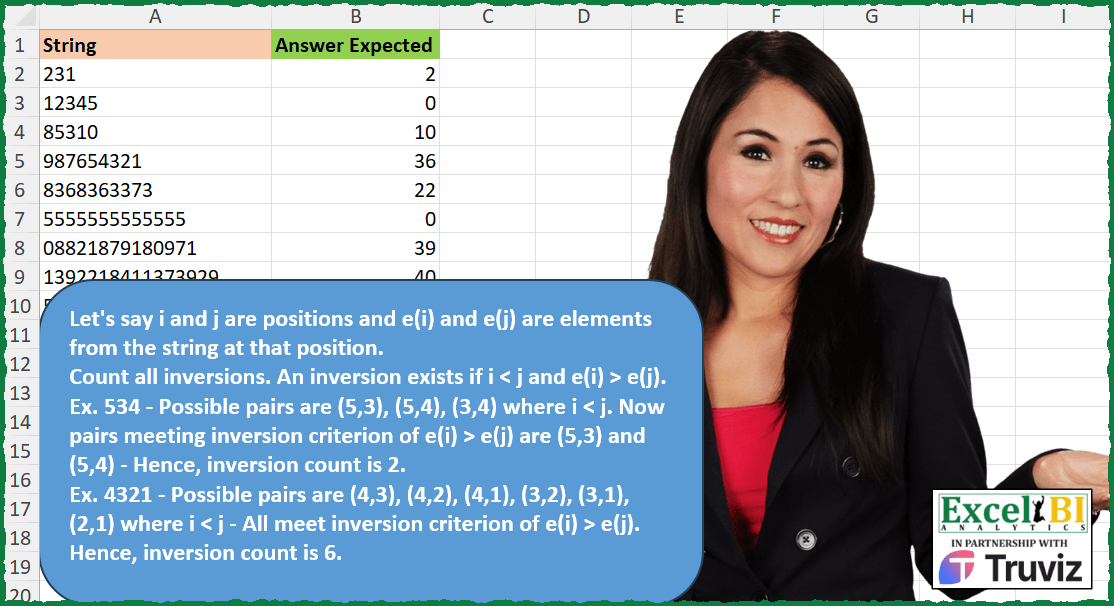
Let’s say i and j are positions and e(i) and e(j) are elements from the string at that position. Count all inversions. An inversion exists if i < j and e(i) > e(j). Ex. 534 – Possible pairs are (5,3), (5,4), (3,4) where i < j. Now pairs meeting inversion criterion of e(i) > e(j) are (5,3) and (5,4) – Hence, inversion count is 2. Ex. 4321 – Possible pairs are (4,3), (4,2), (4,1), (3,2), (3,1), (2,1) where i < j – All meet inversion criterion of e(i) > e(j). Hence, inversion count is 6.
📌 Challenge Details and Links
ExcelBI Excel Challenge Number: 396
Challenge Difficulty: ⭐️⭐️
📥Download Sample File
📥Link to the solutions on LinkedIn
Solving the challenge of Count Inversions in Number Sequence with Power Query
Power Query solution 1 for Count Inversions in Number Sequence, proposed by John V.:
let
 S = Excel.CurrentWorkbook(){0}[Content],
 R = Table.AddColumn(S, "R", each
 let
 a = Text.ToList([String]), b = {0..List.Count(a) - 1},
 c = List.TransformMany(b, each b, (r, c) => Number.From(r < c and a{r} > a{c}))
 in
 List.Sum(c)
 )[[R]]
in
 R
Blessings!
Power Query solution 2 for Count Inversions in Number Sequence, proposed by Alejandro Simón 🇵🇦 🇪🇸:
let
  Source = Excel.CurrentWorkbook(){[Name = "Table1"]}[Content],
  Sol = Table.AddColumn(
    Source,
    "Answer",
    each
      let
        a = Text.ToList([String]),
        b = List.Transform(a, Number.From),
        c = (x, y) =>
          let
            t = List.Transform({1 .. List.Count(x) - 1}, each {x{0}, x{_}})
          in
            if List.Count(x) = 1 then y else @c(List.Skip(x), y & t),
        d = c(b, {}),
        e = List.Select(d, each _{0} > _{1})
      in
        List.Count(e)
  )
in
  Sol
Power Query solution 3 for Count Inversions in Number Sequence, proposed by Ramiro Ayala Chávez:
let
  S = Excel.CurrentWorkbook(){[Name = "Table1"]}[Content],
  Fx = (x) =>
    let
      a = Text.ToList(Text.From(x)),
      b = List.Count(a),
      c = List.Transform(
        {0 .. Number.Power(2, b) - 1},
        (i) =>
          List.Transform(
            {0 .. b - 1},
            (j) =>
              if Number.Mod(Number.IntegerDivide(i, Number.Power(2, j)), 2) = 1 then a{j} else null
          )
      ),
      d = List.Skip(List.Transform(c, each List.RemoveNulls(_))),
      e = List.Select(d, each List.Count(_) = 2),
      f = List.Select(e, each _{0} > _{1}),
      g = List.Count(f)
    in
      g,
  Sol = Table.AddColumn(S, "Answer Expected", each Fx([String]))[[Answer Expected]]
in
  Sol
Power Query solution 4 for Count Inversions in Number Sequence, proposed by Glyn Willis:
let
  Source = Excel.CurrentWorkbook(){[Name = "Table1"]}[Content],
  #"Added Custom" = Table.AddColumn(
    Source,
    "Custom",
    each List.Count(
      List.Combine(
        List.Transform(
          {0 .. Text.Length([String]) - 2},
          (x) =>
            List.Select(
              List.Transform(
                List.RemoveFirstN(
                  Text.ToList(Text.Range([String], x, Text.Length([String]) - x)),
                  1
                ),
                (y) => {Text.Middle([String], x, 1), y}
              ),
              (z) => z{0} > z{1}
            )
        )
      )
    )
  )
in
  #"Added Custom"
Solving the challenge of Count Inversions in Number Sequence with Excel
Excel solution 1 for Count Inversions in Number Sequence, proposed by Bo Rydobon 🇹🇭:
=MAP(A2:A10,
    LAMBDA(a,
    LET(s,
    SEQUENCE(
        LEN(
            a
        )
    ),
    m,
    MID(
        a,
        s,
        1
    ),
    SUM((mTOROW(
        s
    ))))))
Excel solution 2 for Count Inversions in Number Sequence, proposed by John V.:
=MAP(A2:A10,
    LAMBDA(x,
    LET(s,
    SEQUENCE(
        LEN(
            x
        )
    ),
    b,
    MID(
        x,
        s,
        1
    ),
    SUM((sTOROW(
        b
    ))))))
Excel solution 3 for Count Inversions in Number Sequence, proposed by محمد حلمي:
=MAP(A2:A10,
    LAMBDA(a,
    LET(s,
    SEQUENCE(
        LEN(
            a
        )
    ),
    i,
    MID(
        a,
        s,
        1
    ),
    SUM((s>TOROW(
        s
    ))*(i
Excel solution 4 for Count Inversions in Number Sequence, proposed by محمد حلمي:
=MAP(
    A2:A10,
    LAMBDA(
        a,
        LET(
            s,
            SEQUENCE(
                LEN(
                    a
                )
            ),
            d,
            MID(
                a,
                s,
                1
            ),
            SUM(
                MAP(
                    d,
                    s,
                    LAMBDA(
                        a,
                        b,
                        SUM(
                            N(
                                a>DROP(
                                    d,
                                    b-1
                                )
                            )
                        )
                    )
                )
            )
        )
    )
)
Excel solution 5 for Count Inversions in Number Sequence, proposed by Kris Jaganah:
=MAP(
    A2:A10,
    LAMBDA(
        z,
        LET(
            b,
            REDUCE(
                "",
                MID(
                    z,
                    SEQUENCE(
                        LEN(
                            z
                        )
                    ),
                    1
                ),
                LAMBDA(
                    x,
                    y,
                    VSTACK(
                        x,
                        x&y
                    )
                )
            ),
            c,
            FILTER(
                b,
                LEN(
                    b
                )=2
            ),
            COUNT(
                IF(
                    RIGHT(
                        c
                    )
Excel solution 6 for Count Inversions in Number Sequence, proposed by Julian Poeltl:
=BYROW(A2:A10,
    LAMBDA(StringCol,
    LET(String,
    StringCol,
    Len,
    Len(
        String
    ),
    SEQ,
    SEQUENCE(
        Len
    ),
    Part,
    MID(
        String,
        SEQ,
        1
    ),
    ARR,
    SUM((PartTRANSPOSE(
        SEQ
    ))),
    ARR)))
2. approach:
=MAP(A2:A10,
    LAMBDA(StrCol,
    LET(String,
    StrCol,
    Len,
    LEN(
        String
    ),
    SEQ,
    SEQUENCE(
        Len
    ),
    Part,
    MID(
        String,
        SEQ,
        1
    ),
    ARR,
    Part1,
    1,
    0),
    SUM(
        LowTRIMA*ARR
    ))))
Excel solution 7 for Count Inversions in Number Sequence, proposed by Timothée BLIOT:
=MAP(
    A2:A10,
    LAMBDA(
        z,
        SUM(
            MAKEARRAY(
                LEN(
                    z
                ),
                LEN(
                    z
                ),
                LAMBDA(
                    x,
                    y,
                    --IF(
                        x--MID(
                            z,
                            y,
                            1
                        )
                    )
                )
            )
        )
    )
)
Excel solution 8 for Count Inversions in Number Sequence, proposed by Sunny Baggu:
=MAP(

     A2:A10,

     LAMBDA(
         a,

          LET(

               _s,
               SEQUENCE(
                   LEN(
                       a
                   )
               ),

               _r,
               TOROW(
                   _s
               ),

               SUM(
                   IFERROR(
                       TOCOL(
                           IF(
                               IF(
                                   _s < _r,
                                    MID(
                                        a,
                                         _s,
                                         1
                                    ) > MID(
                                        a,
                                         _r,
                                         1
                                    )
                               ),
                                1,
                                x
                           ),
                            3
                       ),
                        0
                   )
               )

          )

     )

)
Excel solution 9 for Count Inversions in Number Sequence, proposed by LEONARD OCHEA 🇷🇴:
=MAP(A2:A10,
    LAMBDA(x,
    SUM(MAP(SEQUENCE(
        LEN(
            x
        )-1
    ),
    LAMBDA(a,
    SUM(--(MID(
        x,
        a,
        1
    )>MID(
        x,
        SEQUENCE(
            LEN(
            x
        )-a,
            ,
            a+1
        ),
        1
    ))))))))
Excel solution 10 for Count Inversions in Number Sequence, proposed by Tyler Cameron:
=MAP(A2:A10,
    LAMBDA(u,
    LET(a,
    LEN(
        u
    ),
    b,
    MID(
        u,
        SEQUENCE(
            a
        ),
        1
    ),
    SUM(--IFERROR(MAKEARRAY(a,
    a,
    LAMBDA(r,
    c,
    INDEX(b,
    r+(c-1))
Solving the challenge of Count Inversions in Number Sequence with Python
Python solution 1 for Count Inversions in Number Sequence, proposed by Giorgi Goderdzishvili:
df = pd.read_clipboard()
lst = [int(i.replace(',','')) for i in df.String]
fin = []
for el in lst:
 cnting = 0
 for i in range(len(str(el))):
 for j in range(i+1,len(str(el))):
 if str(el)[i]>str(el)[j]:
 cnting+=1
 fin.append(cnting)
for i in fin:
 print(i)
Solving the challenge of Count Inversions in Number Sequence with Python in Excel
Python in Excel solution 1 for Count Inversions in Number Sequence, proposed by Abdallah Ally:
import pandas as pd
file_path = 'Excel_Challenge_396 - Count Inversions.xlsx'
df = pd.read_excel(file_path)
def count_inversion(col):
 inversions = []
 for i in range(len(str(col)) - 1):
 for char in str(col)[i + 1:]:
 if str(col)[i] > char:
 inversions.append((str(col)[i], char))
 return len(inversions)
df['My Answer'] = df['String'].apply(count_inversion)
print(df)
https://github.com/mathematiciantz/Excel_BI_Challenges/blob/main/Excel_Challenge_396_Count_Inversions.py
Solving the challenge of Count Inversions in Number Sequence with R
R solution 1 for Count Inversions in Number Sequence, proposed by Konrad Gryczan, PhD:
library(tidyverse)
library(readxl)
input = read_excel("Excel/396 Count Inversions.xlsx", range = "A1:A10")
test = read_excel("Excel/396 Count Inversions.xlsx", range = "B1:B10")
check_inversions = function(x) {
 x = as.character(x)
 inversions = 0

 for (i in 1:(nchar(x) - 1)) {
 for (j in (i + 1):nchar(x)) {
 if (as.numeric(substr(x, i, i)) > as.numeric(substr(x, j, j))) {
 inversions = inversions + 1
 }
 }
 }
 return(inversions)
}
result = input %>%
 mutate(inversions = map_dbl(String, check_inversions))
Solving the challenge of Count Inversions in Number Sequence with Excel VBA
Excel VBA solution 1 for Count Inversions in Number Sequence, proposed by Hiran de Silva FCMA:
Sub ExcelBI_396()
 iRow = 2

 strSource = Cells(iRow, 1).Value

 iStart = 1
 jStart = 1

 Do Until Cells(iRow, 1).Value = ""

 intInversionCount = 0

 strSource = Cells(iRow, 1).Value

 For i = 1 To Len(strSource)

 ei = Mid(strSource, i, 1)

 For j = 1 To Len(strSource)

 ej = Mid(strSource, j, 1)

 If i < j And ei > ej Then

 intInversionCount = intInversionCount + 1

 End If

 Next j

 Next i

 Cells(iRow, 3).Value = intInversionCount
 iRow = iRow + 1
 Loop
End Sub
&&&