
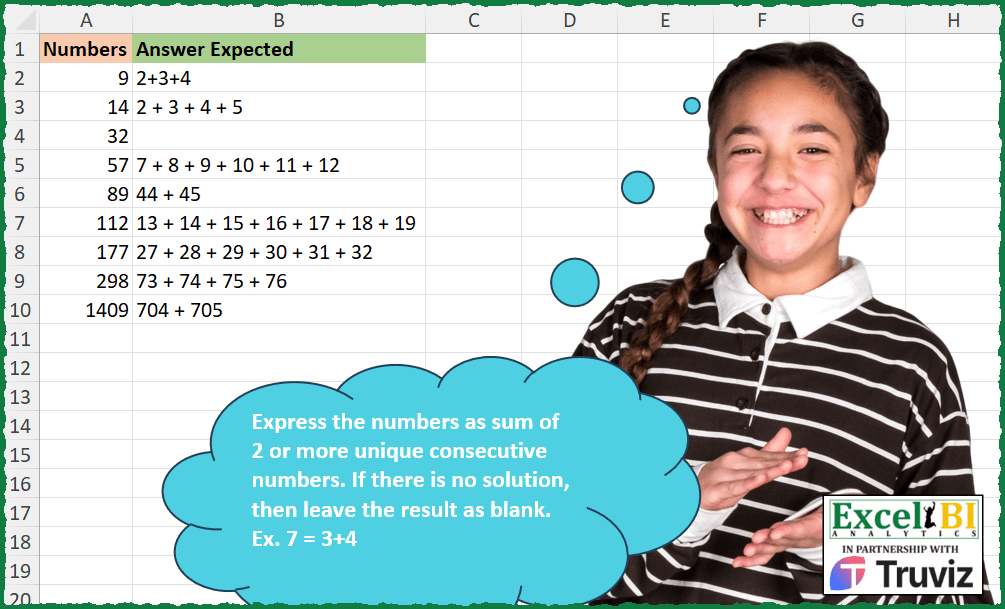
Express the numbers as sum of 2 or more unique consecutive numbers. If there is no solution, then leave the result as blank. Ex. 7 = 3+4 Ex. 8 = Can’t be expressed as sum of 2 or more unique consecutive numbers.
📌 Challenge Details and Links
ExcelBI Excel Challenge Number: 359
Challenge Difficulty: ⭐️⭐️
📥Download Sample File
📥Link to the solutions on LinkedIn
Solving the challenge of Sum of Unique Consecutive Numbers with Power Query
Power Query solution 1 for Sum of Unique Consecutive Numbers, proposed by Alejandro Simón 🇵🇦 🇪🇸:
let
  Source = Excel.CurrentWorkbook(){[Name = "Table1"]}[Content],
  Sol = Table.AddColumn(
    Source,
    "Answer",
    (k) =>
      let
        a = List.Last(
          List.Skip(
            List.Select(
              List.Generate(
                () => [x = 0, z = 1],
                each [z] >= 1,
                each [x = [x] + 1, z = (k[Numbers] - List.Sum({0 .. [x]})) / x],
                each [z]
              ),
              each Int64.From(_) = _
            )
          )
        ),
        b = List.Generate(
          () => [x = 1, y = a, z = a],
          each [y] <= k[Numbers],
          each [x = [x] + 1, z = [z] + 1, y = [y] + z],
          each [z]
        ),
        c = List.Transform(b, Text.From),
        d = if List.Count(c) = 1 then null else Text.Combine(c, " + ")
      in
        d
  )[[Answer]]
in
  Sol
Power Query solution 2 for Sum of Unique Consecutive Numbers, proposed by Ramiro Ayala Chávez:
let
  Origen = Excel.CurrentWorkbook(){[Name = "Tabla1"]}[Content],
  Fx = (x) =>
    let
      a = x,
      b = List.Buffer({1 .. a - 1}),
      c = List.Generate(
        () => [m = 0, n = 1],
        each [m] < List.Count(b),
        each if [n] = List.Count(b) then [m = [m] + 1, n = [m] + 2] else [m = [m], n = [n] + 1],
        each List.Range(b, [m], [n] - [m])
      ),
      d = List.Select(c, each List.Count(_) > 1 and List.Sum(_) = a),
      e = try Text.Combine(List.Transform(d{0}, Text.From), " + ") otherwise null
    in
      e,
  Sol = Table.AddColumn(Origen, "Answer Expected", each Fx([Numbers]))
in
  Sol
Solving the challenge of Sum of Unique Consecutive Numbers with Excel
Excel solution 1 for Sum of Unique Consecutive Numbers, proposed by Bo Rydobon 🇹🇭:
=MAP(
    A2:A10,
    LAMBDA(
        a,
        TEXTJOIN(
            "
",
            ,
            MAP(
                SEQUENCE(
                    SQRT(
                        2*a
                    )
                )+1,
                LAMBDA(
                    n,
                    LET(
                        m,
                        2*a/n-n+1,

                        IF(
                            MOD(
                                m,
                                2
                            ),
                            "",
                            TEXTJOIN(
                                "+",
                                ,
                                SEQUENCE(
                                    n,
                                    ,
                                    m/2
                                )
                            )
                        )
                    )
                )
            )
        )
    )
)
Excel solution 2 for Sum of Unique Consecutive Numbers, proposed by John V.:
=MAP(
    A2:A10,
    LAMBDA(
        x,
        LET(
            s,
            1+SEQUENCE(
                x^0.5
            ),
            i,
            x/s-0.5-s/2,
            b,
            INT(
                i
            )=i,
            IFNA(
                TEXTJOIN(
                    "+",
                    ,
                    LOOKUP(
                        1,
                        0/b,
                        i
                    )+SEQUENCE(
                        LOOKUP(
                            1,
                            0/b,
                            s
                        )
                    )
                ),
                ""
            )
        )
    )
)
Excel solution 3 for Sum of Unique Consecutive Numbers, proposed by محمد حلمي:
=MAP(
    A2:A10,
    LAMBDA(
        a,
        LET(

            e,
            LAMBDA(
                j,

                MAP(
                    SEQUENCE(
                        15,
                        ,
                        2,
                        0.5
                    ),
                    LAMBDA(
                        x,
                        LET(

                            i,
                            SEQUENCE(
                                x,
                                ,
                                INT(
                                    a/x
                                )-j
                            ),

                            TEXTJOIN(
                                " + ",
                                ,

                                TAKE(
                                    i,
                                    XMATCH(
                                        a,
                                        SCAN(
                                            0,
                                            i,
                                            LAMBDA(
                                                c,
                                                v,
                                                c+v
                                            )
                                        )
                                    )
                                )
                            )
                        )
                    )
                )
            ),

            w,
            UNIQUE(
                IFNA(
                    e(
                        0
                    ),
                    e(
                        1
                    )
                )
            ),

            TEXTJOIN(
                CHAR(
                    10
                ),
                ,
                FILTER(
                    w,
                    IFNA(
                        w,

                    )>0,
                    ""
                )
            )
        )
    )
)
Excel solution 4 for Sum of Unique Consecutive Numbers, proposed by محمد حلمي:
=MAP(
    A2:A10,
    LAMBDA(
        a,
        LET(
            e,
            LAMBDA(
                j,

                MAP(
                    SEQUENCE(
                        15,
                        ,
                        2,
                        0.5
                    ),
                    LAMBDA(
                        x,
                        LET(

                            i,
                            SEQUENCE(
                                x,
                                ,
                                INT(
                                    a/x
                                )-j
                            ),
                            TEXTJOIN(
                                " + ",
                                ,

                                TAKE(
                                    i,
                                    XMATCH(
                                        a,
                                        SCAN(
                                            0,
                                            i,
                                            LAMBDA(
                                                c,
                                                v,
                                                c+v
                                            )
                                        )
                                    )
                                )
                            )
                        )
                    )
                )
            ),

            IFNA(
                LOOKUP(
                    "z",
                    IFNA(
                        e(
                            0
                        ),
                        e(
                            1
                        )
                    )
                ),
                ""
            )
        )
    )
)
Excel solution 5 for Sum of Unique Consecutive Numbers, proposed by Kris Jaganah:
=MAP(A2:A10,
    LAMBDA(w,
    LET(n,
    w,
    o,
    SEQUENCE(
        ROUNDUP(
            n/2,
            0
        )
    ),
    p,
    BYCOL(
        IFERROR(
            INDEX(
                o,
                o+TOROW(
                    o
                )
            ),
            0
        ),
        LAMBDA(
            z,
            LET(
                a,
                SCAN(
                    0,
                    z,
                    LAMBDA(
                        x,
                        y,
                        x+y
                    )
                ),
                b,
                FILTER(
                    a,
                    a<=n
                ),
                c,
                IF(
                    TAKE(
                        b,
                        -1
                    )=n,
                    TAKE(
                        z,
                        ROWS(
                            b
                        )
                    ),
                    ""
                ),
                TEXTJOIN(
                    " + ",
                    ,
                    IF(
                        c=0,
                        "",
                        c
                    )
                )
            )
        )
    ),
    FILTER(p,
    (p<>"")*(LEN(
        p
    )=MAX(
        LEN(
        p
    )
    )),
    ""))))
Excel solution 6 for Sum of Unique Consecutive Numbers, proposed by Timothée BLIOT:
=MAP(
    A2:A10,
    LAMBDA(
        z,
        LET(
            A,
            SEQUENCE(
                99,
                ,
                2
            ),
            B,
            CEILING(
                z/A,
                1
            ),
            C,
            MAP(
                A,
                B,
                LAMBDA(
                    a,
                    b,
                     TEXTJOIN(
                         " + ",
                         ,
                         b-FLOOR(
                             a/2,
                             1
                         )+SEQUENCE(
                             ,
                             a,
                             0
                         )
                     )
                )
            ),
             TAKE(
                 FILTER(
                     C,
                     MAP(
                         C,
                         LAMBDA(
                             x,
                             SUM(
                                 --TEXTSPLIT(
                                     x,
                                     " + "
                                 )
                             )=z
                         )
                     ),
                     ""
                 ),
                 -1
             )
        )
    )
)
Only positive solutions:
=MAP(
    A2:A10,
    LAMBDA(
        z,
        LET(
            A,
            SEQUENCE(
                99,
                ,
                2
            ),
            B,
            CEILING(
                z/A,
                1
            ),
            C,
            MAP(
                A,
                B,
                LAMBDA(
                    a,
                    b,
                     TEXTJOIN(
                         " + ",
                         ,
                         b-FLOOR(
                             a/2,
                             1
                         )+SEQUENCE(
                             ,
                             a,
                             0
                         )
                     )
                )
            ),
             D,
            FILTER(
                C,
                MAP(
                    C,
                    LAMBDA(
                        x,
                        SUM(
                            --TEXTSPLIT(
                                x,
                                " + "
                            )
                        )=z
                    )
                )
            ),
            TAKE(
                FILTER(
                    D,
                    LEFT(
                        D
                    )<>"-",
                    ""
                ),
                -1
            )
        )
    )
)
Excel solution 7 for Sum of Unique Consecutive Numbers, proposed by Oscar Mendez Roca Farell:
=MAP(A2:A10,
     LAMBDA(a,
     LET(_n,
     SEQUENCE(
         a/2
     ),
    _m,
    _n*(TOROW(
        _n-1
    )+(_n+1)/2),
    _f,
     FILTER(
         _m,
          MMULT(
              TOROW(
                  _n
              )^0,
               N(
                   _m=a
               )
          )
     ),
     IFERROR(
         TEXTJOIN(
             "+",
              ,
               UNIQUE(
                   SCAN(
                        ,
                       TAKE(
                           _f,
                            ,
                           1
                       ),
                        LAMBDA(
                            i,
                             x,
                             IF(
                                 x>a,
                                  i,
                                  i+1
                             )
                        )
                   )
               )
         ),
          ""
     ))))
Excel solution 8 for Sum of Unique Consecutive Numbers, proposed by Bhavya Gupta:
= 7+8+9+10+11+12,

 57 = 18+19+20,
     57 = 28+29

=MAP(A2:A10,
    LAMBDA(num,
    TEXTJOIN(CHAR(
        10
    ),
    ,
    IFERROR(TOCOL(MAKEARRAY(ROUNDUP(
        num/2+1,

    ),
    ROUNDUP(
        SQRT(
            num
        )+1,

    ),
    LAMBDA(a,
    n,
    IF((n*(2*a+n-1))=2*num,
    TEXTJOIN(
        "+",
        ,
        SEQUENCE(
            n,
            ,
            a
        )
    ),
    1/0))),
    3),
    ""))))
Excel solution 9 for Sum of Unique Consecutive Numbers, proposed by Charles Roldan:
=MAP(A2:A10,
     LAMBDA(x,
     LET(
s,
     SEQUENCE(
         ,
          SQRT(
              2*x + 1/4
          ) - 1/2
     ),

n,
     XLOOKUP(
         0,
          MOD(
              x - COMBIN(
                  s,
                   2
              ),
               s
          ),
          s,
          ,
          ,
          -1
     ),

IFNA(TEXTJOIN(" + ",
     ,
     SEQUENCE(n,
     ,
     x/n - (n - 1)/2)),
     ""))))
Excel solution 10 for Sum of Unique Consecutive Numbers, proposed by JvdV -:
=MAP(A2:A10,LAMBDA(s,LET(q,SEQUENCE(s),x,LAMBDA(f,n,IFNA(REPT(TEXTJOIN("+",,TAKE(q+n,XMATCH(s,SCAN(,q+n,SUM)))),n<>s-1),f(f,n+1))),x(x,))))Excel solution 11 for Sum of Unique Consecutive Numbers, proposed by Giorgi Goderdzishvili:
= MAP(
    A2:A10,
    LAMBDA(
        t,
        LET(
            _p,
            t,

            _nm,
            INT(
                _p/2
            )+1,

            _sq,
            SEQUENCE(
                ,
                _nm
            ),

            _m,
            SEQUENCE(
                15
            ),

            _ind,
             _sq&"-"&_m,

            _mp,
             MAP(
                 _ind,
                 LAMBDA(
                     x,

                     LET(
                         _st,
                         TEXTBEFORE(
                             x,
                             "-"
                         ),
                         _ln,
                   &      TEXTAFTER(
                             x,
                             "-"
                         ),

                         IFERROR(
                             SUM(
                                 --INDEX(
                                     _sq,
                                     1,
                                     SEQUENCE(
                                         ,
                                         _ln,
                                         _st
                                     )
                                 )
                             ),
                             0
                         )
                     )
                 )
             ),

            _fl,
             FILTER(
                 TOCOL(
                     _ind
                 ),
                 TOCOL(
                     _mp
                 )=_p,
                 ""
             ),

            _fn,
             INDEX(
                 _fl,
                 ROWS(
                     _fl
                 ),
                 1
             ),

            IFERROR(
                TEXTJOIN(
                    " + ",
                    TRUE,
                    SEQUENCE(
                        ,
                        TEXTAFTER(
                            _fn,
                            "-"
                        ),
                        TEXTBEFORE(
                            _fn,
                            "-"
                        )
                    )
                ),
                ""
            )
        )
    )
)
Excel solution 12 for Sum of Unique Consecutive Numbers, proposed by Abdelrahman Omer, MBA, PMP:
=MAP(A2:A10,
    LAMBDA(a,
    LET(B,
    SEQUENCE(
        a/2+1
    ),

C,
    SEQUENCE(
        ,
        a/2+1
    ),

D,
    --(SCAN(
        0,
        B,
        LAMBDA(
            X,
            Y,
            X+Y
        )
    )-
SCAN(
    0,
    C-1,
    LAMBDA(
            X,
            Y,
            X+Y
        )
)=a),

E,
    @TAKE(
        FILTER(
            B,
            BYROW(
                D,
                LAMBDA(
                    X,
                    SUM(
                        X
                    )
                )
            )
        ),
        1
    ),

F,
    @TAKE(
        FILTER(
            C,
            BYCOL(
                D,
                LAMBDA(
                    X,
                    SUM(
                        X
                    )
                )
            )
        ),
        ,
        1
    ),

IFERROR(
    TEXTJOIN(
        " + ",
        ,
        SEQUENCE(
            E-F+1,
            ,
            F
        )
    ),
    ""
))))
Excel solution 13 for Sum of Unique Consecutive Numbers, proposed by Abdelrahman Omer, MBA, PMP:
=MAP(A2:A10,
    LAMBDA(a,
    LET(B,
    SEQUENCE(
        a/2+1
    ),
    C,
    SEQUENCE(
        ,
        a/2+1
    ),
    D,
    --(SCAN(
        0,
        B,
        LAMBDA(
            X,
            Y,
            X+Y
        )
    )-SCAN(
        0,
        C-1,
        LAMBDA(
            X,
            Y,
            X+Y
        )
    )=a),
    E,
    TAKE(
        FILTER(
            B,
            BYROW(
                D,
                LAMBDA(
                    X,
                    SUM(
                        X
                    )
                )
            )
        ),
        1
    ),
    F,
    TAKE(
        FILTER(
            C,
            BYCOL(
                D,
                LAMBDA(
                    X,
                    SUM(
                        X
                    )
                )
            )
        ),
        ,
        1
    ),
    TEXTJOIN(
        " + ",
        ,
        SEQUENCE(
            E-F+1,
            ,
            F
        )
    ))))
Excel solution 14 for Sum of Unique Consecutive Numbers, proposed by Arden Nguyen, CPA:
=LET(
ref,
    A2,

g,
    LAMBDA(_n,
    (2*ref/_n-_n+1)/2),

f,
    LAMBDA(
        _i,
        _n,
        _self,
        IF(
            MOD(
                _n,
                1
            )<>0,
            IF(
                _n>=0,
                _self(
                    _i+1,
                    g(
                        _i+1
                    ),
                    _self
                ),
                ""
            ),
            SEQUENCE(
                _i,
                ,
                _n
            )
        )
    ),

TEXTJOIN(
    " + ",
    TRUE,
    f(
        2,
        g(
            2
        ),
        f
    )
)
)
Solving the challenge of Sum of Unique Consecutive Numbers with R
R solution 1 for Sum of Unique Consecutive Numbers, proposed by Konrad Gryczan, PhD:
library(tidyverse)
library(readxl)
input = read_excel("Excel/359 Express as Sum of Consecutive Digits.xlsx", range = "A1:A10")
test = read_excel("Excel/359 Express as Sum of Consecutive Digits.xlsx", range = "B1:B10") %>%
 mutate(`Answer Expected` = str_remove_all(as.character(`Answer Expected`), "\s"))
find_consecutive_sums <- function(target) {
 results <- tibble()
 for (start_num in 1:(target/2 + 1)) {
 sum <- start_num
 next_num <- start_num
 while (sum < target) {
 next_num <- next_num + 1
 sum <- sum + next_num
 if (sum == target) {
 results <- bind_rows(results, tibble(start = start_num, end = next_num))
 }
 }
 }
 if (nrow(results) == 0) {
 return(tibble(Numbers = target, seq = NA_character_))
 } else {
 sqs <- results %>%
 mutate(
 Numbers = target,
 seq = map2_chr(start, end, ~paste(.x:.y, collapse = "+"))
 ) %>%
 select(Numbers, seq)
 return(sqs)
 }
}
result = map(input$Numbers, find_consecutive_sums) %>%
 bind_rows() %>%
 group_by(Numbers) %>%
 slice(1)
Solving the challenge of Sum of Unique Consecutive Numbers with Excel VBA
Excel VBA solution 1 for Sum of Unique Consecutive Numbers, proposed by Nicolas Micot:
VBA solution:
Function f_trouveSomme(sommeCherchee As Integer) As String
Dim nombreDep As Integer, nombre As Integer, somme As Integer, nombreFin As Integer
Dim resultat As String
nombreFin = 1 + sommeCherchee  2
For nombreDep = 1 To nombreFin
 somme = 0
 For nombre = nombreDep To nombreFin
 somme = somme + nombre
 If somme >= sommeCherchee Then Exit For
 Next nombre
 If somme = sommeCherchee Then
 nombreFin = nombre
 For nombre = nombreDep To nombreFin
 resultat = resultat & IIf(resultat = "", "", " + ") & nombre
 Next nombre
 Exit For
 End If
Next nombreDep
f_trouveSomme = resultat
End Function
&&