
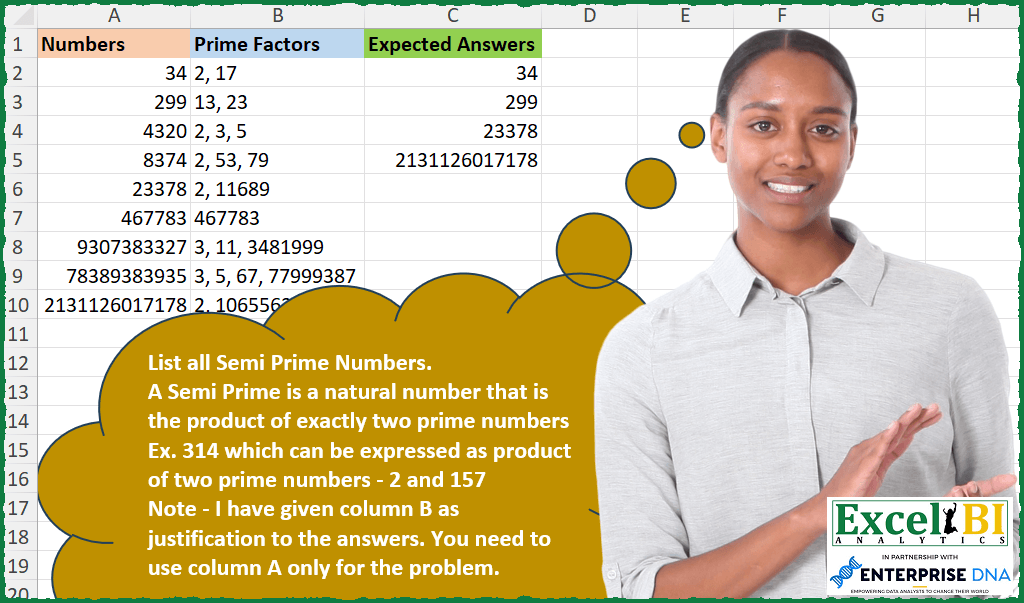
List all Semi Prime Numbers. A Semi Prime is a natural number that is the product of exactly two prime numbers Ex. 314 which can be expressed as product of two prime numbers – 2 and 157 Note – I have given column B as justification to the answers. You need to use column A only for the problem.
📌 Challenge Details and Links
ExcelBI Excel Challenge Number: 306
Challenge Difficulty: ⭐️⭐️⭐️⭐️
📥Download Sample File
📥Link to the solutions on LinkedIn
Solving the challenge of List all Semi Prime Numbers with Power Query
Power Query solution 1 for List all Semi Prime Numbers, proposed by Zoran Milokanović:
let
 Source = Excel.CurrentWorkbook(){[Name = "Input"]}[Content],
 IsPrime = each not List.Accumulate({2 .. Number.RoundDown(Number.Sqrt(_))}, _ = 1, (s, c) => s or (Number.Mod(_, c) = 0)),
 S = Table.SelectRows(Source, each List.Accumulate(List.Numbers(1, Int64.From([Numbers] / 2)), 0, (s, c) => s + (let q = [Numbers] / c, m = Number.Mod([Numbers], c) in Number.From(IsPrime(c) and m = 0 and IsPrime(q)))) = 2)
in
 S

Working well with small numbers, struggles with large ones. Looking forward to see other solutions that work quicker with large numbers. 😇
Power Query solution 2 for List all Semi Prime Numbers, proposed by Alejandro Simón 🇵🇦 🇪🇸:
let
  Source = Excel.CurrentWorkbook(){[Name = "Table1"]}[Content],
  Sol = Table.SelectRows(
    Source,
    each
      let
        a = {2} & List.Select({3 .. Number.RoundDown(Number.Sqrt([Numbers]))}, Number.IsOdd),
        b = List.Select(a, (x) => Number.Mod([Numbers], x) = 0),
        c = List.Transform(b, (y) => {y} & {[Numbers] / y}),
        d = List.Transform(
          c,
          (z) =>
            List.AllTrue(
              List.Combine(
                List.Transform(
                  z,
                  (t) =>
                    List.Transform(
                      {2} & List.Select({3 .. Number.RoundDown(Number.Sqrt(t))}, Number.IsOdd),
                      (w) =>
                        if t = 2 then
                          true
                        else if Number.Mod(t, 2) = 0 then
                          false
                        else
                          Number.Mod(t, w) > 0
                    )
                )
              )
            )
        ),
        e = List.AllTrue(List.Transform(a, (x) => Number.Mod([Numbers], x) > 0))
      in
        List.AllTrue(d) and not e
  )[[Numbers]]
in
  Sol
Power Query solution 3 for List all Semi Prime Numbers, proposed by Luan Rodrigues:
let
  Fonte = Tabela1,
  fx = (n) =>
    List.Select({2 .. Number.RoundDown(Number.Sqrt(n))}, (x) => Number.Mod(n, x) = 0){0}? = null,
  res = Table.SelectRows(
    Fonte,
    each (Expression.Evaluate(Text.Replace([Prime Factors], ", ", "*")) = [Numbers])
      and List.Count(Text.Split([Prime Factors], ", "))
      = 2
        and List.AllTrue(
          List.Transform(Text.Split([Prime Factors], ", "), (x) => fx(Number.From(x)))
        )
  )[[Numbers]]
in
  res
Solving the challenge of List all Semi Prime Numbers with Excel
Excel solution 1 for List all Semi Prime Numbers, proposed by Bo Rydobon 🇹🇭:
=TOCOL(
    MAP(
        A2:A10,
        LAMBDA(
            n,
            LET(
                P,
                LAMBDA(
                    n,
                    LET(
                        c,
                        {2,
                        3,
                        5,
                        7},
                        d,
                        n/TOCOL(
                            VSTACK(
                                c,
                                SEQUENCE(
                                    n^0.5/6,
                                    ,
                                    2
                                )*6+{-1,
                                1}
                            ),
                            3
                        ),
                        IF(
                            OR(
                                n=c
                            ),
                            0,
                            XLOOKUP(
                                0,
                                d-INT(
                                    d
                                ),
                                d,
                                0
                            )
                        )
                    )
                ),

                a,
                P(
                    n
                ),
                n/IF(
                    a,
                    P(
                        a
                    )=0
                )
            )
        )
    ),
    3
)
Excel solution 2 for List all Semi Prime Numbers, proposed by John V.:
=TOCOL(MAP(A2:A10,
    LAMBDA(x,
    LET(a,
    LAMBDA(
        n,
        1+SEQUENCE(
            n^0.5/2,
            2
        )
    ),
    p,
    LAMBDA(
        n,
        SUM(
            N(
                n-a(
                    n
                )*INT(
                    n/a(
                    n
                )
                )=0
            )
        )=0
    ),
    s,
    a(
        x
    ),
    f,
    @TOCOL(s/(x-s*INT(
        x/s
    )=0),
    2),
    x/(1-p(
        x
    ))/p(
        x/f
    )))),
    2)
Excel solution 3 for List all Semi Prime Numbers, proposed by محمد حلمي:
=TOCOL(
    MAP(
        A2:A10,
        LAMBDA(
            c,
            LET(

                i,
                {2,
                3,
                5,
                11,
                13,
                17,
                19,
                21},
                x,
                LAMBDA(
                    w,

                    AND(
                        0<>MOD(
                            w,
                            SEQUENCE(
                                w^
                                IF(
                                    LEN(
                                        c
                                    )>5,
                                    0.25,
                                    0.5
                                ),
                                ,
                                2
                            )
                        )
                    )
                ),
                c/AND(

                    MAP(
                        c/i,
                        LAMBDA(
                            a,
                            IF(
                                OR(
                                    a=i
                                ),
                                1,
                                IF(
                                    x(
                                        c
                                    ),
                                    0,
                                    x(
                                        a
                                    )
                                )
                            )
                        )
                    )
                )
            )
        )
    ),
    2
)
Excel solution 4 for List all Semi Prime Numbers, proposed by Timothée BLIOT:
=TOCOL(A2:A10/MAP(A2:A10,
    LAMBDA(z,
    LET(D,
    LAMBDA(m,
    VSTACK({2;3},
    SEQUENCE(MAX(FLOOR((FLOOR(
        m^0.5,
        1
    )-3)/2,
    1),
    1),
    ,
    5,
    2))),
    P,
    LAMBDA(n,
    OR(SUM(--(n={2;3;5;7;9}))=1,
    PRODUCT(--(MOD(
        n,
        D(
            n
        )
    )<>0)))),

A,
    ROW(
        1:999
    ),
    B,
    FILTER(
        A,
        MAP(
            A,
            LAMBDA(
                x,
                P(
                    x
                )
            )
        )
    ),
    C,
    z/B,
    E,
    FILTER(C,
    INT(
        C
    )=C*(C<>z),
    1/0),
    ROWS(
        UNIQUE(
            TOCOL(
                HSTACK(
                    E,
                    z/E
                ),
                3
            )
        )
    )=2))),
    3)
Excel solution 5 for List all Semi Prime Numbers, proposed by Charles Roldan:
=LET(
 _,
     LAMBDA(
         f,
          LAMBDA(
              g,
               LAMBDA(
                   x,
                    f(
                        g(
                            x
                        )
                    )
               )
          )
     ),

 S,
     LAMBDA(
         f,
          LAMBDA(
              g,
               LAMBDA(
                   x,
                    f(
                            x
                        )(
                        g(
                            x
                        )
                    )
               )
          )
     ),


 Fl,
     LAMBDA(
         f,
          LAMBDA(
              x,
               FILTER(
                   x,
                    f(
                            x
                        )
               )
          )
     ),

 Mp,
     LAMBDA(
         f,
          LAMBDA(
              x,
               MAP(
                   x,
                    f
               )
          )
     ),


 λNot,
     LAMBDA(
         x,
          NOT(
                            x
                        )
     ),

 λMod,
     LAMBDA(
         a,
          LAMBDA(
              b,
               MOD(
                   a,
                    b
               )
          )
     ),


 JustOne,
     LAMBDA(
         x,
          COUNT(
                            x
                        ) = 1
     ),

 Candidates,
     LAMBDA(
         x,
          DROP(
              SEQUENCE(
                  SQRT(
                            x
                        )
              ),
               1
          )
     ),


 Fl(Mp(_(JustOne)(S(_(Fl)(_(_(λNot))(λMod)))(Candidates))))
)(A2:A9)
Excel solution 6 for List all Semi Prime Numbers, proposed by Pieter de Bruijn:
=TOCOL(MAP(A2:A10,
    LAMBDA(a,
    LET(b,
    a/TOCOL(a/(a/VSTACK(
        {2,
        3},
        SEQUENCE(
            a^0.5/6
        )*6-{1,
        -1}
    )),
    2),
    a/(SUM(
        N(
            b=INT(
                b
            )
        )
    )=1)))),
    2)
(Big thanks to Bo Rydobon's formula solution)
Excel solution 7 for List all Semi Prime Numbers, proposed by Abdelrahman Omer, MBA, PMP:
=TOCOL(MAP(A2:A10,
    LAMBDA(b,
    LET(z,
    ROUNDUP(
        SQRT(
            b
        ),

    ),
    y,
    IF(
        ISEVEN(
            z
        ),
        z-1,
        z
    ),
    c,
    VSTACK(
        SEQUENCE(
            ROUNDDOWN(
        SQRT(
            b
        ),

    )/2,
            ,
            y,
            -2
        ),
        2
    ),
    e,
    BYROW(c,
    LAMBDA(f,
    (b/f-INT(
        b/f
    )=0))),
    g,
    FILTER(
        c*e,
        c*e>0
    ),
    d,
    BYROW(g,
    LAMBDA(f,
    --IF(f=2,
    TRUE,
    PRODUCT(--(MOD(
        f,
        SEQUENCE(
            ROUNDDOWN(
                SQRT(
                    f
                ),

            ),
            ,
            ROUNDUP(
                SQRT(
                    f
                ),

            ),
            -1
        )
    )<>0))))),
    FILTER(
        b,
        SUM(
            d
        )=1
    )))),
    3)
Solving the challenge of List all Semi Prime Numbers with Python in Excel
Python in Excel solution 1 for List all Semi Prime Numbers, proposed by Bo Rydobon 🇹🇭:
from sympy import isprime
def iSP(n):
 if isprime(n):return 0
 else:
 for d in range(2,int(n**0.5)+1):
 if n%d==0: return isprime(n//d)
[n for n in xl("A2:A10")[0] if iSP(n)]
Python in Excel solution 2 for List all Semi Prime Numbers, proposed by John V.:
Hi everyone!
def sp(n):
 f = factorint(n)
 return len(f) == 2 and all(isprime(i) for i in f)
[n for n in xl("A2:A10")[0] if sp(n)]
Blessings!
Solving the challenge of List all Semi Prime Numbers with R
R solution 1 for List all Semi Prime Numbers, proposed by Konrad Gryczan, PhD:
library(tidyverse)
library(readxl)
library(gmp)
library(data.table)
input = read_excel("Semi Prime Numbers.xlsx", range = "A1:A10")
test = read_excel("Semi Prime Numbers.xlsx", range = "C1:C5")
is_semiprime = function(n){
 factors <- n %>%
 as.character() %>%
 as.bigz() %>%
 factorize() %>%
 as.vector()
 check = ifelse(length(factors) == 2, TRUE, FALSE)

 return(check)
}
result = input$Numbers %>%
 keep(~ is_semiprime(.))
identical(result, test$`Expected Answers`)
&&&