
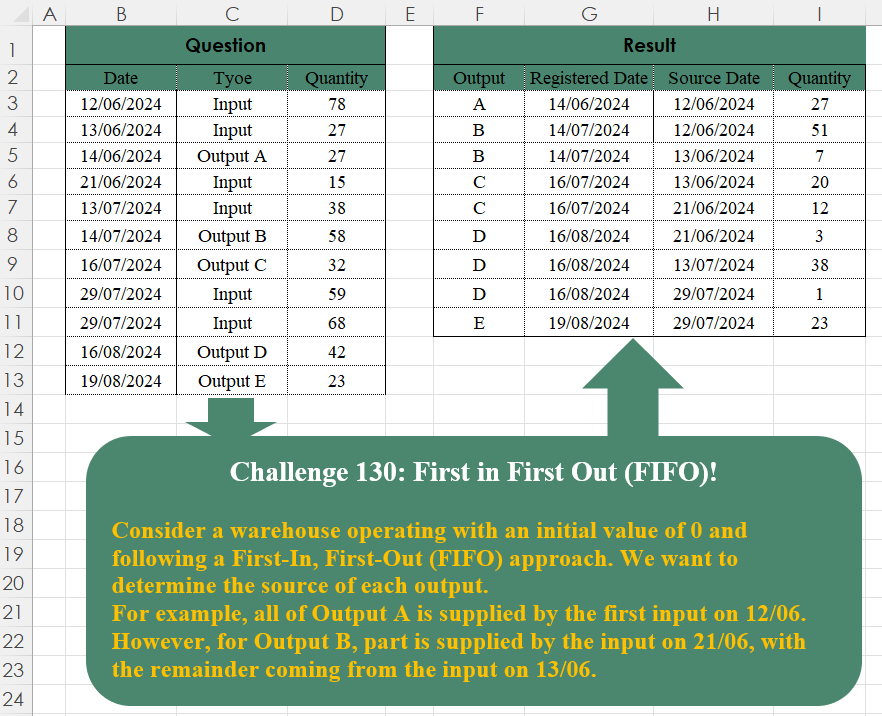
Consider a warehouse operating with an initial value of 0 and following a First-In, First-Out (FIFO) approach. We want to determine the source of each output. For example, all of Output A is supplied by the first input on 12/06. However, for Output B, part is supplied by the input on 21/06, with the remainder coming from the input on 13/06.
📌 Challenge Details and Links
Challenge Number: 130
Challenge Difficulty: ⭐⭐⭐⭐⭐
📥Download Sample File
📥Link to the solutions on LinkedIn
Solving the challenge of First In First Out (Fifo)! with Power Query
Power Query solution 1 for First In First Out (Fifo)!, proposed by Zoran Milokanović:
let
  Source = Excel.CurrentWorkbook(){[Name = "Input"]}[Content],
  F = each Table.SelectRows(Source, (r) => Text.StartsWith(r[Tyoe], _)),
  R = Table.ToRows(F("O")),
  S = Table.FromRows(
    List.TransformMany(
      R,
      each Table.ToRows(
        Table.Group(
          Table.FirstN(
            Table.Skip(
              Table.Combine(
                Table.AddColumn(F("I"), "Q", each Table.Repeat(Table.FromRecords({_}), [Quantity]))[
                  Q
                ]
              ),
              List.Sum(List.Zip(List.FirstN(R, List.PositionOf(R, _))){2}? ?? {0})
            ),
            _{2}
          ),
          "Date",
          {"Q", Table.RowCount}
        )
      ),
      (i, _) => {Text.Split(i{1}, " "){1}, i{0}} & _
    ),
    {"Output", "Registered Date", "Source Date", "Quantity"}
  )
in
  S
Power Query solution 2 for First In First Out (Fifo)!, proposed by Aditya Kumar Darak 🇮🇳:
let
  Source = Excel.CurrentWorkbook(){[Name = "data"]}[Content],
  Input = Table.SelectRows(Source, each [Type] = "Input"),
  Output = Table.SelectRows(Source, each [Type] <> "Input"),
  Generate = List.Generate(
    () => [N1 = - 1, N2 = - 1, RIQ = 0, ROQ = 0],
    each [N1] < Table.RowCount(Input) and [N2] < Table.RowCount(Output),
    each [
      N1  = [N1] + Number.From(C1),
      N2  = [N2] + Number.From(C2),
      IR  = Input{N1},
      ID  = IR[Date],
      IQ  = IR[Quantity],
      OR  = Output{N2},
      OT  = Text.AfterDelimiter(OR[Type], " "),
      OD  = OR[Date],
      OQ  = OR[Quantity],
      C1  = [RIQ] = 0,
      C2  = [ROQ] = 0,
      QU  = List.Min({if C2 then OQ else [ROQ], if C1 then IQ else [RIQ]}),
      RIQ = (if C1 then IQ else [RIQ]) - QU,
      ROQ = (if C2 then OQ else [ROQ]) - QU
    ],
    each [Output = [OT], Registered Date = [OD], Source Date = [ID], Quantity = [QU]]
  ),
  Return = Table.FromRecords(List.Skip(Generate))
in
  Return
Power Query solution 3 for First In First Out (Fifo)!, proposed by Alejandro Simón 🇵🇦 🇪🇸:
let
  Source = Excel.CurrentWorkbook(){[Name = "Table1"]}[Content],
  List1 = List.RemoveLastN(
    Table.ToColumns(
      Table.ExpandListColumn(
        Table.TransformColumns(
          Table.SelectRows(Source, each Text.Contains([Tyoe], "Input")),
          {"Quantity", each List.Repeat({1}, _)}
        ),
        "Quantity"
      )
    ),
    2
  ),
  List2 = List.Reverse(
    List.RemoveLastN(
      Table.ToColumns(
        Table.ExpandListColumn(
          Table.TransformColumns(
            Table.SelectRows(Source, each not Text.Contains([Tyoe], "Input")),
            {{"Quantity", each List.Repeat({1}, _)}, {"Tyoe", each Text.End(_, 1)}}
          ),
          "Quantity"
        )
      )
    )
  ),
  Tbl = Table.SelectRows(
    Table.FromColumns(List2 & List1, {"Output", "Register Date", "Source Date"}),
    each [Output] <> null
  ),
  Sol = Table.Group(Tble, Table.ColumnNames(Tbl), {{"Quantity", each Table.RowCount(_)}})
in
  Sol
Power Query solution 4 for First In First Out (Fifo)!, proposed by Kris Jaganah:
let
  A = Excel.CurrentWorkbook(){[Name = "Table1"]}[Content],
  B = Table.AddColumn(A, "Rep", each List.Repeat({1}, [Quantity])),
  C = Table.ExpandListColumn(B, "Rep"),
  D = Table.AddColumn(C, "Grp", each Text.BeforeDelimiter([Tyoe], " ")),
  E = Table.Sort(D, {{"Grp", 1}, {"Tyoe", 0}, {"Date", 0}}),
  F = Table.Group(E, {"Grp"}, {{"All", each Table.AddIndexColumn(_, "Idx", 1)}}),
  G = Table.Combine(Table.Sort(F, {"Grp", 1})[All]),
  H = Table.AddColumn(
    G,
    "Source Date",
    each Table.SelectRows(G, (x) => x[Idx] = [Idx] and x[Tyoe] = "Input")[Date]{0}
  ),
  I = Table.SelectRows(H, each ([Tyoe] <> "Input")),
  J = Table.RenameColumns(I, {{"Date", "Registered Date"}, {"Tyoe", "Output"}}),
  K = Table.TransformColumns(J, {"Output", each Text.AfterDelimiter(_, " ")}),
  L = Table.Group(
    K,
    {"Output", "Registered Date", "Source Date"},
    {"Quantity", each List.Sum([Rep])}
  )
in
  L
Solving the challenge of First In First Out (Fifo)! with Excel
Excel solution 1 for First In First Out (Fifo)!, proposed by Bo Rydobon 🇹🇭:
=LET(z,
    B3:D13,
    i,
    FILTER(
        z,
        INDEX(
            z,
            ,
            2
        )="input"
    ),
    j,
    TAKE(
        i,
        ,
        -1
    ),
    k,
    SCAN(
        ,
        j,
        SUM
    )-j,REDUCE(F2:I2,
    DROP(
            z,
            ,
            2
        ),
    LAMBDA(a,
    q,
    LET(t,
    +q:C13,LET(b,
    SUMIFS(
        q:D3,
        TAKE(
            q:C3,
            ,
            1
        ),
        "o*"
    )-k,
    c,
    b-q,d,
    IF(b>j,
    j,
    b*(b>0))-IF(c>j,
    j,
    c*(c>0)),IF(
    @t="input",
    a,
    VSTACK(
        a,
        CHOOSE(
            {1,
            2,
            3,
            4},
            RIGHT(
                @t
            ),
            @+B13:q,
            FILTER(
                TAKE(
                    i,
                    ,
                    1
                ),
                d
            ),
            FILTER(
                d,
                d
            )
        )
    )
))))))
Excel solution 2 for First In First Out (Fifo)!, proposed by Oscar Mendez Roca Farell:
=LET(d,
    B3:B13,
    q,
    C3:D13,
    t,
    C3:C13,
    P,
    DROP,
    W,
    BYROW,
    F,
    LAMBDA(
        a,
        FILTER(
            q,
            LEFT(
                t
            )=a
        )
    ),
    i,
    F(
        "I"
    ),
    o,
    F(
        "O"
    ),
    r,
    P(
        REDUCE(
            1-P(
                o,
                ,
                1
            )^0,
            -P(
                i,
                ,
                1
            ),
            LAMBDA(
                i,
                x,
                HSTACK(
                    i,
                    P(
                        REDUCE(
                            x,
                            W(
                                i,
                                SUM
                            )-P(
                o,
                ,
                1
            ),
                            LAMBDA(
                                j,
                                y,
                                VSTACK(
                                    j,
                                    -MAX(
                                        y,
                                        SUM(
                                            j
                                        )
                                    )
                                )
                            )
                        ),
                        1
                    )
                )
            )
        ),
        ,
        1
    ),
     G,
    LAMBDA(
        b,
        c,
        TOCOL(
            IFS(
                r,
                TOROW(
                    XLOOKUP(
                        W(
                            b,
                            CONCAT
                        ),
                        W(
                            q,
                            CONCAT
                        ),
                        c
                    )
                )
            ),
            2
        )
    ),
    HSTACK(G(
        o,
        RIGHT(
                t
            )
    ),
    G(
        o,
        d
    ),
    G(
        i,
        d
    ),
    TOCOL((1/r)^-1,
    2)))
Excel solution 3 for First In First Out (Fifo)!, proposed by Kris Jaganah:
=LET(
    a,
    B3:B13,
    b,
    C3:C13,
    c,
    D3:D13,
    d,
    FILTER(
        HSTACK(
            a,
            c
        ),
        b="Input"
    ),
    e,
    --TEXTSPLIT(
        CONCAT(
            REPT(
                TAKE(
                    d,
                    ,
                    1
                )&" ",
                TAKE(
                    d,
                    ,
                    -1
                )
            )
        ),
        ,
        " ",
        1
    ),
    f,
    FILTER(
        HSTACK(
            a&"-"&RIGHT(
                b
            ),
            c
        ),
        b<>"Input"
    ),
    g,
    TEXTSPLIT(
        CONCAT(
            REPT(
                TAKE(
                    f,
                    ,
                    1
                )&" ",
                TAKE(
                    f,
                    ,
                    -1
                )
            )
        ),
        "-",
        " ",
        1
    ),
    h,
    --TAKE(
        g,
        ,
        1
    ),
    GROUPBY(
        HSTACK(
            TAKE(
                g,
                ,
                -1
            ),
            h,
            TAKE(
                e,
                ROWS(
                    g
                )
            )
        ),
        h,
        COUNT,
        ,
        0
    )
)
Solving the challenge of First In First Out (Fifo)! with Python
Python solution 1 for First In First Out (Fifo)!, proposed by Konrad Gryczan, PhD:
import pandas as pd

path = "CH-130 FIFO.xlsx"
input = pd.read_excel(path, usecols="B:D", skiprows=1, nrows=11)
test = pd.read_excel(path, usecols="F:I", skiprows=1, nrows=9).rename(columns=lambda x: x.replace('.1', ''))

i_data = input[input['Tyoe'].str.startswith('I')].copy()
i_data = i_data.loc[i_data.index.repeat(i_data['Quantity'])].assign(In=1, rn=lambda x: range(1, len(x) + 1)).reset_index(drop=True)

o_data = input[input['Tyoe'].str.startswith('O')].copy()
o_data = o_data.loc[o_data.index.repeat(o_data['Quantity'])].assign(Out=1, rn=lambda x: range(1, len(x) + 1)).reset_index(drop=True)

all_data = pd.merge(i_data, o_data, on='rn', how='outer').dropna().sort_values(by='rn').reset_index(drop=True)
all_data = all_data.groupby(['Date_x', 'Date_y', 'Tyoe_x', 'Tyoe_y'], as_index=False)['In'].sum()
all_data["Output"] = all_data['Tyoe_y'].str[-1]

all_data = all_data.drop(columns=['Tyoe_x', 'Tyoe_y']).reindex(columns=['Output', 'Date_y', 'Date_x', 'In'])
all_data.columns = test.columns

print(all_data.equals(test)) # True
Solving the challenge of First In First Out (Fifo)! with Python in Excel
Python in Excel solution 1 for First In First Out (Fifo)!, proposed by Alejandro Campos:
import deque

data = xl("B2:D13", headers=True)
warehouse, output_sources = deque(), []

for _, row in data.iterrows():
 date, type_, quantity = row["Date"], row["Type"], row["Quantity"]
 if type_ == "Input":
 warehouse.append((date, quantity))
 elif type_.startswith("Output"):
 output_name, remaining_quantity = type_.split()[1], quantity
 while remaining_quantity > 0 and warehouse:
 input_date, input_quantity = warehouse.popleft()
 used_quantity = min(input_quantity, remaining_quantity)
 output_sources.append((output_name, date, input_date, used_quantity))
 remaining_quantity -= used_quantity
 if input_quantity > used_quantity:
 warehouse.appendleft((input_date, input_quantity - used_quantity))

df_output_sources = pd.DataFrame(output_sources, columns=["Output", "Registered Date", "Source Date", "Quantity"])
Solving the challenge of First In First Out (Fifo)! with R
R solution 1 for First In First Out (Fifo)!, proposed by Konrad Gryczan, PhD:
library(tidyverse)
library(readxl)

path = "files/CH-130 FIFO.xlsx"
input = read_excel(path, range = "B2:D13")
test = read_excel(path, range = "F2:I11")

i_data = input %>%
 filter(str_starts(Tyoe, "I")) %>%
 uncount(Quantity, .remove = F) %>%
 mutate(In = 1, rn = row_number())

o_data = input %>%
 filter(str_starts(Tyoe, "O")) %>%
 uncount(Quantity, .remove = F) %>%
 mutate(Out = 1, rn = row_number())

all = full_join(i_data, o_data, by = "rn") %>%
 summarise(all = sum(In, na.rm = T), .by = c(Date.x, Date.y, Tyoe.x, Tyoe.y)) %>%
 na.omit() %>%
 mutate(Output = str_sub(Tyoe.y, -1, -1)) %>%
 select(Output, `Registered Date` = Date.y, `Source Date` = Date.x, Quantity = all)

all.equal(all, test, check.attributes = F)
#> [1] TRUE
Solving the challenge of First In First Out (Fifo)! with Google Sheets
Google Sheets solution 1 for First In First Out (Fifo)!, proposed by Peter Krkos:
PowerQuery solution:
https://docs.google.com/spreadsheets/d/1zR5IZLz8OT76vhaPEHfsPrw8-RDKnLyyqS49IJjdhFk/edit?pli=1&gid=493757374#gid=493757374