
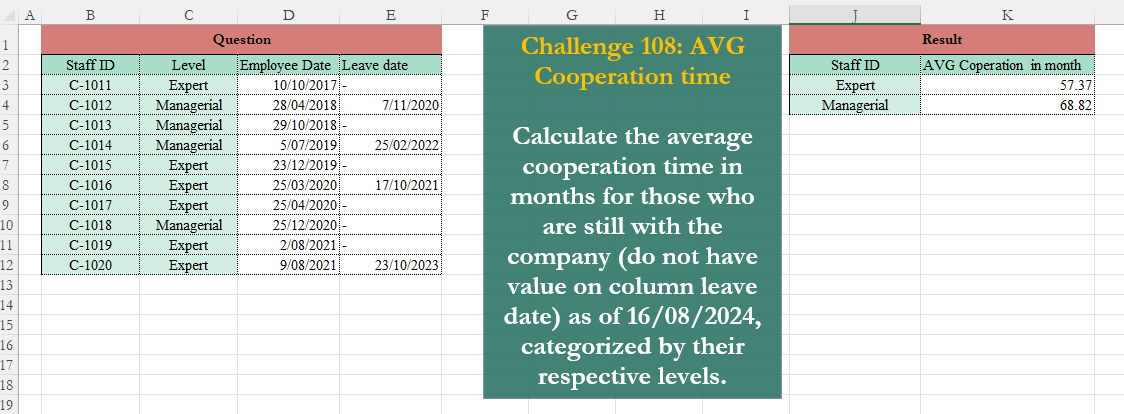
Calculate the average cooperation time in months for those who are still with the company (do not have value on column leave date) as of 16/08/2024, categorized by their respective levels.
📌 Challenge Details and Links
Challenge Number: 108
Challenge Difficulty: ⭐
📥Download Sample File
📥Link to the solutions on LinkedIn
Solving the challenge of Avg Cooperation Time! with Power Query
Power Query solution 1 for Avg Cooperation Time!, proposed by Zoran Milokanović:
let
  Source = Excel.CurrentWorkbook(){[Name = "Input"]}[Content],
  S = Table.Group(
    Source,
    "Level",
    {
      "AVG Cooperation time",
      each List.Average(
        List.Transform(
          List.Select(Table.ToRows(_), each _{3} = "-"),
          each
            let
              e = #datetime(2024, 08, 16, 0, 0, 0)
            in
              (Date.Year(e) - Date.Year(_{2})) * 12 + Date.Month(e) - Date.Month(_{2})
        )
      )
    }
  )
in
  S
Power Query solution 2 for Avg Cooperation Time!, proposed by Brian Julius:
let
  Source = Table.PromoteHeaders(Excel.CurrentWorkbook(){[Name = "rng"]}[Content]),
  Filter = Table.SelectRows(Source, each (try Date.From([#"Leave date"]) otherwise 1) = 1),
  AddMonths = Table.AddColumn(
    Filter,
    "Months",
    each [
      a = #date(2024, 8, 16),
      b = Date.Year(a) - Date.Year([#"Employee Date"]),
      c = Date.Month(a) - Date.Month([#"Employee Date"]),
      d = (b * 12) + c
    ][d]
  ),
  Group = Table.Group(AddMonths, {"Level"}, {{"Avg Cooperation", each List.Average([Months])}})
in
  Group
Power Query solution 3 for Avg Cooperation Time!, proposed by Alejandro Simón 🇵🇦 🇪🇸:
let
  Source = Excel.CurrentWorkbook(){[Name = "Table1"]}[Content],
  Avg = Table.AddColumn(
    Table.SelectRows(Source, each [Leave date] = "-"),
    "A",
    each Duration.Days(#date(2024, 08, 16) - Date.From([Employee Date]))
  ),
  Sol = Table.Group(Avg, {"Level"}, {{"[AVG Cooperation]", each List.Average([A]) / 30}})
in
  Sol
Power Query solution 4 for Avg Cooperation Time!, proposed by Kris Jaganah:
let
  S = Excel.CurrentWorkbook(){[Name = "Table1"]}[Content],
  A = Table.SelectRows(S, each ([Leave date] = "-")),
  B = Table.TransformColumns(
    A,
    {"Employee Date", each (Number.From(#date(2024, 08, 16)) - Number.From(_)) / 30.5}
  ),
  C = Table.Group(B, {"Level"}, {"AVG Cooperation in Months", each List.Average([Employee Date])})
in
  C
Power Query solution 5 for Avg Cooperation Time!, proposed by Yaroslav Drohomyretskyi:
let
  Source = Excel.CurrentWorkbook(){[Name = "Input"]}[Content],
  S = Table.Group(
    Source,
    "Level",
    {
      "AVG Cooperation time",
      each List.Average(
        List.Transform(
          List.Select(Table.ToRows(_), each _{3} = "-"),
          each
            let
              e = #datetime(2024, 08, 16, 0, 0, 0)
            in
              (Date.Year(e) - Date.Year(_{2})) * 12 + Date.Month(e) - Date.Month(_{2})
        )
      )
    }
  )
in
  S
Solving the challenge of Avg Cooperation Time! with Excel
Excel solution 1 for Avg Cooperation Time!, proposed by محمد حلمي:
=LET(c,
    C3:C12,
    u,
    UNIQUE(
        c
    ),HSTACK(u,
    MAP(u,
    LAMBDA(a,AVERAGE(FILTER(
DATEDIF(
    D3:D12,
    "8/16/2024",
    "m"
),(c=a)*(E3:E12="-")))))))
Excel solution 2 for Avg Cooperation Time!, proposed by Oscar Mendez Roca Farell:
=LET(u,
     UNIQUE(
         C3:C12
     ),
     HSTACK(u,
     MAP(u,
     LAMBDA(a,
     AVERAGE(FILTER(45520-D3:D12,
     (C3:C12=a)*(E3:E12="-"))/30)))))
Excel solution 3 for Avg Cooperation Time!, proposed by Julian Poeltl:
=MAP(J3:J4,
    LAMBDA(A,
    AVERAGE(DATE(
        2024,
        8,
        16
    )-FILTER(D3:D12,
    (C3:C12=A)*(E3:E12="-")))))
Excel solution 4 for Avg Cooperation Time!, proposed by Kris Jaganah:
=GROUPBY(C3:C12,
    (DATE(
        2024,
        8,
        16
    )-D3:D12)/30,
    AVERAGE,
    0,
    0,
    ,
    E3:E12="-")
Excel solution 5 for Avg Cooperation Time!, proposed by Imam Hambali:
=LET(    a,
     FILTER(
         HSTACK(
             C3:C12,
             "2024-08-16"-D3:D12
         ),
         E3:E12="-"
     ),    VSTACK(
        HSTACK(
            "Staff ID",
             "AVG Cooperation in month"
        ),
         GROUPBY(
             TAKE(
                 a,
                 ,
                 1
             ),
              TAKE(
                  a,
                  ,
                  -1
              )/365*12,
             AVERAGE,
             0,
             0
         )
    ))
Excel solution 6 for Avg Cooperation Time!, proposed by Sunny Baggu:
=MAP(
 UNIQUE(
     C3:C12
 ), LAMBDA(a, AVERAGE(
 TOCOL(
 IF(
 (C3:C12 = a) * (E3:E12 = E3), YEARFRAC(
     --D3:D12,
      DATE(
          2024,
           8,
           16
      )
 ) * 12, x
 ), 3
 )
 )
 )
)
Excel solution 7 for Avg Cooperation Time!, proposed by Alejandro Campos:
=LET(
 s,
     SUBSTITUTE(
         FILTER(
             C3:E12,
              E3:E12 = "-"
         ),
          "-",
          45520
     ), a,
     HSTACK(
 TAKE(
     s,
      ,
      1
 ), (BYROW(
     --DROP(
     s,
      ,
      1
 ),
      LAMBDA(
          x,
           INDEX(
               x,
                ,
                2
           ) - INDEX(
               x,
                ,
                1
           )
      )
 ) / 30)), GROUPBY(
     TAKE(
         a,
          ,
          1
     ),
      TAKE(
          a,
           ,
           -1
      ),
      AVERAGE,
      0,
      0
 ))
Excel solution 8 for Avg Cooperation Time!, proposed by Eddy Wijaya:
=LET(    d,
    B3:E12,    s_d,
    "8/16/24",    a_d,
    FILTER(
        d,
        TAKE(
            d,
            ,
            -1
        )="-"
    ),    la_d,
    CHOOSECOLS(
        a_d,
        2
    ),    diff,
    BYROW(
        CHOOSECOLS(
            a_d,
            3
        ),
        LAMBDA(
            r,
            s_d-r
        )
    ),    HSTACK(
        UNIQUE(
            la_d
        ),
        MAP(
            UNIQUE(
            la_d
        ),
            LAMBDA(
                m,
                AVERAGE(
                    FILTER(
                        diff,
                        la_d=m
                    )
                )/30
            )
        )
    )
)
Excel solution 9 for Avg Cooperation Time!, proposed by Mey Tithveasna:
=MAP(J3:J4,
    LAMBDA(j,
    AVERAGE(FILTER(
(DATEDIF(
    D3:D12,
    DATE(
        2024,
        8,
        16
    ),
    "m"
),
    (E3:E12="-")*(C3:C12=j)))))
Excel solution 10 for Avg Cooperation Time!, proposed by Milan Shrimali:
=LET(
    A,
    A3:E12,
    mnths,
    BYROW(
        Filter(
            FILTER(
                a,
                CHOOSECOLS(
                    a,
                    3
                )=""
            ),
            {1,
            1,
            0}
        ),
        lambda(
            x,
            hstack(
                x,
                DATEDIF(
                    choosecols(
                        x,
                        2
                    ),
                    date(
                        2024,
                        8,
                        16
                    ),
                    "m"
                )
            )
        )
    ),
    map(
        unique(
            choosecols(
                mnths,
                1
            )
        ),
        lambda(
            x,
            hstack(
                x,
                AVERAGE(
                    filter(
                        choosecols(
                            mnths,
                            3
                        ),
                        choosecols(
                mnths,
                1
            )=x
                    )
                )
            )
        )
    )
)
Excel solution 11 for Avg Cooperation Time!, proposed by Nicolas Micot:
=LET(_levels;
    UNIQUE(
        C3:C12
    );
    MAP(_levels;
    LAMBDA(l_level;MOYENNE(SI((E3:E12="-")*(C3:C12=l_level);
    (DATEVAL(
        "16/08/2024"
    )-D3:D12);
    ""))/(365/12))))
Excel solution 12 for Avg Cooperation Time!, proposed by Pieter de B.:
=LET(u,
    UNIQUE(
        C3:C12
    ),
    HSTACK(u,
    MAP(u,
    LAMBDA(a,
    AVERAGE(YEARFRAC(FILTER(D3:D12,
    (C3:C12=a)*(E3:E12>"")),
    45520,
    3)*12)))))
Excel solution 13 for Avg Cooperation Time!, proposed by Rick Rothstein:
=MAP(J3:J4,
    LAMBDA(x,
    AVERAGE(FILTER(DATEDIF(
        D3:D12,
        DATE(
            2024,
            8,
            16
        ),
        "m"
    ),
    (C3:C12=x)*(E3:E12<>"-")))))
Excel solution 14 for Avg Cooperation Time!, proposed by Zbigniew Grodzicki:
=AVERAGE(FILTER(DATEDIF(
    $D$3:$D$12,
    TODAY(),
    "M"
),
    ($C$3:$C$12=J3)*($E$3:$E$12="-")))
Solving the challenge of Avg Cooperation Time! with Python
Python solution 1 for Avg Cooperation Time!, proposed by Konrad Gryczan, PhD:
import pandas as pd
from datetime import datetime

path = "CH-108 AVG Cooperation time.xlsx"
input_data = pd.read_excel(path, usecols="B:E", skiprows=1)
test_data = pd.read_excel(path, usecols="J:K", skiprows=1, nrows=2)

result = input_data[input_data["Leave date"] == "-"].copy()

result["Difference"] = (datetime(2024, 8, 16) - result["Employee Date"]).dt.days / 30.4375

result["mean_difference"] = result.groupby("Level")["Difference"].transform("mean")
result = result[["Level", "mean_difference"]].drop_duplicates()

print(result)
#         Level  mean_difference
# 0      Expert        56.542094
# 2  Managerial        56.640657
Solving the challenge of Avg Cooperation Time! with Python in Excel
Python in Excel solution 1 for Avg Cooperation Time!, proposed by Alejandro Campos:
import datetime

df = xl("B2:E12", headers=True)

df['Employee Date'] = pd.to_datetime(df['Employee Date'], format='%d/%m/%Y')

current_date = datetime(2024, 8, 16)

df_active = df[df['Leave Date'] == '-']

df_active['AVG Coperation in month'] = (current_date - df_active['Employee Date']).dt.days / 30

average_cooperation = df_active.groupby('Level')['AVG Coperation in month'].mean().reset_index()
average_cooperation
Solving the challenge of Avg Cooperation Time! with R
R solution 1 for Avg Cooperation Time!, proposed by Konrad Gryczan, PhD:
library(tidyverse)
library(readxl)
path = "files/CH-108 AVG Cooperation time.xlsx"
input = read_excel(path, range = 'B2:E12')
test = read_excel(path, range = 'J2:K4')
result = input %>%
 filter(`Leave date` == "-") %>%
 mutate(cooperation = interval(ymd(`Employee Date`), ymd("2024/08/16")) / months(1)) %>%
 summarise(avg_cooperation = mean(cooperation), .by = Level)
result
# Level   avg_cooperation
#
# 1 Expert       56.5
# 2 Managerial     56.6
Solving the challenge of Avg Cooperation Time! with Google Sheets
Google Sheets solution 1 for Avg Cooperation Time!, proposed by Peter Krkos:
PowerQuery Solution:

https://docs.google.com/spreadsheets/d/1zR5IZLz8OT76vhaPEHfsPrw8-RDKnLyyqS49IJjdhFk/edit?usp=sharing