
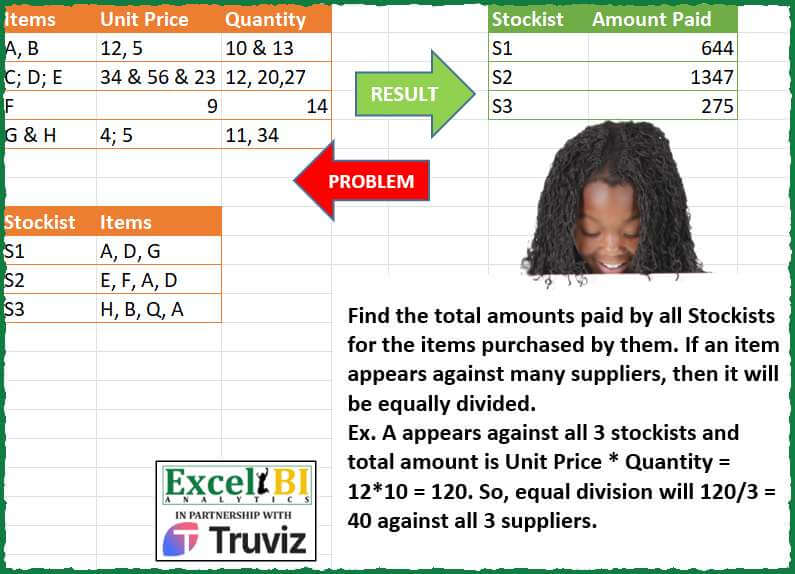
Find the total amounts paid by all Stockists for the items purchased by them. If an item appears against many suppliers, then it will be equally divided. Ex. A appears against all 3 stockists and total amount is Unit Price * Quantity = 12*10 = 120. So, equal division will 120/3 = 40 against all 3 suppliers.
📌 Challenge Details and Links
ExcelBI Power Query Challenge Number: 195
Challenge Difficulty: ⭐️⭐️⭐️⭐️⭐️
📥Download Sample File
📥Link to the solutions on LinkedIn
Solving the challenge of Shared Item Billing Per Supplier with Power Query
Power Query solution 1 for Shared Item Billing Per Supplier, proposed by Zoran Milokanović:
let
  Source = each Excel.CurrentWorkbook(){[Name = _]}[Content],
  T1 = Source("Items"),
  T2 = Table.TransformColumns(Source("Stockists"), {"Items", each Text.Split(_, ", ")}),
  S = Table.RemoveColumns(
    Table.AddColumn(
      T2,
      "Amount Paid",
      each List.Sum(
        List.Transform(
          [Items],
          (m) => (
            List.Select(
              List.TransformMany(
                Table.ToRows(
                  Table.ReplaceValue(
                    T1,
                    ";",
                    "&",
                    (x, y, z) =>
                      let
                        r = (a, b, c) => Text.Replace(Text.From(a), b, c)
                      in
                        Text.Split(r(r(r(x, " ", ""), ";", ","), "&", ","), ","),
                    Table.ColumnNames(T1)
                  )
                ),
                List.Zip,
                (i, _) => {_{0}, Expression.Evaluate(_{1} & "*" & _{2})}
              ),
              each _{0} = m
            ){0}?{1}?
              ?? 0
          )
            / List.Count(List.PositionOf(List.Combine(T2[Items]), m, 2))
        )
      )
    ),
    "Items"
  )
in
  S
Power Query solution 2 for Shared Item Billing Per Supplier, proposed by Zoran Milokanović:
Power Query solution 3 for Shared Item Billing Per Supplier, proposed by Kris Jaganah:
let
  T1 = Excel.CurrentWorkbook(){[Name = "Table1"]}[Content],
  T2 = Excel.CurrentWorkbook(){[Name = "Table2"]}[Content],
  Unpv = Table.UnpivotOtherColumns(T1, {}, "A", "V"),
  Sp = Table.ExpandListColumn(
    Table.TransformColumns(
      Unpv,
      {
        "V",
        each
          let
            a = Text.From(_),
            b = Splitter.SplitTextByAnyDelimiter({", ", "; ", "& ", ","})(a)
          in
            List.Transform(b, Text.Trim)
      }
    ),
    "V"
  ),
  St = Table.Sort(Sp, {"A", 0}),
  Id = Table.AddIndexColumn(St, "Ide", 1, 1),
  Idx = Table.TransformColumns(
    Id,
    {
      "Ide",
      each
        let
          a = List.Count(St[A]) / List.Count(List.Distinct(St[A])),
          b = Number.Mod(_, a)
        in
          if b = 0 then a else b
    }
  ),
  Piv = Table.Pivot(Idx, List.Distinct(Idx[A]), "A", "V"),
  Occ = Table.AddColumn(
    Piv,
    "Occ",
    each
      let
        a = [Items],
        b = List.Count(
          List.Select(List.Combine(List.Transform(T2[Items], each Text.Split(_, ", "))), each _ = a)
        ),
        c = if b = 0 then null else 1 / b * (Number.From([Quantity]) * Number.From([Unit Price]))
      in
        c
  ),
  ST2 = Table.ExpandListColumn(
    Table.TransformColumns(T2, {"Items", Splitter.SplitTextByDelimiter(", ")}),
    "Items"
  ),
  Sol = Table.AddColumn(
    ST2,
    "Ans",
    each List.Sum(Table.SelectRows(Occ, (x) => x[Items] = [Items])[Occ])
  ),
  Grp = Table.Group(Sol, {"Stockist"}, {"Amount Paid", each List.Sum([Ans])})
in
  Grp
Power Query solution 4 for Shared Item Billing Per Supplier, proposed by Alejandro Simón 🇵🇦 🇪🇸:
let
  Source = Excel.CurrentWorkbook(){[Name = "Table1"]}[Content],
  Trans = Table.TransformColumns(
    Source,
    List.Transform(
      Table.ColumnNames(Source),
      each {_, each List.Select(Text.SplitAny(Text.From(_), ", ;&"), each _ <> "")}
    )
  ),
  Tbl = Table.AddColumn(
    Table.Combine(
      Table.AddColumn(
        Trans,
        "A",
        each Table.FromRows(List.Zip(Record.ToList(_)), Table.ColumnNames(Source))
      )[A]
    ),
    "Total",
    each Number.From([Unit Price]) * Number.From([Quantity])
  ),
  Tbl2 = Excel.CurrentWorkbook(){[Name = "Table2"]}[Content],
  Items = Table.FromColumns({List.Combine(List.Transform(Tbl2[Items], each Text.Split(_, ", ")))}),
  Group = Table.Group(Items, {"Column1"}, {{"Count", each Table.RowCount(_)}}),
  Calc = Table.AddColumn(
    Group,
    "B",
    (x) => Table.SelectRows(Tbl, each [Items] = x[Column1])[Total]{0}? / x[Count]
  ),
  Sol = Table.RemoveColumns(
    Table.AddColumn(
      Tbl2,
      "Amount Paid",
      (x) =>
        let
          a = Calc,
          b = Text.Split(x[Items], ", "),
          c = List.Transform(b, each Table.SelectRows(a, (y) => y[Column1] = _)[B]{0})
        in
          List.Sum(c)
    ),
    {"Items"}
  )
in
  Sol
Power Query solution 5 for Shared Item Billing Per Supplier, proposed by Luan Rodrigues:
let
  Fonte = Tabela1,
  add = Table.AddColumn(
    Fonte,
    "tab",
    each
      let
        a = Record.FieldValues(_),
        b = Text.Combine(
          List.Distinct(
            List.TransformMany(
              a,
              (x) => Text.ToList(Text.Remove(Text.From(x), {"0" .. "9", "A" .. "Z", " "})),
              (a, b) => b
            )
          )
        ),
        c = List.Transform(a, (x) => Text.SplitAny(Text.From(x), b)),
        d = Table.FromRows(
          List.Transform(
            {0 .. List.Count(List.Transform(c{0}, each _)) - 1},
            (x) => List.Transform(c, (w) => w{x})
          )
        )
      in
        d
  )[tab],
  tab = Table.TransformColumns(Table.Combine(add), {}, Text.Trim),
  mlt = Table.AddColumn(
    tab,
    "mult",
    each List.Product(List.Transform(List.RemoveFirstN(Record.FieldValues(_)), Number.From))
  ),
  t2 =
    let
      b = Table.TransformColumns(Tabela2, {"Items", each Text.Split(_, ",")}),
      c = Table.TransformColumns(Table.ExpandListColumn(b, "Items"), {}, Text.Trim),
      d = Table.Group(
        c,
        {"Items"},
        {{"count", each Table.RowCount(_)}, {"Stockist", each _[Stockist]}}
      ),
      e = Table.ExpandListColumn(d, "Stockist")
    in
      e,
  cnt = Table.Join(t2, {"Items"}, mlt, {"Column1"})[[Stockist], [Items], [mult], [count]],
  div = Table.AddColumn(cnt, "div", each [mult] / [count]),
  res = Table.Group(div, {"Stockist"}, {{"Amount Paid", each List.Sum([div]), type number}})
in
  res
Power Query solution 6 for Shared Item Billing Per Supplier, proposed by Ramiro Ayala Chávez:
let
  t1 = Excel.CurrentWorkbook(){[Name = "Table1"]}[Content],
  t2 = Excel.CurrentWorkbook(){[Name = "Table2"]}[Content],
  TA = Table.AddColumn,
  TT = Table.TransformColumnTypes,
  TC = Table.TransformColumns,
  a = TT(t1, {{"Items", type text}, {"Unit Price", type text}, {"Quantity", type text}}),
  b = TC(a, {}, each Text.SplitAny(_, ",;&")),
  c = TA(b, "T", each Table.FromColumns({[Items], [Unit Price], [Quantity]}))[[T]],
  d = TC(Table.Combine(c[T]), {}, each Text.Trim(_)),
  e = TT(d, {{"Column2", Int64.Type}, {"Column3", Int64.Type}}),
  f = TA(e, "P", each [Column2] * [Column3])[[Column1], [P]],
  g = TC(t2, {"Items", each Text.Split(_, ", ")}),
  h = TA(
    Table.ExpandListColumn(g, "Items"),
    "P",
    each try f[P]{List.PositionOf(f[Column1], [Items])} otherwise 0
  ),
  i = Table.Group(h, {"Items"}, {"G", each Table.RowCount(_)}),
  j = TA(h, "Q", each i[G]{List.PositionOf(i[Items], [Items])}),
  k = TA(j, "R", each [P] / [Q])[[Stockist], [Items], [R]],
  Sol = Table.Group(k, {"Stockist"}, {"Amount Paid", each List.Sum([R])})
in
  Sol
Power Query solution 7 for Shared Item Billing Per Supplier, proposed by Rafael González B.:
let
 Items_T =  let
 A = Excel.CurrentWorkbook(){0}[Content],
 TC = Table.TransformColumnTypes(A,{{"Items", type text}, {"Unit Price", type text}, {"Quantity", type text}}),
 L = {", "," & ","; ", ","},
 B = List.Accumulate(
 {0..3},
 TC,
 (s,c) => Table.ReplaceValue(s,L{c},"|", Replacer.ReplaceText,Table.ColumnNames(TC))
 )
 in
 B,
 Items_A = Table.Combine(Table.AddColumn(Items_T, "Amount", each
 let
 TS = Text.Split,
 a = TS([Items], "|"),
 b = TS([Unit Price], "|"),
 c = TS([Quantity], "|"),
 d = List.Zip({a,b,c}),
 e = List.Transform(d, each {_{0}} & {Number.From(_{1}) * Number.From(_{2})}),
 f = Table.FromRows(e),
 g = Table.AddColumn(f, "Amount_Ad", each
 [Column2] / List.Count(List.PositionOf(Stock_A[c], [Column1],2)))
 in
 g
 )[Amount])[[Column1], [Amount_Ad]],
Power Query solution 8 for Shared Item Billing Per Supplier, proposed by Rafael González B.:
Part 2/2:
 Stock_A = [
 b = Table.ExpandListColumn(Table.TransformColumns(a, {{"Items", Splitter.SplitTextByDelimiter(", ")}}), "Items"),
 c = b[Items]
 ],
 Nested = Table.Join(Stock_A[b],{"Items"}, Items_A, {"Column1"}, 1),
 Result = Table.Group(Nested, {"Stockist"}, {{"Amount Paid", each List.Sum([Amount_Ad]), type nullable number}})

in
 Result
Power Query solution 9 for Shared Item Billing Per Supplier, proposed by Peter Tholstrup:
let
  source_items = Excel.CurrentWorkbook(){[Name = "Table1"]}[Content],
  source_stocklists = Excel.CurrentWorkbook(){[Name = "Table2"]}[Content],
  lt = List.Transform,
  transform = (l) =>
    lt(
      List.Combine(lt(l, each lt(Text.SplitAny(Text.From(_), ",;&"), Text.Trim))),
      each try Number.From(_) otherwise _
    ),
  stocklists = [
    group  = Table.Group(source_stocklists, {"Stockist"}, {"Items", each transform([Items])}),
    expand = Table.ExpandListColumn(group, "Items")
  ][expand],
  items = [
    items     = transform(source_items[Items]),
    price     = transform(source_items[Unit Price]),
    qty       = transform(source_items[Quantity]),
    get_count = (i) => List.Count(List.Select(stocklists[Items], each _ = i)),
    amount    = lt(List.Zip({price, qty, lt(items, get_count)}), each _{0} * _{1} / _{2}),
    to_table  = Table.FromColumns({items, amount}, {"Items", "Amount Paid"})
  ][to_table],
  join = Table.Join(stocklists, "Items", items, "Items"),
  result = Table.Group(join, {"Stockist"}, {"Amount Paid", each List.Sum([Amount Paid])})
in
  result
Power Query solution 10 for Shared Item Billing Per Supplier, proposed by Yaroslav Drohomyretskyi:
let
  Джерело = Excel.CurrentWorkbook(){[Name = "Items"]}[Content],
  T = Table.Transpose(Джерело),
  I = Table.TransformColumns(
    Table.TransformColumnTypes(
      Table.Transpose(
        Table.SplitColumn(
          Table.CombineColumns(
            Table.TransformColumnTypes(T, List.Transform(Table.ColumnNames(T), each {_, type text})),
            Table.ColumnNames(
              Table.TransformColumnTypes(
                T,
                List.Transform(Table.ColumnNames(T), each {_, type text})
              )
            ),
            Combiner.CombineTextByDelimiter(",", QuoteStyle.None),
            "Combine"
          ),
          "Combine",
          Splitter.SplitTextByAnyDelimiter({";", "&", ","}, QuoteStyle.Csv)
        )
      ),
      {{"Column3", Int64.Type}, {"Column2", Int64.Type}}
    ),
    {{"Column1", Text.Trim, type text}}
  ),
  S = Table.ExpandListColumn(
    Table.TransformColumns(
      Excel.CurrentWorkbook(){[Name = "Stocklist"]}[Content],
      {{"Items", Splitter.SplitTextByDelimiter(", ", QuoteStyle.Csv)}}
    ),
    "Items"
  ),
  C = Table.Group(S, {"Items"}, {{"C", each Table.RowCount(_), Int64.Type}}),
  A = Table.AddColumn(
    Table.ExpandTableColumn(
      Table.NestedJoin(
        Table.ExpandTableColumn(
          Table.NestedJoin(S, {"Items"}, I, {"Column1"}, "i", JoinKind.LeftOuter),
          "i",
          {"Column2", "Column3"},
          {"P", "Q"}
        ),
        {"Items"},
        C,
        {"Items"},
        "x",
        JoinKind.LeftOuter
      ),
      "x",
      {"C"},
      {"C"}
    ),
    "Amount Paid",
    each [P] * [Q] / [C]
  ),
  G = Table.Group(A, {"Stockist"}, {{"Amount Paid", each List.Sum([Amount Paid])}})
in
  G
Power Query solution 11 for Shared Item Billing Per Supplier, proposed by Arnaud Duvernois:
let
 Source = Excel.CurrentWorkbook(){[Name="tCorresp"]}[Content],
 Split = Table.ExpandListColumn(Table.TransformColumns(Source, {"Items" , each Text.Split(_,", ")}) ,"Items")
in
 Split
let
 Source = Excel.CurrentWorkbook(){[Name="tSource"]}[Content],
 Split = Table.TransformColumns(Source,{}, each List.Select(Text.SplitAny(Text.From(_),",&; "),each _ <>"")),
 Combine = Table.Combine(List.Transform(Table.ToRows(Split) , each Table.FromColumns(_,Table.ColumnNames(Source)))),
 AddAmount = Table.AddColumn(Combine, "Amount Paid", each let a = Number.From([Unit Price])*Number.From([Quantity]), b=Table.RowCount(Table.SelectRows(tCorresp, (x)=> x[Items] = [Items])) in if b = 0 then 0 else a/b ),
 Join = Table.NestedJoin(AddAmount, {"Items"}, tCorresp, {"Items"}, "tCorresp", JoinKind.Inner),
 Expand = Table.ExpandTableColumn(Join, "tCorresp", {"Stockist"}, {"Stockist"}),
 Group = Table.Group(Expand, {"Stockist"}, {{"Amount Paid", each List.Sum([Amount Paid]), type number}})
in
 Group
Solving the challenge of Shared Item Billing Per Supplier with Excel
Excel solution 1 for Shared Item Billing Per Supplier, proposed by Bo Rydobon 🇹🇭:
=LET(s,
    LAMBDA(
        x,
        REGEXEXTRACT(
            ARRAYTOTEXT(
                x
            ),
            "w+",
            1
        )
    ),
    i,
    B9:B11,
    t,
    TEXTSPLIT(
        ARRAYTOTEXT(
            i
        ),
        ,
        ", "
    ),

HSTACK(A9:A11,
    MAP(i,
    LAMBDA(x,
    LET(v,
    TEXTSPLIT(
        x,
        ,
        ", "
    ),
    SUM((v=s(
        A2:A5
    ))*s(
        B2:B5
    )*s(
        C2:C5
    )/LOOKUP(
        v,
        GROUPBY(
            t,
            t,
            ROWS
        )
    )))))))
Excel solution 2 for Shared Item Billing Per Supplier, proposed by Bo Rydobon 🇹🇭:
=LET(d,
    DROP(
        REDUCE(
            0,
            BYCOL(
                A2:C5,
                ARRAYTOTEXT
            ),
            LAMBDA(
                a,
                v,
                HSTACK(
                    a,
                    TOCOL(
                        REGEXEXTRACT(
                            v,
                            "w+",
                            1
                        )
                    )
                )
            )
        ),
        ,
        1
    ),

i,
    B9:B11,
    t,
    TEXTSPLIT(
        ARRAYTOTEXT(
            i
        ),
        ,
        ", "
    ),
    g,
    GROUPBY(
        t,
        t,
        ROWS,
        ,
        0
    ),

HSTACK(A9:A11,
    MAP(i,
    LAMBDA(a,
    LET(b,
    TEXTSPLIT(
        a,
        ", "
    ),
    SUM((b=TAKE(
        d,
        ,
        1
    ))*INDEX(
        d,
        ,
        2
    )*INDEX(
        d,
        ,
        3
    )/LOOKUP(
        b,
        g
    )))))))
Excel solution 3 for Shared Item Billing Per Supplier, proposed by Kris Jaganah:
=LET(
    p,
    REDUCE(
        "",
        BYROW(
            A2:C5,
            ARRAYTOTEXT
        ),
        LAMBDA(
            x,
            y,
            VSTACK(
                x,
                LET(
                    a,
                    TOCOL(
                        REGEXEXTRACT(
                            y,
                            "[A-Z]+",
                            1
                        )
                    ),
                    b,
                    REGEXEXTRACT(
                        y,
                        "[0-9]+",
                        1
              &      ),
                    HSTACK(
                        a,
                        BYROW(
                            WRAPCOLS(
                                --b,
                                COLUMNS(
                                    b
                                )/2
                            ),
                            PRODUCT
                        )
                    )
                )
            )
        )
    ),
    q,
    DROP(
        REDUCE(
            "",
            B9:B11,
            LAMBDA(
                v,
                w,
                VSTACK(
                    v,
                    TEXTSPLIT(
                        w,
                        ", "
                    )
                )
            )
        ),
        1
    ),
    r,
    TOCOL(
        q,
        3
    ),
    s,
    GROUPBY(
        r,
        r,
        COUNTA
    ),
    VSTACK(
        {"Stockist",
        "Amount Paid"},
        HSTACK(
            A9:A11,
            BYROW(
                IFNA(
                    VLOOKUP(
                        q,
                        p,
                        2,
                        0
                    )/VLOOKUP(
                        q,
                        s,
                        2,
                        0
                    ),
                    0
                ),
                SUM
            )
        )
    )
)
Excel solution 4 for Shared Item Billing Per Supplier, proposed by Julian Poeltl:
=LET(
    T,
    A2:C5,
    TT,
    A9:B11,
    I,
    TAKE(
        T,
        ,
        1
    ),
    P,
    CHOOSECOLS(
        T,
        2
    ),
    Q,
    TAKE(
        T,
        ,
        -1
    ),
    IT,
    TAKE(
        TT,
        ,
        -1
    ),
    SP,
    LAMBDA(
        A,
        TRIM(
            TEXTSPLIT(
                TEXTJOIN(
                    ",",
                    ,
                    A
                ),
                {",",
                ";",
                "&"}
            )
        )
    ),
    II,
    SP(
        I
    ),
    UP,
    SP(
        P
    ),
    QQ,
    SP(
        Q
    ),
    ITT,
    SP(
        IT
    ),
    QI,
    UP*QQ/MAP(
        II,
        LAMBDA(
            A,
            COUNTA(
                FILTER(
                    ITT,
                    ITT=A
                )
            )
        )
    ),
    VSTACK(
        HSTACK(
            "Stockist",
            "Amount Paid"
        ),
        HSTACK(
            TAKE(
                TT,
                ,
                1
            ),
            MAP(
                IT,
                LAMBDA(
                    A,
                    SUM(
                        XLOOKUP(
                            SP(
                                A
                            ),
                            II,
                            QI,
                            0
                        )
                    )
                )
            )
        )
    )
)
Excel solution 5 for Shared Item Billing Per Supplier, proposed by Oscar Mendez Roca Farell:
=LET(
    t,
     TRIM(
         TEXTSPLIT(
             CONCAT(
                 A2:A5&","
             )&"|"&CONCAT(
                 B2:B5&","
             )&"|"&CONCAT(
                 C2:C5&","
             ),
              {",",
              ";",
              "&"},
              "|",
              1
         )
     ),
     f,
     FIND(
         TAKE(
             t,
              1
         ),
         B9:B11
     ),
     HSTACK(
         A9:A11,
          BYROW(
              IF(
                  f,
                   INDEX(
                       t,
                        2,

                   )*INDEX(
                       t,
                        3,

                   )/BYCOL(
                       f,
                        LAMBDA(
                            c,
                             COUNT(
                                 c
                             )
                        )
                   )
              ),
               LAMBDA(
                   r,
                    SUM(
                        TOCOL(
                            r,
                             2
                        )
                    )
               )
          )
     )
)
Excel solution 6 for Shared Item Billing Per Supplier, proposed by Duy Tùng:
=LET(
    f,
    LAMBDA(
        v,
        TOCOL(
            TEXTSPLIT(
                TEXTJOIN(
                    "/",
                    ,
                    v
                ),
                {",",
                " ",
                ";",
                "&"},
                "/",
                1
            ),
            3
        )
    ),
    a,
    B9:B11,
    b,
    f(
        A2:A5
    ),
    HSTACK(
        A9:A11,
        MAP(
            a,
            LAMBDA(
                s,
                SUM(
                    REGEXTEST(
                        s,
                        b
                    )*IFERROR(
                        f(
                            B2:B5
                        )*f(
                            C2:C5
                        )/BYROW(
                            N(
                                b=TOROW(
                                    f(
                                        a
                                    )
                                )
                            ),
                            SUM
                        ),
                        0
                    )
                )
            )
        )
    )
)
Solving the challenge of Shared Item Billing Per Supplier with Python
Python solution 1 for Shared Item Billing Per Supplier, proposed by Konrad Gryczan, PhD:
import pandas as pd
import re
def split_string(s):
 return re.split(r"W+", str(s))
path = "PQ_Challenge_195.xlsx"
input1 = pd.read_excel(path, usecols="A:C", nrows=5)
input2 = pd.read_excel(path, usecols="A:B", skiprows=7, nrows=3)
test = pd.read_excel(path, usecols="F:G", nrows=3)
input1 = pd.concat([input1[col].apply(split_string).explode().reset_index(drop=True) for col in input1.columns], axis=1)
input2["Items"] = input2["Items"].apply(split_string)
input2 = pd.DataFrame(input2["Items"].explode()).
 merge(input2, left_index=True, right_index=True).
 drop(columns=["Items_y"]).rename(columns={"Items_x": "Items"})
input2["Stockist_no"] = input2.groupby("Items")["Stockist"].transform("count")
input2 = pd.merge(input1, input2, on="Items", how="right").dropna().reset_index(drop=True)
input2["Amount Paid"] = (input2["Unit Price"].astype(int) * input2["Quantity"].astype(int)) / input2["Stockist_no"]
input2["Amount Paid"] = input2["Amount Paid"].astype("int64")
result = input2.groupby("Stockist")["Amount Paid"].sum().reset_index()
print(result.equals(test)) # True
Solving the challenge of Shared Item Billing Per Supplier with Python in Excel
Python in Excel solution 1 for Shared Item Billing Per Supplier, proposed by Abdallah Ally:
import pandas as pd
# Function to clean and split text into alphanumeric words
def clean_split(text):
 for char in text:
 if not char.isalpha() and not char.isdigit():
 text = text.replace(char, ' ')
 return text.split()
file_path = 'PQ_Challenge_195.xlsx'
df1 = pd.read_excel(file_path, usecols='A:C', nrows=4).astype(str)
df2 = pd.read_excel(file_path, usecols='A:B', skiprows=7)
# Perform data wrangling
df2['Items'] = df2['Items'].map(lambda x: x.split(', '))
df2 = df2.explode(column='Items', ignore_index=True)
df2['Count'] = df2.groupby('Items').transform('count')
# Apply clean_split function to each column in df1
for col in df1.columns:
 df1[col] = df1[col].map(clean_split)
df1 = df1.explode(column=['Items', 'Unit Price', 'Quantity'], ignore_index=True)
df = df2.merge(df1)
df[df.columns[2: ]] = df[df.columns[2: ]].astype(int)
df['Amount Paid'] = df.apply(lambda x: x[3] * x[4] /x[2], axis=1).astype(int)
df = df.groupby('Stockist')['Amount Paid'].sum().reset_index()
df
Solving the challenge of Shared Item Billing Per Supplier with R
R solution 1 for Shared Item Billing Per Supplier, proposed by Konrad Gryczan, PhD:
Not short, but concise, verbatim and "pipy" way.
library(tidyverse)
library(readxl)
path = "Power Query/PQ_Challenge_195.xlsx"
input1 = read_xlsx(path, range = "A1:C5")
input2 = read_xlsx(path, range = "A8:B11")
test = read_xlsx(path, range = "F1:G4")
result1 = input1 %>%
 mutate(across(everything(), ~str_split(.x, "\W+"))) %>%
 unnest(cols = everything()) %>%
 mutate(total = as.numeric(`Unit Price`) * as.numeric(Quantity)) %>%
 select(Items, total)
result2 = input2 %>%
 mutate(across(everything(), ~str_split(.x, "\W+"))) %>%
 unnest(cols = everything()) %>%
 mutate(part = n(), .by = Items)
result = result2 %>%
 left_join(result1, by = "Items") %>%
 mutate(paid_by_stockist = total/part) %>%
 summarise(`Amount Paid` = sum(paid_by_stockist, na.rm = T), .by = Stockist)
identical(result, test)
# [1] TRUE
R solution 2 for Shared Item Billing Per Supplier, proposed by Anil Kumar Goyal:
library(readxl)
library(tidyverse)
items <- read_excel("PQ/PQ_Challenge_195.xlsx", range = "A1:C5") %>%
 janitor::clean_names()
stocks <- read_excel("PQ/PQ_Challenge_195.xlsx", range = "A8:B11")
stocks %>%
 separate_rows(Items) %>%
 inner_join(
 items %>%
 separate_rows(items, unit_price, quantity, convert = TRUE),
 by = join_by(Items == items)
 ) %>%
 mutate(amt_paid = unit_price * quantity / n_distinct(Stockist),
 .by = Items) %>%
 summarise(amt_paid = sum(amt_paid),
 .by = Stockist)
&&