
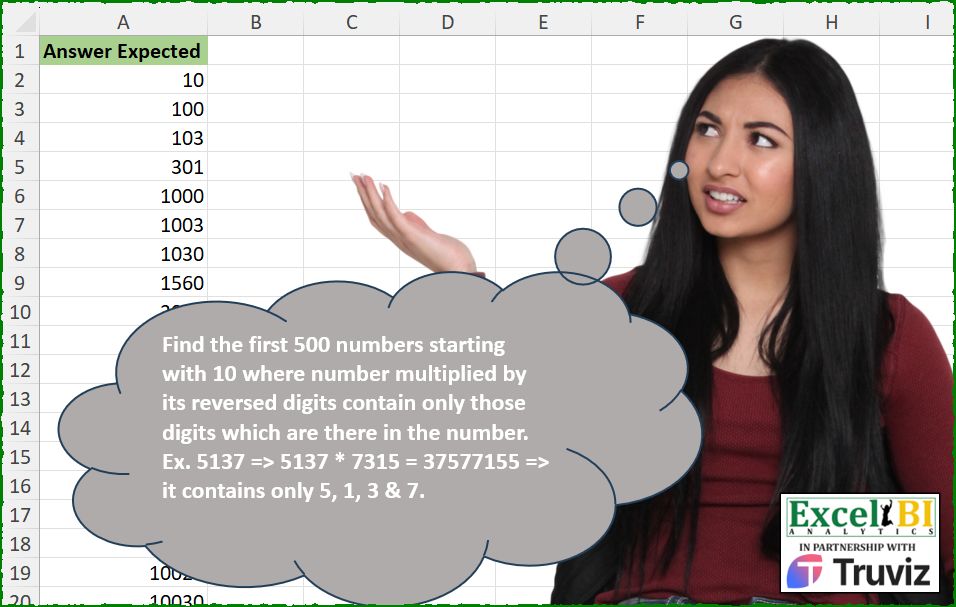
Find the first 500 numbers starting with 10 where number multiplied by its reversed digits contain only those digits which are there in the number. Ex. 5137 => 5137 * 7315 = 37577155 => it contains only 5, 1, 3 & 7.
📌 Challenge Details and Links
ExcelBI Excel Challenge Number: 571
Challenge Difficulty: ⭐️⭐️⭐️
📥Download Sample File
📥Link to the solutions on LinkedIn
Solving the challenge of Digit-Constrained Product Numbers with Power Query
Power Query solution 1 for Digit-Constrained Product Numbers, proposed by Kris Jaganah:
let
  A = Table.FromColumns(
    {
      List.RemoveNulls(
        List.Transform(
          {10 .. 1000156},
          each
            let
              a = Text.From(_),
              b = Text.Reverse(a),
              c = Number.From(b) * _,
              d = Text.Combine(List.Sort(List.Distinct(Text.ToList(Text.From(c))))),
              e = Text.Combine(List.Sort(List.Distinct(Text.ToList(a)))),
              f = if d = e then _ else null
            in
              f
        )
      )
    },
    {"Answer Expected"}
  )
in
  A
Power Query solution 2 for Digit-Constrained Product Numbers, proposed by Alejandro Simón 🇵🇦 🇪🇸:
let
  Source = List.Transform(
    List.Select(
      List.Skip(
        List.Generate(
          () => [x = 9, y = 0],
          each [y] <= 500,
          each [
            x = [x] + 1,
            z = x * Number.From(Text.Reverse(Text.From(x))),
            k = List.Sort(List.Distinct(Text.ToList(Text.From(x))))
              = List.Sort(List.Distinct(Text.ToList(Text.From(z)))),
            y = if k then [y] + 1 else [y]
          ],
          each Record.ToList([[x], [k]])
        )
      ),
      each _{1} = true
    ),
    each _{0}
  )
in
  Source
Power Query solution 3 for Digit-Constrained Product Numbers, proposed by Abdallah Ally:
let
  Generator = (n) =>
    [
      f = (x, y) => List.ContainsAll(Text.ToList(x), Text.ToList(y)),
      a = Text.From(n),
      b = Text.From(n * Number.From(Text.Reverse(a))),
      c = f(a, b) and f(b, a)
    ][c],
  Result = List.RemoveNulls(
    List.Generate(
      () => [num = 9, cond = Generator(num), counter = 0],
      each [counter] <= 500,
      each [num = [num] + 1, cond = Generator(num), counter = [counter] + Byte.From(cond)],
      each if [cond] then [num] else null
    )
  )
in
  Result
Power Query solution 4 for Digit-Constrained Product Numbers, proposed by Abdallah Ally:
let
  Generator = (n) =>
    [
      f = each List.Distinct(List.Sort(Text.ToList(_))),
      a = Text.From(n),
      b = Text.From(n * Number.From(Text.Reverse(a))),
      c = f(a) = f(b)
    ][c],
  Result = List.RemoveNulls(
    List.Generate(
      () => [num = 9, cond = Generator(num), counter = 0],
      each [counter] <= 500,
      each [num = [num] + 1, cond = Generator(num), counter = [counter] + Byte.From(cond)],
      each if [cond] then [num] else null
    )
  )
in
  Result
Power Query solution 5 for Digit-Constrained Product Numbers, proposed by Tyler N.:
let
  a = {2 .. 457000},
  b = List.Transform(
    a,
    each
      let
        c = Text.From(_),
        d = {Text.ToList(Text.From(_ * Number.From(Text.Reverse(c)))), Text.ToList(c)},
        e = Int8.From(List.Transform({0, 1}, each List.RemoveItems(d{_}, d{1 - _})) = {{}, {}})
      in
        e * _
  )
in
  List.RemoveItems(b, {0})
Solving the challenge of Digit-Constrained Product Numbers with Excel
Excel solution 1 for Digit-Constrained Product Numbers, proposed by Bo Rydobon 🇹🇭:
=TOCOL(
    MAP(
        SEQUENCE(
            2^20,
            ,
            10
        ),
        LAMBDA(
            n,
            LET(
                m,
                MID(
                    n,
                    -SORT(
                        -SEQUENCE(
                            LEN(
                                n
                            )
                        )
                    ),
                    1
                ),
                o,
                n*CONCAT(
                    m
                ),
                IFS(
                    AND(
                        SORT(
                            UNIQUE(
                    m
                )
                        )=SORT(
                            UNIQUE(
                                MID(
                                    o,
                                    SEQUENCE(
                                        LEN(
                                            o
                                        )
                                    ),
                                    1
                                )
                            )
                        )
                    ),
                    n
                )
            )
        )
    ),
    3
)
Excel solution 2 for Digit-Constrained Product Numbers, proposed by John V.:
=LET(s,SEQUENCE,n,9+s(10^6+150),f,LAMBDA(x,UNIQUE(SORT(MID(x,s(15),1)))),TOCOL(n/MAP(n,n*BYROW(MID(n,8-s(,7),1),CONCAT),LAMBDA(a,b,AND(f(a)=f(b)))),2))Excel solution 3 for Digit-Constrained Product Numbers, proposed by Kris Jaganah:
=TOCOL(MAP(SEQUENCE(
    10.00025^6,
    ,
    10
),
    LAMBDA(x,
    LET(a,
    LEN(
        x
    ),
    b,
    SEQUENCE,
    c,
    MID(
        x,
        b(
            a,
            ,
            a,
            -1
        ),
        1
    ),
    d,
    CONCAT(
        c
    )*x,
    e,
    MID(
        d,
        b(
            LEN(
                d
            )
        ),
        1
    ),
    x/(MIN(--IFNA((SORT(
        UNIQUE(
        c
    )
    )=SORT(
        UNIQUE(
            e
        )
    )),
    0)))))),
    3)
Excel solution 4 for Digit-Constrained Product Numbers, proposed by Julian Poeltl:
=TAKE(LET(L,
    LAMBDA(A,
    CONCAT((LEN(
        A
    )-LEN(
        SUBSTITUTE(
            A,
            SEQUENCE(
                10,
                ,
                0
            ),
            ""
        )
    ))>0)),
    S,
    SEQUENCE(
        1001000,
        ,
        10
    ),
    R,
    MAP(
        S,
        LAMBDA(
            A,
            CONCAT(
                MID(
                    A,
                    SEQUENCE(
                        LEN(
        A
    ),
                        ,
                        LEN(
        A
    ),
                        -1
                    ),
                    1
                )
            )
        )
    ),
    FILTER(
        S,
        MAP(
            S,
            R*S,
            LAMBDA(
                A,
                B,
                L(
        A
    )=L(
        B
    )
            )
        )
    )),
    500)
Excel solution 5 for Digit-Constrained Product Numbers, proposed by Alejandro Campos:
=LET(
 tInicial, NOW(),
 array, LET(
 sq, SEQUENCE(1000150, , 10),
 rev, MAP(sq, LAMBDA(x, --CONCAT(MID(x, LEN(x) + 1 - SEQUENCE(, LEN(x)), 1)))),
 prd, BYROW(HSTACK(sq, rev), PRODUCT),
 VerFal, MAP(
 sq,
 prd,
 LAMBDA(x, y,
 LET(
 num, CONCAT(SORT(UNIQUE(MID(x, SEQUENCE(LEN(x)), 1)))),
 rvrs, CONCAT(SORT(UNIQUE(MID(y, SEQUENCE(LEN(y)), 1)))),
 AND(num = rvrs)))),
 FILTER(sq, VerFal)),
 VSTACK(TEXT(NOW() - tInicial, "[s],000s"), array))
Excel solution 6 for Digit-Constrained Product Numbers, proposed by Timothée BLIOT:
=LET(S,SEQUENCE(10^6+200,,10),R,MAP(S,LAMBDA(x,CONCAT(MID(x,LEN(x)+1-SEQUENCE(LEN(x)),1))))*S,F,LAMBDA(n,CONCAT(SORT(UNIQUE( MID(n,SEQUENCE(LEN(n)),1))))),FILTER(S,MAP(S,R,LAMBDA(x,y, F(x)=F(y)))))Excel solution 7 for Digit-Constrained Product Numbers, proposed by Md. Zohurul Islam:
=LET(

     P,
     MAP(

          SEQUENCE(
              10 ^ 6,
               ,
               10,
               1
          ),

          LAMBDA(
              x,

               LET(

                    z,
                    LEN(
                        x
                    ),

                    a,
                    ABS(
                        MID(
                            x,
                             SEQUENCE(
                                 z
                             ),
                             1
                        )
                    ),

                    rev,
                    CONCAT(
                        ABS(
                            MID(
                                x,
                                 z - SEQUENCE(
                                 z
                             ) + 1,
                                 1
                            )
                        )
                    ),

                    prd,
                    x * rev,

                    b,
                    ABS(
                        MID(
                            prd,
                             SEQUENCE(
                                 LEN(
                                     prd
                                 )
                             ),
                             1
                        )
                    ),

                    _c1,
                    IFERROR(
                        XMATCH(
                            a,
                             b
                        ),
                         0
                    ),

                    _c2,
                    IFERROR(
                        XMATCH(
                            b,
                             a
                        ),
                         0
                    ),

                    d,
                    IF(
                        AND(
                            _c1 <> 0,
                             _c2 <> 0
                        ),
                         x,
                         0
                    ),

                    d

               )

          )

     ),

     Q,
     FILTER(
         P,
          P > 0
     ),

     Q

)
Excel solution 8 for Digit-Constrained Product Numbers, proposed by Hamidi Hamid:
=LET(sq,
    SEQUENCE(
        1001^2,
        ,
        10,
        1
    ),
    t,
    sq,
    p,
    BYROW(
        MID(
            sq,
            SEQUENCE(
                ,
                15
            ),
            1
        ),
        LAMBDA(
            a,
            CONCAT(
                UNIQUE(
                    SORT(
                        a,
                        ,
                        1,
                        -1
                    ),
                    1
                )
            )
        )
    ),
    q,
    BYROW(
        SORTBY(
            MID(
            sq,
            SEQUENCE(
                ,
                15
            ),
            1
        ),
            SEQUENCE(
                ,
                15,
                15,
                -1
            )
        ),
        LAMBDA(
            a,
            CONCAT(
                UNIQUE(
                    SORT(
                        a,
                        ,
                        1,
                        -1
                    ),
                    1
                )
            )
        )
    ),
    s,
    BYROW(
        BYROW(
            SORTBY(
            MID(
            sq,
            SEQUENCE(
                ,
                15
            ),
            1
        ),
            SEQUENCE(
                ,
                15,
                15,
                -1
            )
        ),
            CONCAT
        )*sq,
        LAMBDA(
            a,
            CONCAT(
                SORT(
                    UNIQUE(
                        MID(
                            a,
                            SEQUENCE(
                ,
                15
            ),
                            1
                        ),
                        1
                    ),
                    1,
                    1,
                    1
                )
            )
        )
    ),
    r,
    IFERROR(FILTER(t,
    (p*1=s*1)*(s=q)),
    ""),
    IF(
        SEQUENCE(
            520
        )>500,
        "",
        r
    ))
Excel solution 9 for Digit-Constrained Product Numbers, proposed by Edwin Tisnado:
=TOCOL(SEQUENCE(10^6+150,,10)/MAP(SEQUENCE(10^6+150,,10),LAMBDA(x,LET(l,LEN,s,SEQUENCE,i,x*CONCAT(MID(x,s(l(x),,l(x),-1),1)),j,SORT(UNIQUE(MID(i,s(l(i)),1))),AND(j=SORT(UNIQUE(MID(x,s(l(x)),1))))))),2)Excel solution 10 for Digit-Constrained Product Numbers, proposed by RIJESH T.:
=LET(list,SEQUENCE(1000156,,10),
rev,MAP(list,LAMBDA(a,CONCAT(MID(a,SORT(SEQUENCE(LEN(a)),,-1),1)))),
mut,rev*list,
FILTER(list,MAP(list,LAMBDA(b,CONCAT(UNIQUE(SORT(MID(b,SEQUENCE(LEN(b)),1))))))=
MAP(mut,LAMBDA(b,CONCAT(UNIQUE(SORT(MID(b,SEQUENCE(LEN(b)),1))))))))
Solving the challenge of Digit-Constrained Product Numbers with Python
Python solution 1 for Digit-Constrained Product Numbers, proposed by Konrad Gryczan, PhD:
import pandas as pd
path = "571 Product of Number and its revese.xlsx"
input = pd.read_excel(path)
result = [n for n in range(10, 1200000) if set(str(n)) == set(str(int(str(n)[::-1]) * n))][:500]
print(input["Answer Expected"].equals(pd.Series(result)))   # True
Python solution 2 for Digit-Constrained Product Numbers, proposed by Anshu Bantra:
import itertools as itt
def rev_num(num: int):
 return int(str(num)[::-1])
def set_num(num: int):
 return set([*str(num)])
def some_set():
 for num in range(10, 1004**20):
 if set_num(num*rev_num(num)) == set_num(num):
 yield num
numbers = some_set()
lst = itt.islice(numbers, 500)
lst = [*lst]
lst
Solving the challenge of Digit-Constrained Product Numbers with Python in Excel
Python in Excel solution 1 for Digit-Constrained Product Numbers, proposed by Alejandro Campos:
import time
def is_valid_number(num):
 num_str = str(num)
 reversed_num = int(num_str[::-1])
 product = num * reversed_num
 product_str = str(product)
 if all(digit in num_str for digit in product_str) and all(digit in product_str for digit in num_str):
 return True
 return False
start_time = time.time()
valid_numbers = [num for num in range(10, 1000160) if is_valid_number(num)][:500]
end_time = time.time()
total_time = end_time - start_time
valid_numbers

         &
Python in Excel solution 2 for Digit-Constrained Product Numbers, proposed by Abdallah Ally:
from collections import Counter
from itertools import count, islice
# Create a function to identify required numbers
def meets_criteria(num):
 rev = int(str(num)[::-1]) * num
 k1, k2 = Counter(str(num)), Counter(str(rev))
 return k1.keys() == k2.keys()
# Perform data manipulation
numbers = list(islice(filter(meets_criteria, count(10)), 500))
numbers[490:]
Solving the challenge of Digit-Constrained Product Numbers with R
R solution 1 for Digit-Constrained Product Numbers, proposed by Konrad Gryczan, PhD:
library(tidyverse)
library(readxl)
path = "Excel/571 Product of Number and its revese.xlsx"
test = read_excel(path) %>% unlist() %>% as.integer()
check_number = function(num) {
 get_digits = function(n) {
 digits = integer()
 while (n > 0) {
 digits = c(digits, n %% 10)
 n = n %/% 10
 }
 return(sort(unique(digits)))
 }
 dig_num = get_digits(num)
 rev_num = as.numeric(paste(rev(as.integer(strsplit(as.character(num), "")[[1]])), collapse = ""))
 prod_num = num * rev_num
 dig_prod = get_digits(prod_num)
 return(identical(dig_num, dig_prod))
}
find_numbers = function(limit) {
 results = integer(limit)
 count = 0
 num = 10
 while (count < limit) {
 if (check_number(num)) {
 count = count + 1
 results[count] = num
 }
 num = num + 1
 }
 return(results)
}
result = find_numbers(500)
all.equal(result, test)
# [1] TRUE
&&