
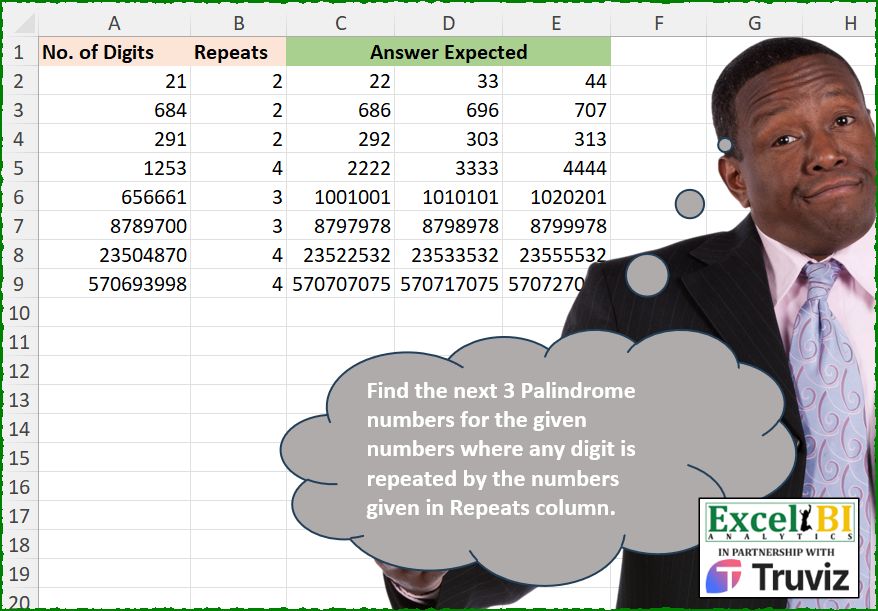
Find the next 3 Palindrome numbers for the given numbers where any digit is repeated by the numbers given in Repeats column. The repetitions need to be exact not at least. So, if 3 is there in repeat column, a digit needs to be repeated by 3 times not at least 3 times.
📌 Challenge Details and Links
ExcelBI Excel Challenge Number: 534
Challenge Difficulty: ⭐️⭐️⭐️
📥Download Sample File
📥Link to the solutions on LinkedIn
Solving the challenge of Next Palindrome with Repeats with Power Query
Power Query solution 1 for Next Palindrome with Repeats, proposed by Aditya Kumar Darak 🇮🇳:
let
  Source = Excel.CurrentWorkbook(){[Name = "data"]}[Content],
  Record = Table.AddColumn(
    Source,
    "R",
    each [
      N = [#"No. of Digits"],
      Rp = [Repeats],
      G = List.Generate(
        () => [a = N, i = false, z = 0],
        (f) => f[z] < 3,
        (f) => [
          a = f[a] + 1,
          b = Text.From(a),
          c = Text.Reverse(b) = b,
          d = Text.ToList(b),
          e = List.Distinct(d),
          g = List.Select(e, (x) => List.Count(Text.PositionOf(b, x, 2)) = Rp),
          h = List.Count(g) > 0,
          i = c and h,
          z = f[z] + Number.From(i)
        ],
        (f) => if f[i] then f[a] else null
      ),
      Rn = List.RemoveNulls(G),
      C = List.Count(G),
      A = Rn & {N + C},
      R = Record.FromList(A, {"N1", "N2", "N3"})
    ][R]
  ),
  Return = Table.ExpandRecordColumn(Record, "R", {"N1", "N2", "N3"})
in
  Return
Solving the challenge of Next Palindrome with Repeats with Excel
Excel solution 1 for Next Palindrome with Repeats, proposed by Bo Rydobon 🇹🇭:
=DROP(REDUCE(0,B2:B9,LAMBDA(a,r,LET(n,@+A9:r,l,LEN(n)/2,VSTACK(a,TAKE(TOROW(MAP(IF(ISODD(r)*ISEVEN(l*2),1&REPT(0,l),
LEFT(n,ROUNDUP(l,)))+SEQUENCE(50)-1,LAMBDA(x,LET(m,MID(x,-SORT(-SEQUENCE(l)),1),c,--CONCAT(x,m),IFS((c>n)*OR(LEN(c)-LEN(SUBSTITUTE(c,m,))=r),c)))),3),,3))))),1)
Excel solution 2 for Next Palindrome with Repeats, proposed by Bo Rydobon 🇹🇭:
=DROP(REDUCE(0,
    B2:B9,
    LAMBDA(a,
    r,
    LET(n,
    @+A9:r,
    l,
    LEN(
        n
    ),

m,
    --IF(rn
        ),
        ,
        3
    )
)))),
    1)
Excel solution 3 for Next Palindrome with Repeats, proposed by Bo Rydobon 🇹🇭:
=DROP(REDUCE(0,B2:B9,LAMBDA(a,r,LET(n,@+A9:r,l,LEN(n),m,--MAP(LEFT(n,MAX(EVEN(l)/2,r/(ISEVEN(r)+1)))+{0,1,2,3},LAMBDA(a,a&CONCAT(MID(a,-SORT(-SEQUENCE(LEN(a)-ISODD(l))),1)))),
VSTACK(a,TAKE(FILTER(m,m>n),,3))))),1)
Excel solution 4 for Next Palindrome with Repeats, proposed by John V.:
=LET(
    z,
    LAMBDA(
        z,
        n,
        r,
        LET(
            l,
            LEN(
                n
            ),
            s,
            SEQUENCE(
                l
            ),
            d,
            -MID(
                n,
                s,
                1
            ),
            IF(
                OR(
                    FREQUENCY(
                        d,
                        d
                    )=r
                )*AND(
                    d=-MID(
                        n,
                        1+l-s,
                        1
                    )
                ),
                n,
                z(
                    z,
                    1+n,
                    r
                )
            )
        )
    ),
    DROP(
        REDUCE(
            A2:A9,
            {1;2;3},
            LAMBDA(
                a,
                v,
                HSTACK(
                    a,
                    MAP(
                        TAKE(
                            a,
                            ,
                            -1
                        ),
                        B2:B9,
                        LAMBDA(
                            x,
                            y,
                            z(
                                z,
                                1+x,
                                y
                            )
                        )
                    )
                )
            )
        ),
        ,
        1
    )
)
Excel solution 5 for Next Palindrome with Repeats, proposed by محمد حلمي:
=DROP(
    REDUCE(
        0,
        B2:B9,
        LAMBDA(
            a,
            v,
            VSTACK(
                a,
                LET(

                    s,
                    @+v:A9+SEQUENCE(
                        ,
                        51000
                    ),
                    TAKE(
                        FILTER(
                            s,
                            MAP(
                                s,

                                LAMBDA(
                                    a,
                                    LET(
                                        i,
                                        LEN(
                                            a
                                        ),
                                        s,
                                        SEQUENCE(
                                            i
                                        ),
                                        e,
                                        MID(
                                            a,
                                            s,
                                            1
                                        ),

                                        AND(
                                            SUM(
                                                N(
                                                    MMULT(
                                                        N(
                                                            e=TOROW(
                                                                e
                                                            )
                                                        ),
                                                        s^0
                                                    )=v
                                                )
                                            )=v,

                                            a=--CONCAT(
                                                MID(
                                                    a,
                                                    i+1-s,
                                                    1
                                                )
                                            )
                                        )
                                    )
                                )
                            ),
                            {"",
                            "",
                            ""}
                        ),
                        ,
                        3
                    )
                )
            )
        )
    ),
    1
)
Excel solution 6 for Next Palindrome with Repeats, proposed by Julian Poeltl:
=DROP(REDUCE(0,
    A2:A9,
    LAMBDA(A,
    B,
    VSTACK(A,
    LET(S,
    B+SEQUENCE(
        400000
    ),
    L,
    LEN(
        S
    ),
    P,
    TOCOL(
        MAP(
            S,
            L,
            LAMBDA(
                A,
                B,
                LET(
                    L,
                    LEFT(
                        A,
                        B/2
                    ),
                    C,
                    CONCAT(
                        MID(
                            A,
                            SEQUENCE(
                                B/2,
                                ,
                                B,
                                -1
                            ),
                            1
                        )
                    ),
                    IF(
                        L=C,
                        A,
                        X
                    )
                )
            )
        ),
        3
    ),
    TAKE(TOROW(FILTER(P,
    MAP(P,
    LAMBDA(A,
    SUM(--(XLOOKUP(
        B,
        A2:A9,
        B2:B9
    )=(LEN(
        A
    )-LEN(
        SUBSTITUTE(
            A,
            SEQUENCE(
                ,
                10,
                0
            ),
            ""
        )
    )))))))),
    ,
    3))))),
    1)
Excel solution 7 for Next Palindrome with Repeats, proposed by Timothée BLIOT:
=DROP(REDUCE(0,
    SEQUENCE(
        8
    ),
    LAMBDA(w,
    v,
     LET(A,
    INDEX(
        A2:A9,
        v,

    ) +SEQUENCE(
        400000
    ),
    VSTACK(w,
    TOROW(TAKE(FILTER(A,
    MAP(A,
    LAMBDA(x,
     AND(--CONCAT(
         MID(
             x,
             LEN(
                 x
             )+1-SEQUENCE(
                 LEN(
                 x
             )
             ),
             1
         )
     )=x,
    SUM(--((LEN(
                 x
             )-LEN(
        SUBSTITUTE(
            x,
            MID(
                x,
                SEQUENCE(
                 LEN(
                 x
             )
             ),
                1
            ),
            ""
        )
    ))=INDEX(
        B2:B9,
        v,

    )))>0)))),
    3),
    3))))),
    1)
Excel solution 8 for Next Palindrome with Repeats, proposed by Sunny Baggu:
=LET(
 t, A2:B9,
 DROP(
 REDUCE(
 "",
 SEQUENCE(ROWS(t)),
 LAMBDA(a, v,
 VSTACK(
 a,
 LET(
 _g1, INDEX(t, v, 1),
 _g2, INDEX(t, v, 2),
 LET(
 _n, SEQUENCE(363541, , _g1),
 l, LAMBDA(a, MID(a, LEN(a) + 1 - SEQUENCE(LEN(a)), 1)),
 _r, MAP(_n, LAMBDA(x, CONCAT(l(x)) + 0)),
 _n1, FILTER(_n, _n = _r),
 _c2, MAP(_n1, LAMBDA(y, LET(_m, l(y), _um, UNIQUE(_m), OR(MAP(_um, LAMBDA(a, SUM(N(_m = a)))) = _g2)))),
 TOROW(TAKE(FILTER(_n1, _c2), 3))
 )
 )
 )
 )
 ),
 1
 )
)
Excel solution 9 for Next Palindrome with Repeats, proposed by LEONARD OCHEA 🇷🇴:
=LET(n,
    A2:A9,
    r,
    B2:B9,
    P,
    LAMBDA(P,
    x,
    y,
    LET(l,
    LEN(
        x
    ),
    s,
    SEQUENCE(
        l
    ),
    e,
    --MID(
        x,
        s,
        1
    ),
    IF((OR(
        FREQUENCY(
            e,
            e
        )=y
    ))*AND(
        e=--MID(
            x,
            l-s+1,
            1
        )
    ),
    x,
    P(
        P,
        x+1,
        y
    )))),
    DROP(
        REDUCE(
            n,
            SEQUENCE(
                3
            ),
            LAMBDA(
                i,
                j,
                HSTACK(
                    i,
                    MAP(
                        TAKE(
                            i+1,
                            ,
                            -1
                        ),
                        r,
                        LAMBDA(
                            a,
                            b,
                            P(
                                P,
                                a,
                                b
                            )
                        )
                    )
                )
            )
        ),
        ,
        1
    ))
Excel solution 10 for Next Palindrome with Repeats, proposed by Fabián Abdala:
=CONCATENAR(IZQUIERDA(A2;1);REPETIR("2";4);DERECHA(A2;1))Solving the challenge of Next Palindrome with Repeats with Python
Python solution 1 for Next Palindrome with Repeats, proposed by Konrad Gryczan, PhD:
import pandas as pd
path = "534 Palindrome Numbers with Digit Repeations.xlsx"
input = pd.read_excel(path, usecols="A:B")
test = pd.read_excel(path, usecols="C:E", names=["res1", "res2", "res3"])
def is_palindrome(n):
 return str(n) == str(n)[::-1]
def has_repeated_digits(n, times):
 return any(str(n).count(d) == times for d in str(n))
def find_next_palindromic_numbers(start_number, repeats):
 found_numbers = []
 num = start_number + 1
 while len(found_numbers) < 3:
 if is_palindrome(num) and has_repeated_digits(num, repeats):
 found_numbers.append(num)
 num += 1
 return found_numbers
output = input.apply(lambda x: find_next_palindromic_numbers(x["No. of Digits"], x["Repeats"]), axis=1)
output = output.apply(pd.Series)
output.columns = ["res1", "res2", "res3"]
output = output.astype("int64")
print(output.equals(test)) # True
Solving the challenge of Next Palindrome with Repeats with Python in Excel
Python in Excel solution 1 for Next Palindrome with Repeats, proposed by Alejandro Campos:
def is_palindrome(n):
 s = str(n)
 return s == s[::-1]
def has_exact_repeats(n, repeats):
 digit_count = {}
 for digit in str(n):
 digit_count[digit] = digit_count.get(digit, 0) + 1
 return any(count == repeats for count in digit_count.values())
def next_palindromes_with_repeats(number, repeats, count=3):
 palindromes = []
 current_number = number + 1
 while len(palindromes) < count:
 if is_palindrome(current_number) and has_exact_repeats(current_number, repeats):
 palindromes.append(current_number)
 current_number += 1

 return palindromes
df = xl("A1:B9", headers=True)
df[['Next Palindrome 1', 'Next Palindrome 2', 'Next Palindrome 3']] = df.apply(
 lambda row: pd.Series(next_palindromes_with_repeats(row['Numbers'], row['Repeats'])),
 axis=1
)
df
Python in Excel solution 2 for Next Palindrome with Repeats, proposed by Anshu Bantra:
import numpy as np
import itertools
# Return True if Number is Palindrome
def is_palindrome(num: int) -> bool:
 str_num = str(num)
 return str_num == str_num[::-1]
# Returns True is a digit in number is repeating x times
def is_x_repeating(num: int, digit: int) -> bool:
 num = str(num)
 lst = [num.count(x) for x in num]
 return np.any(np.array(lst)==digit)
# Returns next 3 Palindromes with x matching digits
def x_palindromes(num: int, digits: int) -> list:
 rng = range(num+1,num+100000001)
 rng = filter(is_palindrome, rng)
 rng = filter(lambda x: is_x_repeating(x, digits), rng)
 return list(itertools.islice(rng, 3))
df = xl("A1:B9", headers=True)
pd.DataFrame(
 df.apply(lambda x: x_palindromes(x['No. of Digits'], x['Repeats']), axis=1).to_list(),
 columns=['Ans1', 'Ans2', 'Ans3']
 )
Solving the challenge of Next Palindrome with Repeats with R
R solution 1 for Next Palindrome with Repeats, propose&d by Konrad Gryczan, PhD:
library(tidyverse)
library(stringi)
library(readxl)
path = "Excel/534 Palindrome Numbers with Digit Repeations.xlsx"
input = read_excel(path, range = "A1:B9")
test = read_excel(path, range = "C1:E9")
has_digit_repeated_n_times <- function(num, N) {
 any(table(strsplit(as.character(num), "")[[1]]) == N)
}
is_palindrome <- function(num) {
 as.character(num) == stri_reverse(as.character(num))
}
result <- input %>%
 rowwise() %>%
 mutate(
 res = list(
 seq(.data$`No. of Digits`, .data$`No. of Digits` + 1000000) %>%
 keep(~ is_palindrome(.x)) %>%
 keep(~ has_digit_repeated_n_times(.x, .data$Repeats)) %>%
 head(3)
 )
 ) %>%
 unnest(res) %>%
 ungroup()
res <- result %>%
 mutate(nr = row_number(), .by = `No. of Digits`) %>%
 select(-c(Repeats)) %>%
 pivot_wider(names_from = nr, names_glue = "P_{nr}", values_from = res) %>%
 select(-`No. of Digits`)
all.equal(test, res, check.attributes = FALSE)
#> [1] TRUE
&&