
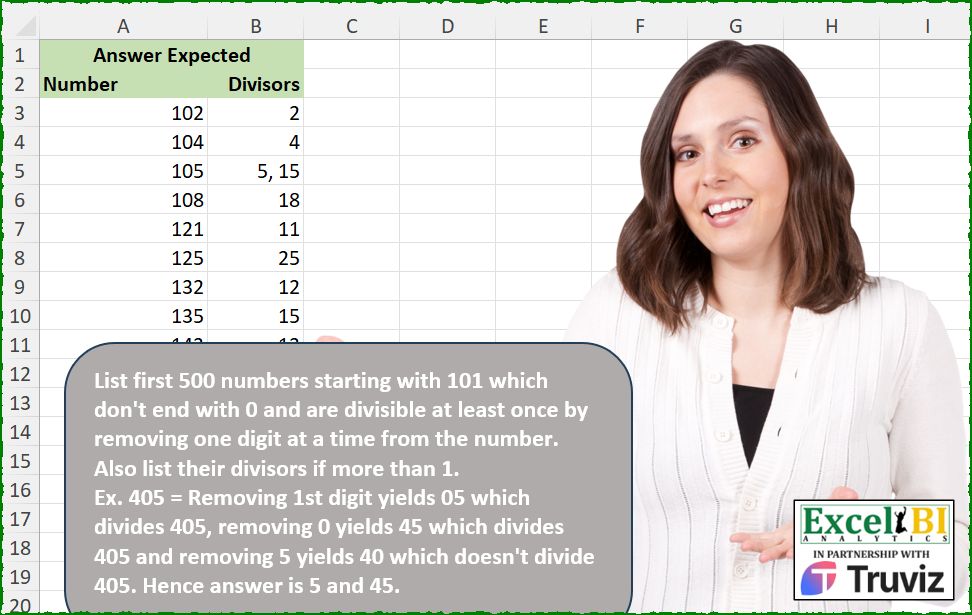
List first 500 numbers starting with 101 which don’t end with 0 and are divisible at least once by removing one digit at a time from the number. Also list their divisors if more than 1. Ex. 405 = Removing 1st digit yields 05 which divides 405, removing 0 yields 45 which divides 405 and removing 5 yields 40 which doesn’t divide 405. Hence answer is 5 and 45.
📌 Challenge Details and Links
ExcelBI Excel Challenge Number: 531
Challenge Difficulty: ⭐️⭐️⭐️
📥Download Sample File
📥Link to the solutions on LinkedIn
Solving the challenge of Remove Digit to Make Divisible with Power Query
Power Query solution 2 for Remove Digit to Make Divisible, proposed by Aditya Kumar Darak 🇮🇳:
let
  Source = List.Generate(
    () => [a = 101, z = 0, r = null],
    each [z] <= 500,
    each [
      a = [a] + 1,
      b = Text.From(a),
      c = not Text.EndsWith(b, "0"),
      d = Text.Length(b) - 1,
      e = List.Transform(
        {0 .. d},
        (f) =>
          [
            rr = Text.RemoveRange(b, f, 1),
            nb = Number.From(rr),
            dv = Number.Mod(a, nb),
            r  = if dv = 0 then Text.From(nb) else null
          ][r]
      ),
      g = List.RemoveMatchingItems(List.RemoveNulls(e), {"1"}),
      h = not List.IsEmpty(g),
      i = Text.Combine(List.Distinct(g), ", "),
      j = c and h,
      r = if j then [Number = a, Divisors = i] else null,
      z = [z] + Number.From(j)
    ],
    each [r]
  ),
  Filter = List.RemoveNulls(Source),
  Return = Table.FromRecords(Filter)
in
  Return
Power Query solution 3 for Remove Digit to Make Divisible, proposed by Alejandro Simón 🇵🇦 🇪🇸:
let
  Source = List.Generate(
    () => [x = 101, y = 0, k = false, z = {}],
    each [y] <= 500,
    each [
      x = [x] + 1,
      z =
        let
          a = Text.From(x),
          b = List.Transform(
            {0 .. Text.Length(a) - 1},
            each Number.From(Text.Combine(List.RemoveRange(Text.ToList(a), _, 1)))
          ),
          c = List.Select(b, each Number.Mod(x / _, 1) = 0)
        in
          c,
      k = if List.Count(z) = 0 or Text.EndsWith(Text.From(x), "0") or z = {1} then false else true,
      y = if k then [y] + 1 else [y]
    ],
    each {[x], [z], [k]}
  ),
  Sol = Table.Combine(
    List.Transform(
      List.Select(Source, each _{2} = true),
      each Table.FromRows(
        {{_{0}, Text.Combine(List.Transform(List.Distinct(_{1}), Text.From), ", ")}},
        {"Number", "Divisors"}
      )
    )
  )
in
  Sol
Power Query solution 4 for Remove Digit to Make Divisible, proposed by Ramiro Ayala Chávez:
let
  A = List.Transform({101 .. 1000000}, Text.From),
  B = List.Select(A, each Text.End(_, 1) <> "0"),
  C = Table.FromColumns({List.Transform(B, Number.From)}, {"Number"}),
  Fx = (x) =>
    let
      a = x,
      b = Text.ToList(Text.From(a)),
      c = List.Generate(
        () => [i = 0],
        each [i] < List.Count(b),
        each [i = [i] + 1],
        each Text.Combine(List.RemoveRange(b, [i], 1))
      ),
      d = List.Transform(c, Number.From),
      e = List.Repeat({a}, List.Count(d)),
      f = List.Transform(
        List.Positions(e),
        each if Number.Mod(e{_} / d{_}, 1) = 0 then d{_} else null
      ),
      g = List.Distinct(List.Transform(f, each if _ = 1 then null else _)),
      h = Text.Combine(List.Transform(List.RemoveNulls(g), Text.From), ", ")
    in
      h,
  D = Table.AddColumn(C, "Divisors", each Fx([Number])),
  Sol = Table.FirstN(Table.SelectRows(D, each [Divisors] <> ""), 500)
in
  Sol
Power Query solution 5 for Remove Digit to Make Divisible, proposed by Mihai Radu O:
let
  p1 = [
    lt = List.Transform,
    tf = Text.From,
    nf = Number.From,
    ls = List.Select,
    a = ls({102 .. 1000000}, (x) => Number.Mod(x, 10) > 0),
    b = lt(
      a,
      (x) =>
        Text.Combine(
          List.Distinct(
            ls(
              lt(
                {0 .. Text.Length(tf(x)) - 1},
                (y) =>
                  [
                    _a = nf(Text.ReplaceRange(tf(x), y, 1, "")),
                    _b = Number.Mod(x, _a),
                    _c = lt(List.Zip({{_a}, {_b}}), (z) => if z{1} = 0 then tf(z{0}) else null){0}
                  ][_c]
              ),
              each _ <> "1"
            )
          ),
          ", "
        )
    ),
    c = Table.FirstN(Table.SelectRows(Table.FromColumns({a, b}), each [Column2] <> ""), 500)
  ][c]
in
  p1
Solving the challenge of Remove Digit to Make Divisible with Excel
Excel solution 1 for Remove Digit to Make Divisible, proposed by Bo Rydobon 🇹🇭:
=LET(z,DROP(SORT(REDUCE(0,VSTACK(SEQUENCE(700,,2),SEQUENCE(250,,750,125)),LAMBDA(b,n,
IF(-RIGHT(n),LET(l,LEN(n),s,SEQUENCE(10)-1,
d,UNIQUE(DROP(REDUCE(0,SEQUENCE(l),LAMBDA(a,i,LET(j,REPLACE(n,i,,IF(i=1,DROP(s,1)&REPT(0,SEQUENCE(,7-l,1-(l>1))),s)),k,TOCOL(IFS(MOD(j,n)=0,--j),3),IF(ISERR(@k),a,VSTACK(a,IF({1,0},k,n)))))),1)),
IF(ISERR(@d),b,VSTACK(b,d))),b)))),1),GROUPBY(TAKE(z,,1),DROP(z,,1),ARRAYTOTEXT,,0))
Excel solution 2 for Remove Digit to Make Divisible, proposed by John V.:
=LET(n,
    SCAN(100,
    SEQUENCE(
        812723
    ),
    LAMBDA(a,
    v,
    1+a+(RIGHT(
        a
    )="9"))),
    i,
    --REPLACE(
        n,
        {1,
        2,
        3,
        4,
        5,
        6},
        1,

    ),
    a,
    BYROW(IF((i1)*(MOD(
        n/i,
        1
    )=0),
    i,
    ""),
    LAMBDA(
        x,
        TEXTJOIN(
            ", ",
            ,
            UNIQUE(
                x,
                1
            )
        )
    )),
    z,
    HSTACK(
        IF(
            a="",
            "",
            n
        ),
        a
    ),
    FILTER(
        z,
        a>""
    ))
Excel solution 3 for Remove Digit to Make Divisible, proposed by محمد حلمي:
=REDUCE(A2:B2,SEQUENCE(96000,,101),LAMBDA(a,v,
LET(
s,--REPLACE(v,SEQUENCE(LEN(v)),1,),
e,TEXTJOIN(", ",,
IF((s>1)*IF(s,INT(v/s)=v/s)*RIGHT(v),s,"")),
IF(e="",a,VSTACK(a,HSTACK(v,e))))))
Excel solution 4 for Remove Digit to Make Divisible, proposed by Kris Jaganah:
=LET(p,SEQUENCE(10^6,,101),q,TOCOL(p/(MOD(p/10,1)<>0),3),r,MAP(q,LAMBDA(x,LET(a,SEQUENCE(LEN(x)),b,MAP(a,LAMBDA(y,REPLACE(x,y,1,""))),c,x/b,d,ARRAYTOTEXT(--FILTER(b,(c=INT(c))*(x<>c),"")),d))),TAKE(FILTER(HSTACK(q,r),--ISERR(r)=0),500))Excel solution 5 for Remove Digit to Make Divisible, proposed by Julian Poeltl:
=TAKE(LET(S,
    SEQUENCE(
        10^6,
        ,
        101
    ),
    SS,
    FILTER(
        S,
        --RIGHT(
            S
        )<>0
    ),
    M,
    MAP(SS,
    LAMBDA(N,
    LET(R,
    --REPLACE(
        N,
        SEQUENCE(
            LEN(
                N
            )
        ),
        1,
        ""
    ),
    M,
    MOD(
        N/R,
        1
    ),
    TEXTJOIN(", ",
    ,
    FILTER(R,
    (M=0)*(R>1)))))),
    N,
    NOT(
        ISERR(
            M
        )
    ),
    H,
    HSTACK(
        FILTER(
            SS,
            N
        ),
        FILTER(
            M,
            N
        )
    ),
    IFERROR(
        --H,
        H
    )),
    500)
Excel solution 6 for Remove Digit to Make Divisible, proposed by Timothée BLIOT:
=LET(A,SEQUENCE(10^6)+99,B,FILTER(A,RIGHT(A)<>"0"), C,MAP(B, LAMBDA(x, LET(D,--REPLACE(x,SEQUENCE(LEN(x)),1,""), E,MOD(x,FILTER(D,D<>1)), ARRAYTOTEXT(FILTER(D,E=0,1/0))))), TAKE(HSTACK(FILTER(B,NOT(ISERROR(C))),TOCOL(C,3)),500))Excel solution 7 for Remove Digit to Make Divisible, proposed by Hussein SATOUR:
=LET(a,
    SEQUENCE(
        904000
    )+100,
    List,
    FILTER(
        a,
        MOD(
            a,
            10
        )>0
    ),
    Calc,
    MAP(List,
    LAMBDA(x,
    LET(c,
    REPLACE(
        x,
        SEQUENCE(
            LEN(
                x
            )
        ),
        1,
        """"
    ),
    ARRAYTOTEXT(FILTER(c,
    (MOD(
        x,
        c
    )=0)*(--c>1)))))),
     FILTER(
         HSTACK(
             List,
             Calc
         ),
         NOT(
             ISERR(
                 Calc
             )
         )
     ))
Excel solution 8 for Remove Digit to Make Divisible, proposed by Oscar Mendez Roca Farell:
=LET(
    s,
     SEQUENCE(
         7.1^7,
          ,
          101
     ),
     f,
     FILTER(
         s,
          MOD(
              s,
               10
          )>0
     ),
     m,
     MAP(
         f,
          LAMBDA(
              a,
               LET(
                   s,
                    -REPLACE(
                        a,
                         SEQUENCE(
                             LEN(
                                 a
                             )
                         ),
                         1,
                         ""
                    ),
                    r,
                    TOCOL(
                        IFS(
                            MOD(
                                a,
                                 s
                            )=0,
                            -s
                        ),
                         2
                    ),
                    IFERROR(
                        IFS(
                            AND(
                                r<>1
                            ),
                             TEXTJOIN(
                                 ", ",
                                  ,
                                  r
                             )
                        ),

                    )
               )
          )
     ),
     FILTER(
         HSTACK(
             f,
              m
         ),
          m<>0
     )
)
Excel solution 9 for Remove Digit to Make Divisible, proposed by Sunny Baggu:
=LET(

     n,
     SEQUENCE(
         905000,
          ,
          101
     ),

     nu,
     FILTER(
         n,
          RIGHT(
              n
          ) <> "0"
     ),

     _d,
     MAP(

          nu,

          LAMBDA(
              x,

               LET(

                    _m,
                    MID(
                        x,
                         SEQUENCE(
                             LEN(
                                 x
                             )
                         ),
                         1
                    ),

                    _s,
                    REPLACE(
                        x,
                         SEQUENCE(
                             LEN(
                                 x
                             )
                         ),
                         1,
                         ""
                    ) + 0,

                    _c,
                    MOD(
                        x,
                         _s
                    ),

                    _t,
                    UNIQUE(
                        FILTER(
                            _s,
                             _c = 0
                        )
                    ),

                    ARRAYTOTEXT(
                        FILTER(
                            _t,
                             _t > 1
                        )
                    )

               )

          )

     ),

     TAKE(
         HSTACK(
             FILTER(
                 nu,
                  1 - ISERR(
                      _d
                  )
             ),
              TOCOL(
                  _d,
                   3
              )
         ),
          500
     )

)
Excel solution 10 for Remove Digit to Make Divisible, proposed by Bilal Mahmoud kh.:
=DROP(LET(Test,
    LAMBDA(x,
    LET(m,
    MAP(
        SEQUENCE(
            LEN(
                x
            ),
            ,
            0
        ),
        LAMBDA(
            n,
            CONCAT(
                LEFT(
                    x,
                    n
                ),
                RIGHT(
                    x,
                    LEN(
                x
            )-n-1
                )
            )
        )
    ),
    TEXTJOIN(",",
    TRUE,
    UNIQUE(IF((--m<>1)*(INT(
        x/m
    )=(
        x/m
    )),
    --m,
    ""))))),
    REDUCE(
        ,
        SEQUENCE(
            903125,
            ,
            101
        ),
        LAMBDA(
            x,
            y,
            IF(
                --RIGHT(
                    y,
                    1
                )<>0,
                LET(
                    z,
                    Test(
                        y
                    ),
                    IF(
                        z<>"",
                        VSTACK(
                            x,
                            HSTACK(
                                y,
                                z
                            )
                        ),
                        x
                    )
                ),
                x
            )
        )
    )),
    1)
Excel solution 11 for Remove Digit to Make Divisible, proposed by Eddy Wijaya:
=LET(
a,
    SEQUENCE(
        905000,
        ,
        102
    ),

notZ,
    FILTER(
        a,
        RIGHT(
            a,
            1
        )<>"0"
    ),

dbCalc,
    HSTACK(notZ,
    MAP(notZ,
    LAMBDA(m,
    LET(
sp,
    MID(
        m,
        SEQUENCE(
            LEN(
                m
            )
        ),
        1
    ),

l_comb_ord,
    REDUCE(
        0,
        sp,
        LAMBDA(
            a,
            v,
            VSTACK(
                a,
                a&v
            )
        )
    ),

genArr,
    --DROP(
        FILTER(
            l_comb_ord,
            LEN(
                l_comb_ord
            )>=COUNTA(
                sp
            )
        ),
        -1
    ),

res,
    TOROW(UNIQUE(SORT(FILTER(genArr,
    (MOD(
        m,
        genArr
    )=0)*(genArr<>1)),
    1,
    1))),

IF(
    COUNTA(
        res
    )=1,
    res,
    TEXTJOIN(
        ", ",
        ,
        res
    )
))))),

FILTER(
    dbCalc,
    ISERROR(
        CHOOSECOLS(
            dbCalc,
            -1
        )
    )=FALSE
))
Excel solution 12 for Remove Digit to Make Divisible, proposed by Nonbow Wu:
=LET(s,
    NOW(),

foo,
    LAMBDA(n,
    LET(d,
    UNIQUE(
        --REPLACE(
            n,
            SEQUENCE(
                LEN(
                    n
                )
            ),
            1,

        )
    ),
    ARRAYTOTEXT(TOROW(IFS((MOD(
        n/d,
        1
    )=0)*MOD(
        n,
        10
    )*(d>1),
    d),
    2)))),

xn,
    LET(
k,
    10^4,

i,
    SEQUENCE(
        8
    ),

a,
    VSTACK(
        1,
        2^i,
        5^i
    ),

p,
    {9,
    21,
    39,
    3,
    7,
    11,
    13,
    17,
    19,
    23,
    29,
    31,
    37,
    43,
    47,
    59,
    73},

x,
    a*p,

xa,
    TOCOL(x/(x0,
                nn
            ),
            2
        ),
        TOCOL(
            ra,
            2
        )
    ),

VSTACK((NOW()-s)*86400,
    A2:B2,
    ans))
Solving the challenge of Remove Digit to Make Divisible with Python
Python solution 1 for Remove Digit to Make Divisible, proposed by Konrad Gryczan, PhD:
import pandas as pd
path = "531 Numbers Divisible after Removing a Digit.xlsx"
test = pd.read_excel(path, skiprows=1)
def transform_number(number):
 return [int(str(number)[:i] + str(number)[i+1:]) for i in range(len(str(number)))]
numbers = pd.DataFrame({'number': range(101, 1000001)})
numbers = numbers[numbers['number'] % 10 != 0]
numbers['new_number'] = numbers['number'].apply(transform_number)
numbers = numbers.explode('new_number')
numbers['new_number'] = pd.to_numeric(numbers['new_number'])
numbers = numbers.drop_duplicates(subset=['number', 'new_number'])
filtered_numbers = numbers[(numbers['number'] % numbers['new_number'] == 0) & (numbers['new_number'] != 1)]
result = filtered_numbers.groupby('number').agg(divisors=('new_number', lambda x: ', '.join(map(str, x)))).reset_index()
n1 = result.head(500)
n1.columns = test.columns
print(all(n1.eq(test))) # True
Solving the challenge of Remove Digit to Make Divisible with Python in Excel
Python in Excel solution 1 for Remove Digit to Make Divisible, proposed by Alejandro Campos:
def find_valid_numbers(limit):
 valid_numbers = []
 number = 102

 while len(valid_numbers) < limit:
 str_num = str(number)
 if str_num[-1] != '0' and not str_num.endswith('01'):
 divisors = []
 for i in range(len(str_num)):
 reduced_number = int(str_num[:i] + str_num[i+1:])
 if reduced_number != 0 and number % reduced_number == 0:
 divisors.append(reduced_number)
 if divisors:
 divisors.sort()
 divisors_str = ', '.join(map(str, divisors))
 valid_numbers.append([number, divisors_str])
 number += 1

 return pd.DataFrame(valid_numbers, columns=['Number', 'Divisors'])
df = find_valid_numbers(500)
df
Python in Excel solution 2 for Remove Digit to Make Divisible, proposed by Abdallah Ally:
# Perform data manipulation
values = []
number = 101
while len(values) != 500:
 if str(number)[-1] != '0':
 str_num = str(number)
 combs = [str_num[:i] + str_num[i+1:] for i in range(len(str_num))]
 combs = [x for x in sorted(int(x) for x in combs) if x not in [0, 1]]
 combs = [str(x) for x in combs if not number % x]
 divisors = ', '.join(combs)
 if divisors:
 values.append([number, divisors])
 number += 1
df = pd.DataFrame(data=values, columns=['Number', 'Divisors'])
df
Solving the challenge of Remove Digit to Make Divisible with R
R solution 1 for Remove Digit to Make Divisible, proposed by Konrad Gryczan, PhD:
Took about 13-15 seconds just like Python one, not 1 minute.
library(tidyverse)
library(readxl)
path = "Excel/531 Numbers Divisible after Removing a Digit.xlsx"
test = read_excel(path, range = "A2:B502")
find_divisors = function(n) {
 digits = strsplit(as.character(n), NULL)[[1]]
 divisors = integer(0)

 for (i in seq_along(digits)) {
 reduced_number = as.integer(paste0(digits[-i], collapse = ""))
 if (reduced_number > 1 && n %% reduced_number == 0) {
 divisors = c(divisors, reduced_number)
 }
 }
 return(divisors)
}
find_numbers = function(count = 500, start = 101) {
 result = list()
 number = start
 while (length(result) < count) {
 if (number %% 10 != 0) {
 divisors = find_divisors(number)
 if (length(divisors) > 0) {
 result[[as.character(number)]] = divisors
 }
 }
 number = number + 1
 }
 return(result)
}
numbers_with_divisors = find_numbers()
numbers_with_divisors = map(numbers_with_divisors, unique)
df = tibble(
 Number = names(numbers_with_divisors) %>% as.numeric(),
 Divisors = I(unname(numbers_with_divisors))
) %>%
 mutate(Divisors = map_chr(Divisors, ~ paste(.x, collapse = ", ")))
identical(df, test) # TRUE
R solution 2 for Remove Digit to Make Divisible, proposed by Konrad Gryczan, PhD:
library(charcuterie)
library(tidyverse)
library(readxl)
path = "Excel/531 Numbers Divisible after Removing a Digit.xlsx"
test = read_excel(path, range = "A2:B502")
transform_number <- function(number) {
 num_str <- as.character(number)
 num_split <- chars(num_str)
 len <- length(num_split)
 result <- character(len)
 for (i in seq_along(num_split)) {
 result[i] <- paste0(num_split[-i], collapse = "")
 }
 result <- paste(result, collapse = ", ")
 return(result)
}
transform_number <- Vectorize(transform_number)
numbers <- data.frame(number = 101:1000000) %>%
 filter(number %% 10 != 0)
n1 = numbers %>%
 mutate(new_number = map_chr(number, transform_number)) %>%
 separate_rows(new_number, sep = ", ") %>%
 distinct() %>%
 mutate(new_number = as.numeric(new_number)) %>%
 filter(number %% new_number == 0, new_number != 1) %>%
 summarise(divisors = paste(new_number, collapse = ", "), .by = "number") %>%
 head(500)
all.equal(n1, test, check.attributes = FALSE)
#> [1] TRUE
&&