
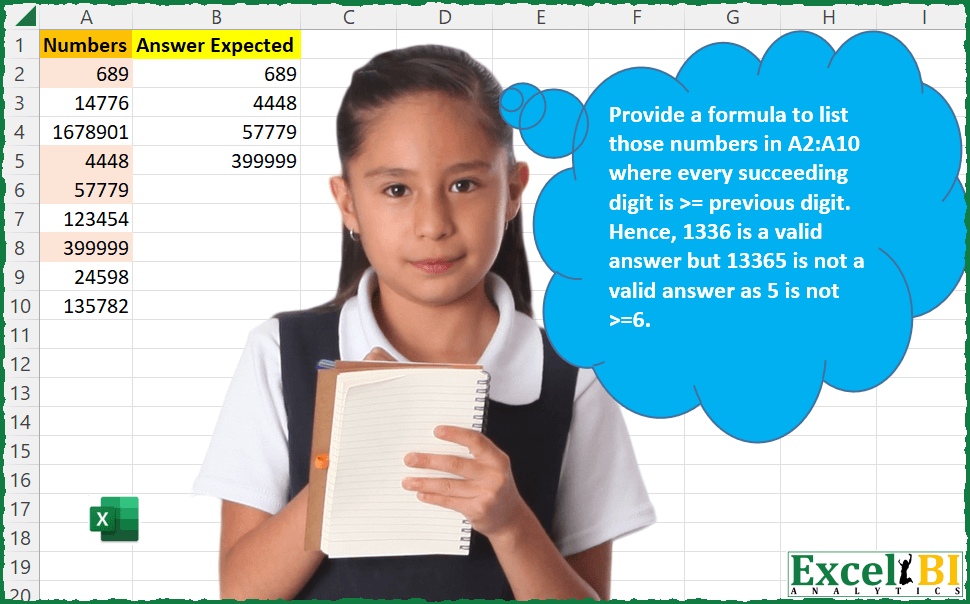
Provide a formula to list those numbers in A2:A10 where every succeeding digit is >= previous digit. Hence, 1336 is a valid answer but 13365 is not a valid answer as 5 is not >=6. Similarly, 51678 is not a valid answer as 1 is not >=5.
📌 Challenge Details and Links
ExcelBI Excel Challenge Number: 49
Challenge Difficulty: ⭐️
📥Download Sample File
📥Link to the solutions on LinkedIn
Solving the challenge of Digits in Increasing Sequence with Power Query
Power Query solution 1 for Digits in Increasing Sequence, proposed by Aditya Kumar Darak 🇮🇳:
let
  Source = Excel.CurrentWorkbook(){[Name = "data"]}[Content],
  Result = Table.SelectRows(
    Source,
    each Number.From(Text.Combine(List.Sort(Text.ToList(Text.From([Numbers]))))) = [Numbers]
  )
in
  Result
Power Query solution 2 for Digits in Increasing Sequence, proposed by Luan Rodrigues:
let
  Fonte = Excel.CurrentWorkbook(){[Name = "Tabela1"]}[Content],
  Result = Table.SelectRows(
    Fonte,
    each Text.ToList(Text.From([Numbers])) = List.Sort(Text.ToList(Text.From([Numbers])))
  )
in
  Result
Power Query solution 3 for Digits in Increasing Sequence, proposed by Matthias Friedmann:
let
  Source = Excel.CurrentWorkbook(){[Name = "CompDigits"]}[Content],
  #"Filtered Rows" = Table.SelectRows(
    Source,
    each Text.From([Numbers]) = Text.Combine(List.Sort(Text.ToList(Text.From([Numbers]))))
  )
in
  #"Filtered Rows"
Power Query solution 4 for Digits in Increasing Sequence, proposed by Antriksh Sharma:
let
  Source = DataSource,
  ChangedType = Table.TransformColumnTypes(Source, {{"Numbers", Int64.Type}}),
  Transformation = Table.AddColumn(
    ChangedType,
    "Answer",
    (Digits) =>
      let
        NumList = List.Transform(Text.ToList(Text.From(Digits[Numbers])), Number.From),
        NumCount = List.Count(NumList),
        Index = {1 .. NumCount - 1},
        Check = List.Accumulate(
          Index,
          {NumList{0}},
          (State, Current) =>
            if NumList{Current} >= List.Max({List.Last(State), 0}) then
              State & {NumList{Current}}
            else
              {}
        ),
        Result = if List.Count(Check) = NumCount then true else false
      in
        Result,
    Logical.Type
  ),
  FilteredRows = Table.SelectRows(Transformation, each ([Answer] = true))[[Numbers]]
in
  FilteredRows
Power Query solution 5 for Digits in Increasing Sequence, proposed by Venkata Rajesh:
let
  Source = Data,
  Result = Table.SelectRows(
    Source,
    each (
      let
        _check = Text.ToList(Text.From([Numbers]))
      in
        _check = List.Sort(_check)
    )
  )
in
  Result
Power Query solution 6 for Digits in Increasing Sequence, proposed by Mahmoud Bani Asadi:
let
  Source = Excel.CurrentWorkbook(){[Name = "Table1"]}[Content],
  FilteredRows = Table.SelectRows(
    Source,
    each [
      NtoT      = Text.From([Numbers]),
      TxtToList = Text.ToList(NtoT),
      SrtList   = List.Sort(TxtToList),
      Compare   = TxtToList = SrtList
    ][Compare]
  )
in
  FilteredRows
Solving the challenge of Digits in Increasing Sequence with Excel
Excel solution 1 for Digits in Increasing Sequence, proposed by Rick Rothstein:
=FILTER(A2:A10,MAP(A2:A10,LAMBDA(x,0+CONCAT(SORT(MID(x,SEQUENCE(LEN(x)),1)))=x)))Excel solution 2 for Digits in Increasing Sequence, proposed by Rick Rothstein:
=FILTER(A2:A10,MAP(A2:A10,LAMBDA(x,LET(c,LEN(x)-1,SUM(0+(MID(x,SEQUENCE(,c),1)<=MID(x,SEQUENCE(,c,2),1)))=c))))Excel solution 3 for Digits in Increasing Sequence, proposed by John V.:
=FILTER(
    A2:A10,
    MAP(
        A2:A10,
        LAMBDA(
            x,
            AND(
                MMULT(
                    -MID(
                        x,
                        SEQUENCE(
                            LEN(
                                x
                            )-1
                        )+{0,
                        1},
                        1
                    ),
                    {1;-1}
                )>=0
            )
        )
    )
)

=FILTER(
    A2:A10,
    MAP(
        A2:A10,
        LAMBDA(
            x,
            LET(
                c,
                MID(
                    x,
                    ROW(
                        1:9
                    ),
                    1
                ),
                CONCAT(
                    SORT(
                        c
                    )
                )=CONCAT(
                        c
                    )
            )
        )
    )
)

=FILTER(
    A2:A10,
    MAP(
        A2:A10,
        LAMBDA(
            x,
            --CONCAT(
                SORT(
                    MID(
                    x,
                    ROW(
                        1:9
                    ),
                    1
                )
                )
            )=x
        )
    )
)
Excel solution 4 for Digits in Increasing Sequence, proposed by محمد حلمي:
=FILTER(A2:A10,MAP(A2:A10,LAMBDA(A,AND(SCAN("",SEQUENCE(,LEN(A)),LAMBDA(B,C,MID(A&9,C+1,1)>=MID(A&9,C,1)))))))Excel solution 5 for Digits in Increasing Sequence, proposed by محمد حلمي:
=TOCOL(SORTBY(FORMULATEXT(B2:J2),
LEN(FORMULATEXT(B2:J2))))
Excel solution 6 for Digits in Increasing Sequence, proposed by محمد حلمي:
=FILTER(
    A2:A10,
    MAP(
        A2:A10,
        LAMBDA(
            x,
            x=0+CONCAT(
                SORT(
                    MID(
                        x,
                        ROW(
                            1:20
                        ),
                        1
                    )
                )
            )
        )
    )
)
Excel solution 7 for Digits in Increasing Sequence, proposed by محمد حلمي:
=FILTER(A2:A10,MAP(A2:A10,LAMBDA(x,x=0+CONCAT(SORT(MID(x,ROW(1:20),1))))))Excel solution 8 for Digits in Increasing Sequence, proposed by محمد حلمي:
=FILTER(
    A2:A10,
    MAP(
        A2:A10,
        LAMBDA(
            A,
            AND(
                MID(
                    A&9,
                    SEQUENCE(
                        LEN(
                            A
                        )
                    )+1,
                    1
                )>=MID(
                    A,
                    SEQUENCE(
                        LEN(
                            A
                        )
                    ),
                    1
                )
            )
        )
    )
)
Excel solution 9 for Digits in Increasing Sequence, proposed by محمد حلمي:
=FILTER(A2:A10,MAP(A2:A10,LAMBDA(a,
LET(c,MID(a,SEQUENCE(LEN(a)),1),
AND((DROP(c,1)-DROP(c,-1))>=0)))))
Excel solution 10 for Digits in Increasing Sequence, proposed by محمد حلمي:
=FILTER(
    A2:A10,
    MAP(
        A2:A10,
        LAMBDA(
            A,
            AND(
                MID(
                    A&9,
                    ROW(
                        2:11
                    ),
                    1
                )>=MID(
                    A,
                    ROW(
                        1:10
                    ),
                    1
                )
            )
        )
    )
)
Excel solution 11 for Digits in Increasing Sequence, proposed by Kris Jaganah:
=LET(
    b,
    A2:A10,
    a,
    MAP(
        b,
        LAMBDA(
            x,
            TEXTJOIN(
                "",
                TRUE,
                SMALL(
                    MID(
                        x,
                        SEQUENCE(
                            ,
                            LEN(
                                x
                            ),
                            1,
                            1
                        ),
                        1
                    )/1,
                    SEQUENCE(
                            ,
                            LEN(
                                x
                            ),
                            1,
                            1
                        )
                )
            )/1
        )
    ),
    FILTER(
        b,
        b=a
    )
)
Excel solution 12 for Digits in Increasing Sequence, proposed by Julian Poeltl:
=FILTER(
    A2:A10,
    MAP(
        A2:A10,
        LAMBDA(
            N,
            LET(
                L,
                LEN(
                    N
                ),
                SP,
                MID(
                    N,
                    SEQUENCE(
                        L
                    ),
                    1
                ),
                L-1=SUM(
                    --DROP(
                        SP<=DROP(
                            SP,
                            1
                        ),
                        -1
                    )
                )
            )
        )
    )
)
Excel solution 13 for Digits in Increasing Sequence, proposed by Aditya Kumar Darak 🇮🇳:
= FILTER(

     A2:A10,

     MAP(

          A2:A10,

          LAMBDA(

               a,

               LET(

                    _splt,

                    --MID(
                        a,
                         SEQUENCE(
                             LEN(
                                 a
                             )
                         ),
                         1
                    ),

                    AND(
                        DROP(
                            _splt,
                             1
                        ) >= DROP(
                            _splt,
                             -1
                        )
                    )
               )
          )
     )
)
Excel solution 14 for Digits in Increasing Sequence, proposed by Aditya Kumar Darak 🇮🇳:
= FILTER(
 A2:A10,
 MAP(
 A2:A10,
 LAMBDA(
 a,
 LET(
 _splt,
 --MID(a, SEQUENCE(LEN(a)), 1),
 AND(_splt = SORT(_splt))))))
Excel solution 15 for Digits in Increasing Sequence, proposed by Timothée BLIOT:
=LET(

Numbers,A2:A10,

Digits, MAKEARRAY(ROWS(Numbers),MAX(LEN(Numbers)+1),LAMBDA(a,b,
IFERROR(VALUE(MID(INDEX(Numbers,a),b,1)),0)
)),

DigitsPrev, HSTACK(INDEX(Digits,,1), TAKE(Digits, , COLUMNS(Digits)-1)),

Compare, --(Digits >= DigitsPrev)* (DigitsPrev > 0),

SumCompare,BYROW(Compare, LAMBDA(a,SUM(a))),
NumberOfDigits,BYROW(Numbers, LAMBDA(a,LEN(a))),
IsValid, IF(SumCompare=NumberOfDigits,1,0),
Answer, FILTER(Numbers,IsValid,""),

Answer)
Excel solution 16 for Digits in Increasing Sequence, proposed by Hussein SATOUR:
=FILTER(A2:A10, BYROW(A2:A10, LAMBDA(x,
LET(y, MID(x, SEQUENCE(LEN(x)),1)*1, z, MID(x, SEQUENCE(LEN(x)) + 1,1)*1, SUM(DROP(y>z, -1)*1)))) = 0)
Excel solution 17 for Digits in Increasing Sequence, proposed by Duy Tùng:
=TOCOL(MAP(A2:A10,LAMBDA(x,LET(a,MID(x,SEQUENCE(LEN(x)),1),x/AND(DROP(a,1)>=DROP(a,-1))))),3)Excel solution 18 for Digits in Increasing Sequence, proposed by Bhavya Gupta:
=FILTER(A2:A10,
    MAP(A2:A10,
    LAMBDA(n,
    LET(m,
    MID(
        n,
        SEQUENCE(
            LEN(
                n
            )
        ),
        1
    ),
    PRODUCT(--(DROP(
        m,
        1
    )>=DROP(
        m,
        -1
    )))))))
Excel solution 19 for Digits in Increasing Sequence, proposed by Charles Roldan:
=LET(

     Diff,
     LAMBDA(
         x,
          DROP(
              x,
               1
          ) - DROP(
              x,
               -1
          )
     ),

     TextToArray,
     LAMBDA(
         x,
          MID(
              x,
               SEQUENCE(
                   LEN(
                       x
                   )
               ),
               1
          )
     ),

     FixedBy,
     LAMBDA(
         f,
          LAMBDA(
              x,
               x = f(
                       x
                   )
          )
     ),

     B,
     LAMBDA(
         f,
          g,
          LAMBDA(
              x,
               f(
                   g(
                       x
                   )
               )
          )
     ),

     FlMp,
     LAMBDA(
         f,
          LAMBDA(
              x,
               FILTER(
                   x,
                    MAP(
                        x,
                         f
                    )
               )
          )
     ),

     FlMp(
         B(
             B(
                 B(
                     FixedBy(
                         ABS
                     ),
                      MIN
                 ),
                  Diff
             ),
              TextToArray
         )
     )

)(A2:A10)
Excel solution 20 for Digits in Increasing Sequence, proposed by Stefan Olsson:
=FILTER(
    A2:A10,
     MAP(
         A2:A10,
          LAMBDA(
              _n,
               IF(
                   _n=VALUE(
                       JOIN(
                           "",
                           SORT(
                               TRANSPOSE(
                                   SPLIT(

                                       REGEXREPLACE(
                               &            _n&"",
                                           "(?s)(.{1})",
                                           "$1"&CHAR(
                                               127
                                           )
                                       )
                                       ,
                                       CHAR(
                                               127
                                           )
                                   )
                               )
                           )
                       )
                   ),
                   _n,

               )
          )
     )
)
Excel solution 21 for Digits in Increasing Sequence, proposed by Jardiel Euflázio:
=LET(a,
    A2:A10,
    FILTER(a,
    BYROW(a,
    LAMBDA(a,
    LET(b,
    LEN(
        a
    ),
    SUM(0+(MID(
        a,
        SEQUENCE(
            b-1,
            ,
            b,
            -1
        ),
        1
    )>=MID(
        a,
        SEQUENCE(
            b-1,
            ,
            b-1,
            -1
        ),
        1
    )))=b-1)))))
Excel solution 22 for Digits in Increasing Sequence, proposed by Victor Momoh (MVP, MOS, R.Eng):
Excel solution 23 for Digits in Increasing Sequence, proposed by Victor Momoh (MVP, MOS, R.Eng):
=FILTER($A$2:$A$10,MAP(A2:A10,LAMBDA(x,x=CONCAT(SORT(MID(x,SEQUENCE(,LEN(x)),1)+0,,,1))+0)))Excel solution 24 for Digits in Increasing Sequence, proposed by Mahmoud Bani Asadi:
=FILTER(
    Table1[Numbers],

    BYROW(
        Table1[Numbers],

        LAMBDA(
            x,
            LET(

                length,
                LEN(
                    x
                ),

                txtToList,
                MID(
                    x,
                    SEQUENCE(
                        length
                    ),
                    1
                ),

                srt,
                SORT(
                    txtToList
                ),

                AND(
                    txtToList=srt
                )
            )
        )
    )
)
Excel solution 25 for Digits in Increasing Sequence, proposed by Gabriel Raigosa:
=LET(
    d,
    A2:A10,
    m,
    --MID(
        d,
        SEQUENCE(
            1,
            16
        ),
        1
    ),
    FILTER(
        d,
        BYROW(
            --IFERROR(
                m<=TAKE(
                    m,
                    ROWS(
                        d
                    ),
                    -15
                ),
                1
            ),
            LAMBDA(
                f,
                MIN(
                    f
                )
            )
        )
    )
)
Excel solution 26 for Digits in Increasing Sequence, proposed by Sarun Chimamphant:
=REDUCE(
    ,
    A2:A10,
    LAMBDA(
        acc,
        cur,
        LET(
            l,
            LEN(
                cur
            ),
            a,
            MID(
                cur,
                SEQUENCE(
                    l
                ),
                1
            ),
            IF(
                AND(
                    SORT(
                        a
                    )=a
                ),
                VSTACK(
                    acc,
                    cur
                ),
                acc
            )
        )
    )
)
Excel solution 27 for Digits in Increasing Sequence, proposed by Ibrahim Sadiq:
=FILTER(A2:A10,MAP(A2:A10,LAMBDA(x,IFERROR((RIGHT(x))*1>=(RIGHT(OFFSET(x,-1,)))*1,TRUE))))


This formular should work based on my new understanding of the challenge
=FILTER(A2:A10,MAP(A2:A10,LAMBDA(x,(RIGHT(x))*1>=(IF(LEFT(RIGHT(x,2))="0",LEFT(RIGHT(x,3)),LEFT(RIGHT(x,2)))*1))))
Excel solution 28 for Digits in Increasing Sequence, proposed by Meni Porat:
=FILTER(A2:A10,MAP(A2:A10,LAMBDA(x,x=(--TEXTJOIN("",,SORT(MID(x,SEQUENCE(LEN(x)),1)))))))Solving the challenge of Digits in Increasing Sequence with Python in Excel
Python in Excel solution 1 for Digits in Increasing Sequence, proposed by Alejandro Campos:
numbers = xl("A2:A10")[0]
[n for n in numbers if str(n) == ''.join(sorted(str(n)))]
Solving the challenge of Digits in Increasing Sequence with DAX
DAX solution 1 for Digits in Increasing Sequence, proposed by Zoran Milokanović:
EVALUATE
FILTER(Input,
 VAR N = CONVERT(Input[Numbers], STRING)
 VAR T = COUNTROWS(FILTER(ADDCOLUMNS(GENERATESERIES(1, LEN(N)),
 "C", MID(N, [Value], 1),
 "P", MID(N, SWITCH(TRUE(), [Value] = 1, 1, [Value] - 1), 1)
 ), [P] > [C]))
 RETURN
 ISBLANK(T)
)
&&