
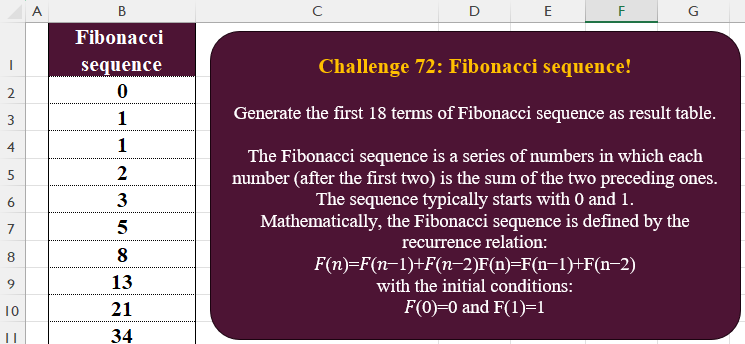
Generate the first 18 terms of Fibonacci sequence as result table. The Fibonacci sequence is a series of numbers in which each number (after the first two) is the sum of the two preceding ones. The sequence typically starts with 0 and 1. Mathematically, the Fibonacci sequence is defined by the recurrence relation: 𝐹(𝑛)=𝐹(𝑛−1)+𝐹(𝑛−2)F(n)=F(n−1)+F(n−2) with the initial conditions: 𝐹(0)=0 and F(1)=1
📌 Challenge Details and Links
Challenge Number: 72
Challenge Difficulty: ⭐⭐⭐
📥Download Sample File
📥Link to the solutions on LinkedIn
Solving the challenge of Fibonacci Sequence! with Power Query
Power Query solution 1 for Fibonacci Sequence!, proposed by Zoran Milokanović:
let
  Source = 18,
  S = List.Accumulate(
    {1 .. Source},
    {},
    (s, c) => s & {{List.Sum(List.LastN(s, 2))}, {c - 1}}{Number.From(c < 3)}
  )
in
  S
Power Query solution 2 for Fibonacci Sequence!, proposed by Zoran Milokanović:
let
  Source = 18,
  S = List.Generate(
    () => {1, 0, 1},
    each _{0} <= Source,
    each {_{0} + 1, _{2}, _{1} + _{2}},
    each _{1}
  )
in
  S
Power Query solution 3 for Fibonacci Sequence!, proposed by Ramiro Ayala Chávez:
let
a = List.Generate(()=>[x=0,y=1,c=1], each [c]<=18, each [y=[x]+[y], x=[y], c=[c]+1], each [x]),
Sol = Table.FromColumns({a},{"Fibonacci sequence"})
in
Sol
Power Query solution 4 for Fibonacci Sequence!, proposed by Aditya Kumar Darak 🇮🇳:
let
  Generate = List.Generate(
    () => [a = 0, b = {}, c = 0],
    each [a] < 18,
    each [a = [a] + 1, b = {[b]{1}? ?? [a], List.Sum([b]) ?? a}, c = b{1}],
    each [c]
  ),
  Return = List.Combine(Generate)
in
  Return
Power Query solution 5 for Fibonacci Sequence!, proposed by Alejandro Simón 🇵🇦 🇪🇸:
let
  N = 18,
  FS = List.Generate(
    () => [x = 1, y = 0, z = 1],
    each [z] <= N,
    each [x = [y], y = [x] + [y], z = [z] + 1],
    each [y]
  ),
  Sol = Table.FromColumns({FS}, {"Fibonacci sequence"})
in
  Sol
Power Query solution 6 for Fibonacci Sequence!, proposed by Alejandro Simón 🇵🇦 🇪🇸:
let
  n   = 18,
  a   = Number.Power,
  Sol = List.Transform({0 .. n - 1}, each Number.Round(a(1 + a(5, .5), _) / (a(2, _) * a(5, .5))))
in
  Sol
Power Query solution 7 for Fibonacci Sequence!, proposed by Alexis Olson:
let
  phi    = (1 + Number.Sqrt(5)) / 2,
  F      = (n) => (Number.Power(phi, n) - Number.Power(- phi, - n)) / (2 * phi - 1),
  Result = List.Transform({0 .. 18}, F)
in
  Result
Power Query solution 8 for Fibonacci Sequence!, proposed by Abdallah Ally:
let
  n = 18,
  Numbers = List.Accumulate(
    {0 .. n - 1},
    {},
    (x, y) => if y < 2 then x & {y} else x & {List.Sum(List.LastN(x, 2))}
  )
in
  Numbers
Power Query solution 9 for Fibonacci Sequence!, proposed by Abdallah Ally:
let
  n       = 18,
  f       = (x) => if x < 2 then x else @f(x - 2) + @f(x - 1),
  Numbers = List.Transform({0 .. n - 1}, f)
in
  Numbers
Power Query solution 10 for Fibonacci Sequence!, proposed by 🇮🇷 Navid Esmaeilzadeh اسماعیل زاده:
let
  Query2 = List.Generate(
    () => [x = 1, n = 1, y = 0],
    each [n] <= 18,
    each [x = [y], y = [x] + [y], n = [n] + 1],
    each [y]
  ),
  #"Converted to Table" = Table.FromList(
    Query2,
    Splitter.SplitByNothing(),
    null,
    null,
    ExtraValues.Error
  ),
  #"Renamed Columns" = Table.RenameColumns(#"Converted to Table", {{"Column1", "Answer"}})
in
  #"Renamed Columns"
Power Query solution 11 for Fibonacci Sequence!, proposed by Meganathan Elumalai:
let
  Cnt    = 18,
  Source = {1 .. Cnt - 2},
  Result = List.Accumulate(Source, {0, 1}, (s, c) => s & {List.Sum(List.LastN(s, 2))})
in
  Result
Power Query solution 12 for Fibonacci Sequence!, proposed by Venkata Rajesh:
let
 n   = 18,
 list  = List.Accumulate({2 .. n-1}, {1,0}, (s, c) => {s{0} + s{1}} & s),
 Output = Table.FromColumns({List.Sort(list)},{"Fibonacci sequence"})
in
Output
Solving the challenge of Fibonacci Sequence! with Excel
Excel solution 1 for Fibonacci Sequence!, proposed by Bo Rydobon 🇹🇭:
=TEXTSPLIT(
    SCAN(
        "0-1",
        SEQUENCE(
            1151
        ),
        LAMBDA(
            a,
            v,
            LET(
                b,
                TEXTSPLIT(
                    a,
                    "-"
                ),
                INDEX(
                    b,
                    2
                )&"-"&Plus(
                    b
                )
            )
        )
    ),
    "-"
)

My formula broke at 1151

Where Plus is from
https://1drv.ms/x/s!Ak8Fla2fCeo6g-Fpe7d7v85Pm0EimA?e=5LHLvL


The 1150
https://zeptomath.com/calculators/fibonaccinumbers.php?number=1150

plus
=LAMBDA(
    num,
    [subtrack],
    LET(
        n,
        TOROW(
            num,
            3
        ),
        l,
        CEILING(
            MAX(
                LEN(
                    n
                )
            ),
            10
        ),        s,
        -SORT(
            -SEQUENCE(
                l/10,
                ,
                ,
                10
            )
        ),
        r,
        REPT(
            0,
            10
        ),        m,
        VSTACK(
            BYROW(
                MID(
                    RIGHT(
                        REPT(
                            0,
                            l
                        )&n,
                        l
                    ),
                    s,
                    10
                )*IF(
                    subtrack,
                    {1,
                    -1},
                    1
                ),
                SUM
            ),
            0
        ),        o,
        TEXT(
            MOD(
                SCAN(
                    0,
                    m,
                    LAMBDA(
                        a,
                        v,
                        INT(
                            a/10^10
                        )+v
                    )
                ),
                10^10
            ),
            r
        ),        c,
        CONCAT(
            TEXT(
                SORTBY(
                    o,
                    VSTACK(
                        s,
                        0
                    )
                ),
                r
            )
        ),        RIGHT(
            c,
            LEN(
                TEXT(
                    c,
                    0
                )
            )
        )
    )
)
Excel solution 2 for Fibonacci Sequence!, proposed by Bo Rydobon 🇹🇭:
=LET(n,
    SEQUENCE(
        18
    )-1,
    f,
    5^0.5,
    ((1+f)^n-(1-f)^n)/2^n/f)
Excel solution 3 for Fibonacci Sequence!, proposed by محمد حلمي:
=REDUCE(
    {0;1},
    SEQUENCE(
        16
    ),
    LAMBDA(
        a,
        v,
        VSTACK(
            a,
            SUM(
                TAKE(
                    a,
                    -2
                )
            )
        )
    )
)
Excel solution 4 for Fibonacci Sequence!, proposed by محمد حلمي:
=LET(    r,
    LAMBDA(
        r,
        a,
        IF(
            ROWS(
                a
            )=18,
            a,
            r(
                r,
                VSTACK(
                    a,
                    SUM(
                        TAKE(
                            a,
                            -2
                        )
                    )
                )
            )
        )
    ),    r(
        r,
        {0;1}
    )
)
Excel solution 5 for Fibonacci Sequence!, proposed by Aditya Kumar Darak 🇮🇳:
=REDUCE(
    {0; 1},
     SEQUENCE(
         16
     ),
     LAMBDA(
         a,
          b,
          VSTACK(
              a,
               SUM(
                   TAKE(
                       a,
                        -2
                   )
               )
          )
     )
)
Excel solution 6 for Fibonacci Sequence!, proposed by Oscar Mendez Roca Farell:
=REDUCE(
    {0;1},
     ROW(
         1:16
     ),
     LAMBDA(
         i,
          x,
          VSTACK(
              i,
               SUM(
                   LARGE(
                       i,
                        {1,
                       2}
                   )
               )
          )
     )
)
Excel solution 7 for Fibonacci Sequence!, proposed by Julian Poeltl:
=REDUCE(
    VSTACK(
        0,
        1
    ),
    SEQUENCE(
        16
    ),
    LAMBDA(
        A,
        B,
        VSTACK(
            A,
            INDEX(
                A,
                B
            )+INDEX(
                A,
                B+1
            )
        )
    )
)

=REDUCE(
    VSTACK(
        0,
        1
    ),
    SEQUENCE(
        16
    ),
    LAMBDA(
        A,
        B,
        VSTACK(
            A,
            SUM(
                TAKE(
                    A,
                    -2
                )
            )
        )
    )
)
Excel solution 8 for Fibonacci Sequence!, proposed by Abdallah Ally:
=LET(
    n,
    18,
    f,
    LAMBDA(
        f,
        a,
        s,
        IF(
            COUNT(
                a
            )=n,
            a,
            f(
                f,
                IFS(
                    s=1,
                    a,
                    s=2,
                    VSTACK(
                        a,
                        1
                    ),
                    1,
                    VSTACK(
                        a,
                        SUM(
                            TAKE(
                                a,
                                -2
                            )
                        )
                    )
                ),
                s+1
            )
        )
    ),
    f(
        f,
        0,
        1
    )
)
Excel solution 9 for Fibonacci Sequence!, proposed by Abdallah Ally:
=REDUCE(
    0,
    SEQUENCE(
        18
    ),
    LAMBDA(
        x,
        y,
        IFS(
            y=1,
            x,
            y=2,
            VSTACK(
                x,
                1
            ),
            1,
             VSTACK(
                 x,
                 SUM(
                     TAKE(
                         x,
                         -2
                     )
                 )
             )
        )
    )
)
Excel solution 10 for Fibonacci Sequence!, proposed by Sunny Baggu:
=MAP(
 SEQUENCE(18, , 0),
 LAMBDA(x,
 ((1 + SQRT(5)) ^ x - ((1 - SQRT(5)) ^ x)) /
 (2 ^ x * SQRT(5))
 )
)
Excel solution 11 for Fibonacci Sequence!, proposed by Sunny Baggu:
=MAP(
 SEQUENCE(
     18,
      ,
      0
 ), LAMBDA(x, LET(
 a,
     SQRT(
         5
     ), ((1 + a) ^ x - ((1 - a) ^ x)) / (2 ^ x * a)
 )
 )
)
Excel solution 12 for Fibonacci Sequence!, proposed by Sunny Baggu:
=TAKE(     REDUCE(          {0; 1},          SEQUENCE(
              18
          ),          LAMBDA(
              a,
               v,
               VSTACK(
                   a,
                    SUM(
                        TAKE(
                            a,
                             -2
                        )
                    )
               )
          )     ),     18)
Excel solution 13 for Fibonacci Sequence!, proposed by Bilal Mahmoud kh.:
=TOCOL(
    REDUCE(
        {0,
        1},
        SEQUENCE(
            18
        ),
        LAMBDA(
            x,
            y,
            HSTACK(
                x,
                LARGE(
                    x,
                    1
                )+LARGE(
                    x,
                    2
                )
            )
        )
    )
)
Excel solution 14 for Fibonacci Sequence!, proposed by Hussein SATOUR:
=REDUCE(
    ,
    SEQUENCE(
        18
    ),
    LAMBDA(
        x,
        y,
        VSTACK(
            x,
            SUM(
                TAKE(
                    x,
                    -2
                )
            )
        )
    )
)
Excel solution 15 for Fibonacci Sequence!, proposed by Mey Tithveasna:
=LET(n,
    SEQUENCE(
        18,
        ,
        0
    ),
    ((1+SQRT(
        5
    ))^n-(1-SQRT(
        5
    ))^n)/(2^n*SQRT(
        5
    )))
Excel solution 16 for Fibonacci Sequence!, proposed by Nicolas Micot:
=FRACTIONNER.TEXTE(
    REDUCE(
        "0;1";
        SEQUENCE(
            16
        );
        LAMBDA(
            n_values;
            seq_table;
            n_values & ";" & SOMME(
                PRENDRE(
                    FRACTIONNER.TEXTE(
                        n_values;
                        ;
                        ";"
                    )+0;
                    -2;

                )
            )
        )
    );
    ;
    ";"
)
Excel solution 17 for Fibonacci Sequence!, proposed by Rick Rothstein:
=REDUCE(
    {0;1},
    SEQUENCE(
        16
    ),
    LAMBDA(
        a,
        v,
        VSTACK(
            a,
            SUM(
                TAKE(
                    a,
                    -2
                )
            )
        )
    )
)
Solving the challenge of Fibonacci Sequence! with Python
Python solution 1 for Fibonacci Sequence!, proposed by Konrad Gryczan, PhD:
import pandas as pd

path = "CH-072 Fibonacci sequence .xlsx"
test = pd.read_excel(path, usecols="B").values.tolist()
test = [item for sublist in test for item in sublist]

def fibonacci_memo(n, memo={0: 0, 1: 1}):
 if n not in memo:
 memo[n] = fibonacci_memo(n - 1, memo) + fibonacci_memo(n - 2, memo)
 return memo[n]

def generate_fibonacci_sequence(N):
 return [fibonacci_memo(i) for i in range(N)]

result = generate_fibonacci_sequence(18)
print(result == test)  # True
Python solution 2 for Fibonacci Sequence!, proposed by Abdallah Ally:
import pandas as pd
# Function to generate a list of the first n Fibonacci numbers
def fibonacci_sequence(n):
 def fibonacci(n, memo={}):
 if n in memo:
 return memo[n]
 if n <= 1:
 return n
 memo[n] = fibonacci(n-1, memo) + fibonacci(n-2, memo)
 return memo[n]
 return [fibonacci(i) for i in range(n)]
# Perform data wrangling
df = pd.DataFrame(fibonacci_sequence(18), columns=['Fibonacci Sequence'])
# Display the final dataset
df
Python solution 3 for Fibonacci Sequence!, proposed by Saidi Namtanga:
def generate_fibonacci(n):
 fib_sequence = [0, 1] # Starting the sequence with the first two numbers
 while len(fib_sequence) < n:
 fib_sequence.append(fib_sequence[-1] + fib_sequence[-2]) # Append the sum of the last two numbers
 return fib_sequence
# Number of Fibonacci numbers to generate
n = 18
# Generate the Fibonacci sequence
fib_sequence = generate_fibonacci(n)
# Print the Fibonacci sequence
print(f"The first {n} Fibonacci numbers are:")
print(fib_sequence)
Solving the challenge of Fibonacci Sequence! with R
R solution 1 for Fibonacci Sequence!, proposed by Konrad Gryczan, PhD:
library(tidyverse)
library(readxl)
path = "files/CH-072 Fibonacci sequence .xlsx"
test = read_excel(path, range = "B1:B19") %>% pull()
fibonacci <- function(n) {
 if (n == 1) {
 return(c(0))
 } else if (n == 2) {
 return(c(0, 1))
 } else {
 fib_sequence <- accumulate(3:n, .init = c(0, 1), ~ c(.x, .x[length(.x)] + .x[length(.x) - 1]))
 return(unlist(fib_sequence[n-1]))
 }
}
identical(fibonacci(18), test)
# [1] TRUE
 ------------------------------------------------------------
fibonacci1 <- function(n) {
 fib_sequence <- numeric(n)
 fib_sequence[1] <- 0
 if (n > 1) {
 fib_sequence[2] <- 1
 }
 if (n > 2) {
 map(3:n, ~ {
 fib_sequence[.x] <<- fib_sequence[.x - 1] + fib_sequence[.x - 2]
 })
 }
 return(fib_sequence)
}
identical(fibonacci1(18), test)
# [1] TRUE